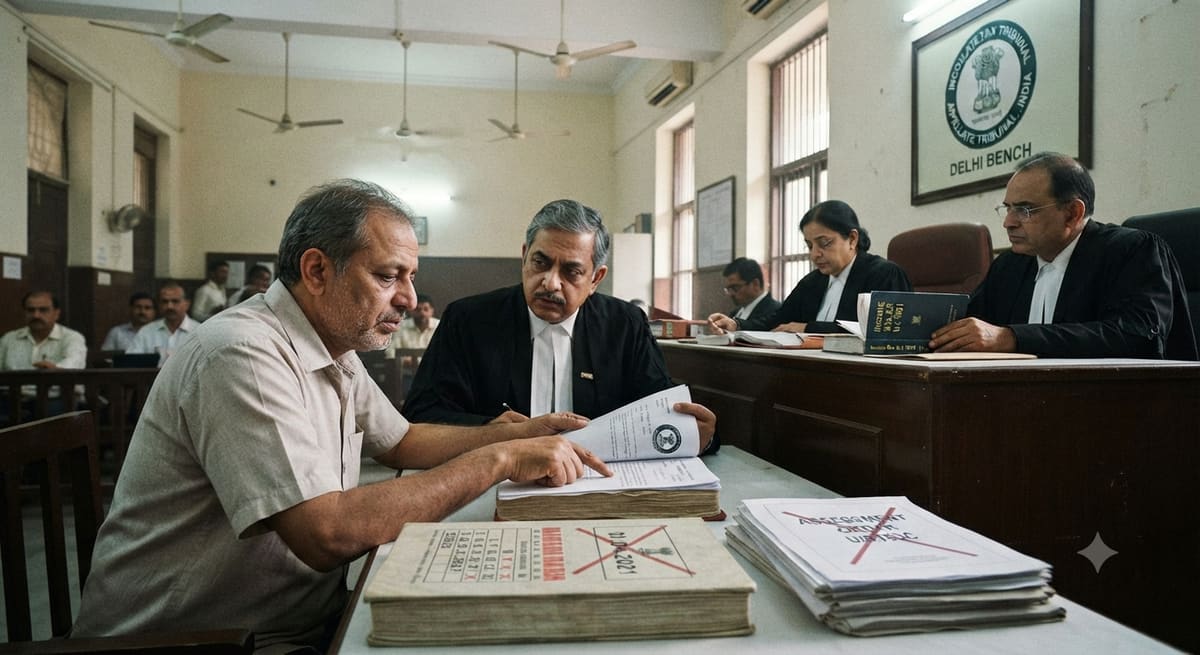
The Income Tax Appellate Tribunal, Delhi Bench 'B', has delivered a pivotal ruling clarifying that reassessment proceedings under Section 153C of the Income Tax Act, 1961, are invalid if the satisfaction note is recorded on or after 01.04.2021. This judgment reinforces the legislative intent behind the amendment to Section 153C(3), effectively closing the door on the use of search-based reassessment for non-searched persons after that date.
Background & Facts
The Dispute
The appellant, Shri Ashutosh Agarwal, was assessed under Section 153C for Assessment Years (A.Y.) 2014-15, 2015-16, and 2016-17 following a search and seizure operation conducted under Section 132 on the Alankit Group and its associates on 18.10.2019. Documents allegedly belonging to the appellant were recovered during the search. The Assessing Officer (AO) of Central Circle-28, New Delhi, issued a notice under Section 153C on 12.06.2023, directing the appellant to file returns for the three assessment years. The assessment orders were passed on 09.03.2024, adding undisclosed income under Sections 68, 69A, and 69C. The Commissioner of Income Tax (Appeals) [CIT(A)] dismissed the appellant’s appeal on 09.10.2025.
Key Facts
- Original returns filed:
- A.Y. 2014-15: 13.08.2014, declaring income of Rs. 4,27,520
- A.Y. 2015-16: 12.03.2016, declaring income of Rs. 4,80,100
- A.Y. 2016-17: Filed on 15.07.2017 (implied)
- Search conducted under Section 132: 18.10.2019 on Alankit Group premises
- Documents relating to the appellant were seized during the search
- Satisfaction note recorded by the AO of the appellant: 03.12.2021
- Notice under Section 153C issued: 12.06.2023
- Assessment order passed: 09.03.2024
- CIT(A) order: 09.10.2025
- Appeal filed before ITAT: 28.03.2026 (implied from hearing date)
- Hearing date: 22.04.2026
- Judgment date: 30.04.2026
Procedural History
- 18.10.2019: Search conducted under Section 132 on Alankit Group premises
- 03.12.2021: AO of the appellant recorded satisfaction note based on seized documents
- 12.06.2023: Notice issued under Section 153C for A.Y. 2014-15, 2015-16, and 2016-17
- 09.03.2024: Assessment completed under Section 153C
- 09.10.2025: CIT(A) dismissed appeal
- 28.03.2026: Appeals filed before ITAT (ITA Nos. 6624, 6625, 6626/Del/2025)
- 22.04.2026: Hearing before ITAT
- 30.04.2026: Judgment pronounced
The Parties' Positions
For the Appellant
The appellant’s counsel, Dr. Rakesh Gupta and Sh. Somil Aggarwal, contended that:
- The satisfaction note under Section 153C was recorded on 03.12.2021, which is after 01.04.2021
- Sub-section (3) of Section 153C explicitly bars the application of Section 153C to searches initiated on or after 01.04.2021
- The date of handing over seized documents to the AO of the non-searched person (the appellant) is the relevant date for determining initiation of proceedings
- The Madras High Court in Harigovind v. ACIT (2025) 180 Taxmann.com 197 and the ITAT Delhi’s own decision in Smt. Geetanjali Bhayana v. DCIT (27.10.2026) have held that Section 153C proceedings are invalid post 01.04.2021
- The notice under Section 153C was issued without jurisdiction and must be quashed
For the Respondent
The Revenue, represented by Sh. Kumar Avikal Manu, CIT-DR, argued that:
- The search was initiated on 18.10.2019, which is before 01.04.2021
- Section 153C applies to the search event, not the satisfaction recording date
- The proceedings are valid as the search was initiated within the permissible period
- The appellant’s reliance on Harigovind and Bhayana is misplaced as those cases involved different factual matrices
Relief Sought
The appellant sought:
- Quashing of the notice under Section 153C dated 12.06.2023
- Setting aside of the assessment order dated 09.03.2024
- Setting aside of the CIT(A) order dated 09.10.2025
- Declaration that the proceedings under Section 153C are invalid and without jurisdiction
The Legal Issue
The central question was whether proceedings under Section 153C of the Income Tax Act, 1961 are valid when the satisfaction note is recorded on or after 01.04.2021, despite the original search having been conducted before that date.
Arguments Presented
For the Appellant
The appellant relied on the decision of the Hon’ble Madras High Court in Harigovind v. ACIT (2025) 180 Taxmann.com 197, which held that the date of handing over seized documents to the AO of the non-searched person is the date of initiation of search for the purpose of Section 153C. The appellant further cited the ITAT Delhi’s own decision in Smt. Geetanjali Bhayana v. DCIT (27.10.2026), which applied the same principle. It was argued that Section 153C(3) explicitly bars the application of Section 153C to searches initiated on or after 01.04.2021, and since the satisfaction note was recorded on 03.12.2021, the proceedings were statutorily prohibited. The appellant also invoked the Supreme Court’s ruling in Jasjit Singh v. CIT to establish that the first proviso to Section 153C(1) governs not only abatement but also the initiation of proceedings.
For the Respondent
The Revenue contended that the search under Section 132 was initiated on 18.10.2019, which is before the cut-off date of 01.04.2021, and therefore Section 153C remains applicable. It argued that the date of the search, not the date of satisfaction recording, is the relevant trigger for determining the applicability of Section 153C. The Revenue further submitted that the Madras High Court’s decision was not binding on the Tribunal and that the legislative intent was to preserve the validity of proceedings initiated before the amendment.
The Court's Analysis
The Tribunal undertook a detailed statutory interpretation of Section 153C, particularly focusing on sub-section (3), which states: "Nothing contained in this Section shall apply in relation to a search initiated under Section 132 or books of account, other documents or any assets requisitioned under Section 132A on or after the 1st day of April, 2021."
The Tribunal noted that the term "search initiated" is not defined in the Act. However, the Hon’ble Madras High Court in Harigovind and the ITAT Delhi in Bhayana had interpreted this phrase to mean the date on which the seized materials are handed over to the AO of the non-searched person - the date of satisfaction recording. The Tribunal agreed with this interpretation, observing that the legislative intent behind the amendment was to prevent the use of Section 153C as a backdoor mechanism for reassessment after 01.04.2021, when Section 148 had been amended to allow reassessment without the need for a search.
"The date of initiation of search for the other person shall be the date on which the materials are handed over to the jurisdictional AO of such person."
The Tribunal further emphasized that the Supreme Court in Jasjit Singh had rejected the Revenue’s narrow interpretation that the first proviso to Section 153C(1) applies only to abatement. The Court held that the proviso governs the entire framework of Section 153C, including the initiation of proceedings. Therefore, if the satisfaction note is recorded after 01.04.2021, the proceedings are barred.
The Tribunal also noted that the AO had himself initiated Section 153C proceedings for A.Y. 2018-19 to 2020-21 based on the same search, yet the satisfaction note for the appellant was recorded on 03.12.2021 - clearly after the cut-off. This inconsistency further undermined the Revenue’s position.
The Tribunal concluded that the notice under Section 153C dated 12.06.2023 was issued without jurisdiction and was therefore invalid. The assessment order and the CIT(A) order were consequently unsustainable.
The Verdict
The appellant succeeded. The ITAT Delhi quashed the notice under Section 153C dated 12.06.2023, set aside the assessment order dated 09.03.2024, and reversed the CIT(A) order dated 09.10.2025. The Tribunal held that the proceedings under Section 153C were invalid as the satisfaction note was recorded on 03.12.2021, which is after 01.04.2021, and therefore fell within the prohibition of Section 153C(3). The Tribunal directed that the Revenue may initiate proceedings under Section 148, if otherwise permissible, within the statutory limitation period.
What This Means For Similar Cases
Section 153C Proceedings Are Time-Bound by Satisfaction Date
- Practitioners must now treat the date of recording the satisfaction note under Section 153C - not the date of the original search - as the critical trigger for determining validity
- Any notice issued under Section 153C where satisfaction is recorded on or after 01.04.2021 is void ab initio
- The burden shifts to the Revenue to prove that the satisfaction note was recorded before 01.04.2021
Section 148 Is the Exclusive Remedy Post 01.04.2021
- Revenue authorities must now rely solely on Section 148 for reassessment of non-searched persons where documents are discovered after 01.04.2021
- Section 153C cannot be used as a substitute for Section 148 proceedings
- Practitioners should challenge any Section 153C notice issued after 01.04.2021 on jurisdictional grounds
Jurisdictional Challenges Must Be Raised Early
- Appeals against Section 153C assessments must include a specific challenge to the date of satisfaction recording
- Failure to raise this ground before the CIT(A) may not be fatal if the jurisdictional defect is patent
- The ITAT’s decision confirms that jurisdictional errors under Section 153C(3) are not curable by waiver or acquiescence