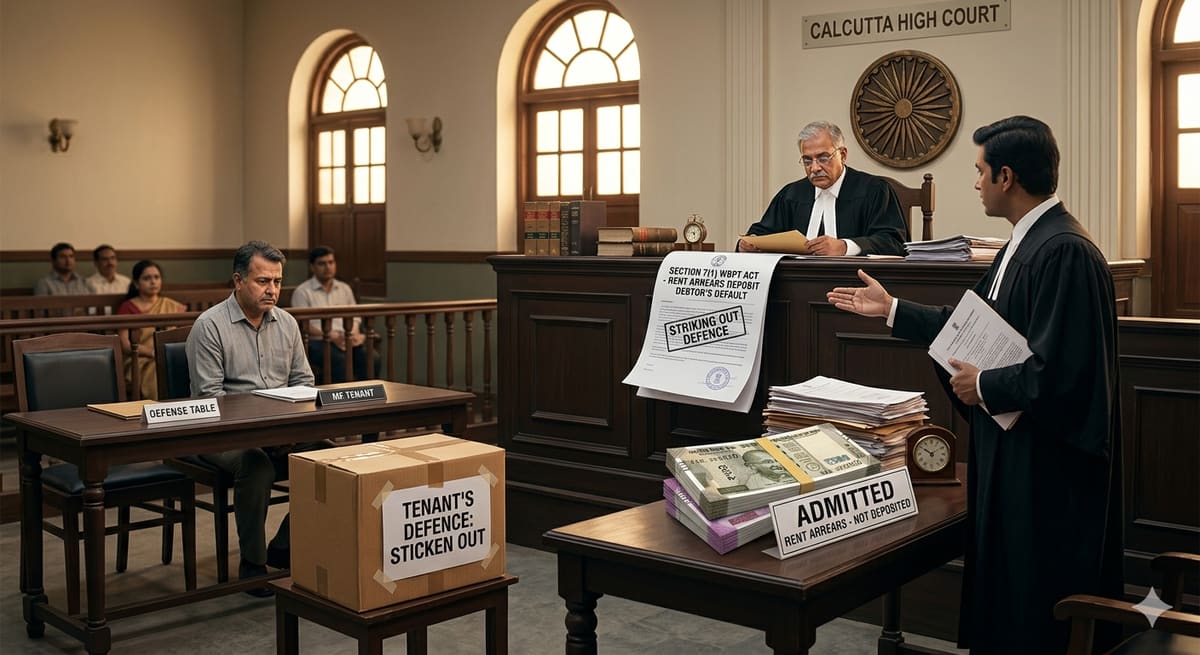
The Calcutta High Court clarified that the stringent provisions of Section 7(3) of the West Bengal Premises Tenancy Act, 1997 cannot be invoked to strike out a tenant's defence unless the tenant has either admitted rent arrears or such arrears have been determined under Section 7(2) of the Act. The Court emphasized that a sham or false dispute does not attract the protective regime of Section 7(2), leaving the tenant exposed to eviction proceedings.
Background & Facts
The Dispute
The dispute arose from Title Suit No. 378 of 2015 filed by the husband of opposite party No. 1 before the Civil Judge (Junior Division), 1st Court, Chandernagore, Hooghly, seeking eviction of the petitioner on grounds of default in payment of rent and reasonable requirement. The petitioner, a tenant, filed applications under Sections 7(1) and 7(2) of the WB Premises Tenancy Act, 1997 seeking directions for deposit of current rent and arrears, and asserting that expenses incurred on repairs were to be adjusted against rent.
Key Facts
- The husband of opposite party No. 1 instituted Title Suit No. 378 of 2015 praying for eviction of the petitioner.
- The petitioner entered appearance on 02 January 2016 and filed applications under Sections 7(1) and 7(2) of the 1997 Act on the same date.
- In the Section 7(2) application, the petitioner asserted he was not a defaulter, claimed to have spent Rs. 2,00,000/- on repairs with the plaintiff’s permission, and alleged that the plaintiff assured adjustment of such expenditure against monthly rent.
- Despite repeated requests, the plaintiff did not issue rent receipts, citing lack of blank receipts.
- During pendency of the Section 7(2) application, the original plaintiff died; the present opposite parties (Smt. Shelly Jaiswal & another) were substituted as legal heirs.
- The opposite parties filed written objections to the petitioner’s Section 7(2) application.
- The learned Trial Court dismissed the petitioner’s Section 7(2) application by order dated 31 July 2018.
- The petitioner challenged that order via C.O. 4024 of 2018 before the High Court.
- The High Court, by order dated 12 July 2023, set aside the 31 July 2018 order and remanded the matter for fresh consideration after affording the parties an opportunity to lead evidence.
- Upon remand, the Trial Court rejected the Section 7(2) application and, relying on Section 7(3), struck out the petitioner’s defence, observing that the petitioner had “stirred up a story of alleged repair to cover up not only for the mistake that was already done but also to avoid paying the due arrear amount as well as to validate such monthly deposits in the garb of such created story”.
- Feeling aggrieved, the petitioner filed the present revisional application (C.O. 166 of 2026) challenging the impugned order dated 02 January 2026.
Procedural History
- 02 January 2016: Petitioner entered appearance and filed applications under Sections 7(1) and 7(2) of the 1997 Act.
- 31 July 2018: Trial Court dismissed petitioner’s Section 7(2) application (Order dated 31.07.2018).
- Date not specified: Petitioner filed C.O. 4024 of 2018 challenging the above order.
- 12 July 2023: High Court set aside the 31 July 2018 order and remanded for fresh hearing (Order dated 12.07.2023).
- 02 January 2026: Trial Court, after remand, rejected Section 7(2) application and struck out defence under Section 7(3) (Impugned order dated 02.01.2026).
- 17 September 2026: Judgment of the High Court in the present revisional application (C.O. 166 of 2026).
Parties' Positions
Petitioner’s submissions:
- The Trial Court erred by striking out the defence without determining rent arrears under Section 7(2).
- The petitioner had incurred repair expenses with the plaintiff’s permission; lack of documentary proof did not constitute admission of arrears.
- Earlier, the High Court in C.O. 4024 of 2018 had recognized a dispute regarding rent arrears, attaining finality on that issue.
- Section 7(3) applies only if the tenant fails to deposit rent after admitting arrears or fails to deposit arrears determined under Section 7(2); neither condition existed.
- Reliance on Bijay Kumar Singh & Others v. Amit Kumar Chamariya & Another to assert that Section 7(2) requires deposit of admitted arrears along with an application for determination.
- Reference to Makhan Lal Bose v. Charupama Debi & Others to argue that lawful advances agreed to be adjusted against rent confer a contractual right enforceable under Section 7(2).
- The Trial Court ignored the petitioner’s volunteer statement that repair expenditure documents were handed to the landlord.
- The opposite parties did not face the witness box, depriving the Court of an opportunity to test the truth of the petitioner’s claims.
Opposite parties’ submissions:
- The High Court in C.O. 4024 of 2018 did not decide the existence of a dispute; it merely remanded for fresh adjudication.
- The petitioner’s claim of spending Rs. 2,00,000/- on repairs was false; given the rent of Rs. 50/- per month, no rent would be payable in his lifetime.
- Mere averments of repair expenses without proof cannot create a genuine dispute; the tenant must deposit admitted arrears to benefit from Section 7(2).
- If tenants could avoid depositing arrears by raising sham disputes, the protective provisions would be rendered meaningless.
- Reliance on Gujarat Printing Press v. Naraindas Jewraj and Ruby Banerjee v. Mechanics Enterprises Private Limited to contend that a false/sham dispute ousts the operation of Section 7(2) and brings the case under Section 7(1).
- Citation of Debasish Paul & Another v. Amal Boral to assert that a tenant must deposit all arrears of rent, even when disputing liability, to claim protection under Section 7(2).
Relief Sought
The petitioner sought:
- Quashing of the impugned order dated 02 January 2026.
- Restoration of the order dated 12 July 2023 (which had remanded the matter).
- A direction to the Trial Court to determine rent arrears under Section 7(2) and to allow deposit thereof.
- Costs of the proceedings.
The Legal Issue
The central question was whether Section 7(3) of the West Bengal Premises Tenancy Act, 1997 can be invoked to strike out a tenant's defence where the tenant has neither admitted rent arrears nor had such arrears determined under Section 7(2) of the Act, and where the alleged dispute over repairs is found to be sham or false.
The Court's Analysis
The Court began by noting that Section 7(2) of the 1997 Act contemplates four stages: (i) existence of a dispute, (ii) an application for determination of rent payable, (iii) judicial determination of rent, and (iv) deposit of the rent so determined. Section 7(3) provides the stringent consequence of striking out a tenant's defence and applies only when the tenant fails to deposit rent after admitting arrears or fails to deposit arrears as determined under Section 7(2).
The Court emphasized that the provisions of Section 7(3) cannot be invoked in the absence of an admission of rent arrears or a judicial determination thereof. It observed:
"Section 7(3) of the 1997 Act could be invoked only if the tenant (i.e., the petitioner) had either failed to deposit rent even after admitting that there were rental arrears or failed to deposit the rent arrears as determined under Section 7(2) of the 1997 Act."
Since the petitioner had not admitted any rent arrears and the Trial Court had not determined any arrears under Section 7(2), the condition for invoking Section 7(3) was unsatisfied. The Court further held that a dispute which is wholly unsupported by evidence - such as the petitioner’s claim of Rs. 2,00,000/- spent on repairs without any documentary proof - warrants an inference that the dispute is sham. Once a dispute is deemed sham, the protective shield of Section 7(2) withers away, and the tenant becomes liable under Section 7(1) for default in payment of rent.
The Court relied on a catena of Division Bench decisions - Gujarat Printing Press, Tarak Nath Gupta, Ruby Banerjee, and Biswanath Roy - which hold that if a dispute raised under Section 7(2) is sham, false, frivolous, or raised mala fide to gain time, the Court must hold that there is no dispute to attract the operation of Section 7(2), and the application thereunder must be dismissed. The Court also noted that the petitioner’s reliance on Bijay Kumar Singh did not aid him because that case required deposit of admitted arrears, which was absent here.
Finally, the Court found no jurisdictional error or illegality in the Trial Court’s order that would warrant interference under Article 227 of the Constitution. The Trial Court’s factual finding that the dispute was sham was neither impossible nor implausible, and thus the revisional application was dismissed.
The Verdict
The petitioner failed. The High Court dismissed C.O. 166 of 2026, upheld the impugned order dated 02 January 2026 striking out the petitioner’s defence under Section 7(3), and awarded no costs. No monetary relief, interest, or compliance timelines were granted as the petition was unsuccessful on all counts.
What This Means For Similar Cases
Section 7(3) Requires Admission or Determination of Arrears
Practitioners must note that the drastic remedy of striking out a tenant’s defence under Section 7(3) is available only where the tenant has either admitted rent arrears or such arrears have been judicially determined under Section 7(2). A mere allegation of repair expenses, unsupported by evidence, does not trigger this provision.
Sham Disputes Oust the Protective Regime of Section 7(2)
If a tenant’s dispute over rent or adjustments is found to be false, frivolous, or raised mala fide to delay proceedings, the Court will treat it as no dispute at all. Consequently, the tenant loses the benefit of Section 7(2) and remains liable under Section 7(1) for non-payment of rent, exposing the tenant to eviction.
Burden Lies on the Tenant to Prove a Genuine Dispute
The tenant seeking to invoke Section 7(2) must lead credible evidence to substantiate the claim of a genuine dispute. In the absence of documentary proof or corroborative testimony, the Court may infer that the dispute is sham, thereby denying the tenant the procedural safeguards intended for bona fide disputes.