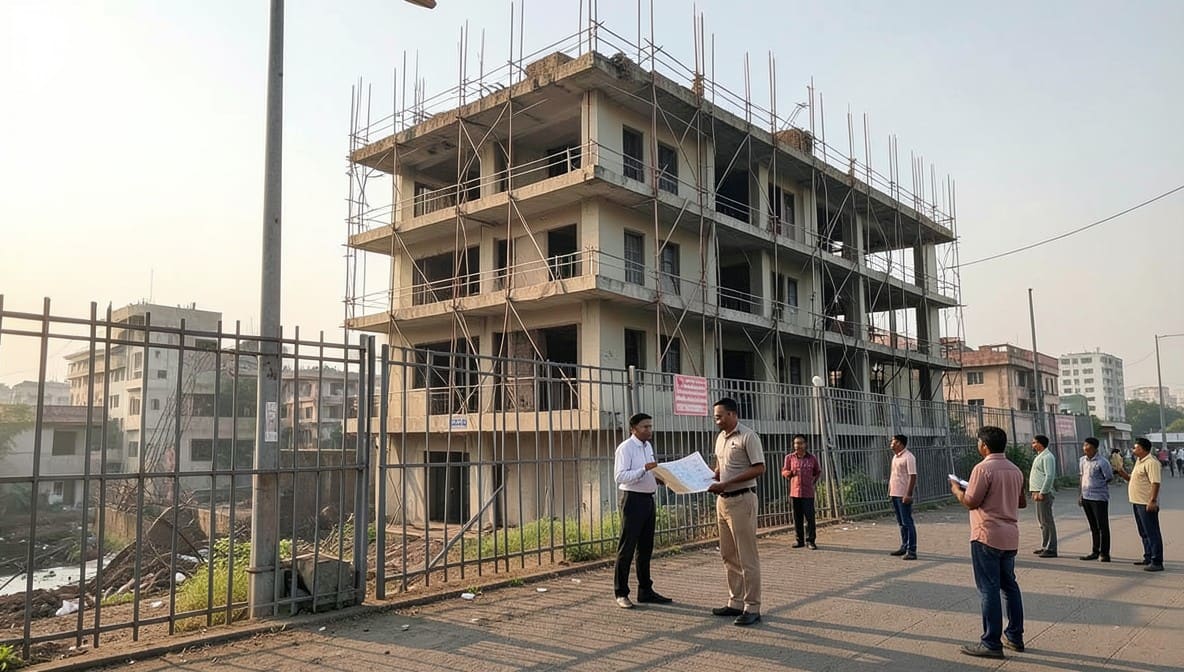
The Madhya Pradesh High Court at Gwalior has reaffirmed that procedural fairness is non-negotiable in land revenue proceedings. A landowner’s right to be heard, even in cases of alleged encroachment, cannot be overridden by administrative expediency. The court’s decision underscores that failure to serve notice or provide access to incriminating reports renders any order void ab initio.
Background & Facts
The Dispute
The petitioner, Tripupati Krishi Pipe Industries, through its proprietor Smt. Pushpa Devi Goyal, acquired land in Village Rawar, Tehsil and District Gwalior, through a registered sale deed dated 04.08.2018. The property comprised Survey Nos. 592, 593, 594, 595, and 788/Min-2. Following acquisition, the petitioner’s name was duly entered into the revenue records via mutation proceedings, and a mutation book was issued by the competent authority.
Key Facts
- The petitioner applied for diversion of land use on 15.01.2019, which was granted by the Sub-Divisional Officer (Revenue) on 25.02.2019.
- A Nazul No Objection Certificate was issued by the State for Survey Nos. 592, 593, and other surveyed plots.
- On 25.01.2020, the Gram Panchayat Adopura, Janpad Panchayat Morar, granted a No Objection Certificate for establishing a factory on the land.
- The petitioner commenced and continued business operations on the land for approximately five years without any prior objection from revenue authorities.
- The impugned order dated 02.04.2026 (Annexure P/1) alleged encroachment on Government land bearing Survey No. 591 and directed eviction and penalty.
- The petitioner was never served with any notice prior to the passing of the order.
- The alleged service via WhatsApp to the petitioner’s son was not recognized as valid under law.
- The encroachment report prepared by the Patwari was not disclosed to the petitioner.
- No joint demarcation of land was conducted before the report was submitted.
- The petitioner had not constructed any structure on Survey No. 591; construction was confined to Survey Nos. 592 and 593, as per registered documents.
Procedural History
- 04.08.2018: Registered sale deed executed for acquisition of land.
- 15.01.2019: Application for land diversion submitted.
- 25.02.2019: Land diversion approved by Sub-Divisional Officer (Revenue).
- 25.01.2020: Gram Panchayat issued NOC for factory establishment.
- 02.04.2026: Impugned order passed under Section 248 of the Madhya Pradesh Land Revenue Code, 1959, without notice or hearing.
- 10.04.2026: Writ Petition No. 13374 of 2026 filed before the High Court of Madhya Pradesh at Gwalior.
- 04.05.2026: Hearing conducted and judgment delivered.
The Parties' Positions
For the Petitioner: The petitioner asserted lawful ownership through registered sale deed, mutation entries, Nazul NOC, and Gram Panchayat permission. The petitioner emphasized continuous lawful use of land for five years and challenged the ex parte nature of the order. The petitioner contended that service via WhatsApp to a third party (son) was invalid, the encroachment report was withheld, and no demarcation was conducted. The petitioner relied on the principles of natural justice and Section 129 of the MP Land Revenue Code, which mandates disclosure of documents.
For the Respondent/State: The State contended that the impugned order was passed in accordance with the MP Land Revenue Code, 1959, based on a report from the Patwari. It was claimed that notice was issued and the petitioner failed to appear, justifying ex parte proceedings. The State alleged that the petitioner had encroached upon Government land bearing Survey No. 591 and had constructed unauthorized structures.
Relief Sought
The petitioner sought:
- Quashing of the impugned order dated 02.04.2026 (Annexure P/1)
- Remand of the matter to Respondent No. 3 for fresh adjudication
- Direction to issue proper notice, supply all documents including the encroachment report, and afford a meaningful opportunity of hearing
- Compliance with Section 129 of the MP Land Revenue Code and principles of natural justice
The Legal Issue
The central question was whether an order under Section 248 of the Madhya Pradesh Land Revenue Code, 1959, passed without serving notice, affording hearing, or disclosing the incriminating report, violates the principles of natural justice and is therefore void.
Arguments Presented
For the Petitioner
The petitioner relied on the foundational principle of audi alteram partem and cited State of U.P. v. Mohd. Noor to argue that even in revenue proceedings, the right to be heard is sacrosanct. The petitioner emphasized that service via WhatsApp to a non-authorized person cannot constitute valid service under law. The petitioner further invoked Section 129 of the MP Land Revenue Code, which mandates that all relevant documents must be supplied to the affected party before an adverse order is passed. The petitioner argued that the unilateral report by the Patwari, without joint inspection or disclosure, rendered the proceedings arbitrary and violative of Article 14 and 21 of the Constitution.
For the Respondent
The State contended that the proceedings were conducted in accordance with the Code and that notice was issued, though the petitioner failed to appear. It relied on the presumption of regularity of official acts and submitted that the encroachment report was based on field inspection. The State did not produce any proof of service or documentation showing compliance with procedural norms under Section 129. The argument was largely based on the alleged fact of encroachment, without addressing the procedural lapses.
The Court's Analysis
The Court conducted a meticulous review of the procedural record and found that the impugned order was passed without any evidence of valid service. The State’s claim of service through WhatsApp to the petitioner’s son was dismissed as legally insufficient. The Court observed that service under the MP Land Revenue Code must follow prescribed modes under the Code or the Code of Civil Procedure, and electronic service to a third party without authorization does not satisfy due process.
"The entire proceedings stand vitiated because the petitioner was not given an opportunity to examine the report upon which the adverse order was based, nor was he heard before the order was passed. This is a clear breach of the principles of natural justice."
The Court further noted that Section 129 of the MP Land Revenue Code imposes a statutory duty on revenue authorities to supply all relevant documents to the affected party. The failure to disclose the encroachment report deprived the petitioner of the ability to rebut allegations, rendering the order arbitrary under Article 14. The Court also rejected the State’s assertion of encroachment on Survey No. 591, noting that no demarcation was conducted and the petitioner’s construction was confined to legally acquired land.
The Court emphasized that administrative convenience cannot override fundamental procedural rights. Even in cases of alleged land encroachment, the State must follow due process. The ex parte nature of the proceedings, coupled with non-disclosure of evidence, rendered the order legally unsustainable.
The Verdict
The writ petition was allowed. The impugned order dated 02.04.2026 (Annexure P/1) passed by Respondent No. 3 is hereby quashed and set aside. The matter is remanded to Respondent No. 3 for fresh adjudication. The authority shall issue proper notice to the petitioner, supply all relevant documents including the encroachment report, conduct a joint demarcation of the land, and afford a reasonable opportunity of hearing. A reasoned and speaking order must be passed within 15 days from the date of receipt of a certified copy of this order. The Court clarified that no opinion is expressed on the merits of the encroachment allegation, and all issues remain open for determination by the competent authority.
What This Means For Similar Cases
Procedural Compliance Is Non-Negotiable
- Practitioners must insist on proof of valid service in all revenue proceedings - WhatsApp messages to relatives are not valid service.
- Any order passed without notice or hearing is void and can be challenged under Article 226.
- The burden lies on the State to prove compliance with procedural norms, not on the petitioner to prove non-compliance.
Document Disclosure Is Mandatory Under Section 129
- Revenue authorities cannot rely on secret reports; all documents used to support an adverse order must be disclosed.
- Failure to supply documents under Section 129 of the MP Land Revenue Code invalidates the entire proceeding.
- Petitioners should routinely demand production of inspection reports, survey maps, and witness statements in writ petitions.
Demarcation Must Precede Allegations of Encroachment
- No adverse action can be taken on the basis of unverified or unilateral survey reports.
- Joint demarcation with the landowner is mandatory before alleging encroachment on government land.
- Courts will not uphold eviction orders based on speculative or uncorroborated claims.