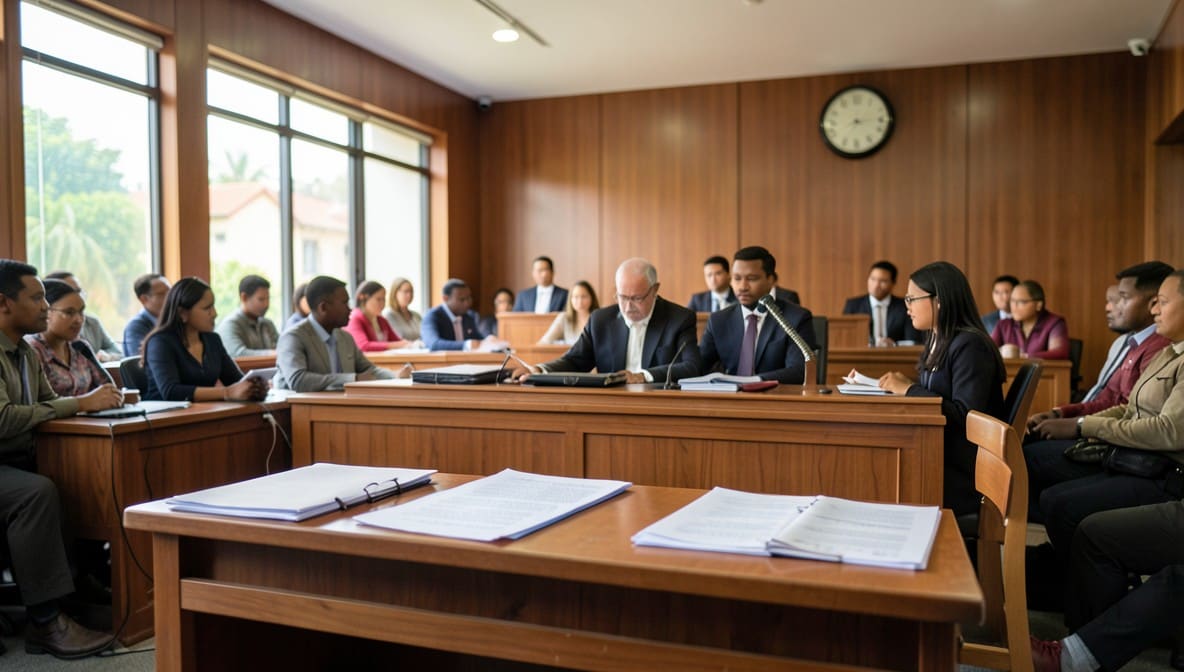
The Karnataka High Court has clarified that an order transferring suits under Section 24 of the Code of Civil Procedure constitutes a 'case decided' and is revisable under Section 115, provided no appeal lies. The Court further held that allegations of judicial bias against a trial judge, made to circumvent procedural delays, cannot justify transfer when the presiding officer is actively enforcing timelines set by the High Court.
Background & Facts
The Dispute
The dispute arises from competing claims over a property in Bengaluru. Respondents No.1 and 2 (Anushka Constructions Pvt. Ltd. and Srinivasa Trust) filed O.S.No.1453/2024 seeking specific performance of an agreement dated 13.03.2023. Petitioner No.1 (Ekta Kukreja) purchased the same property from Respondent No.3 (Smt. Vandanap L) under a registered sale deed dated 13.03.2024 and filed O.S.No.2897/2024 for a permanent injunction. A third miscellaneous petition, M.C.No.576/2024, was filed by Respondents No.1 and 2 alleging violation of an injunction order.
Key Facts
- The sale agreement dated 13.03.2023 was executed between Respondents No.1 and 2 and Respondent No.3.
- Petitioner No.1 purchased the property from Respondent No.3 on 13.03.2024 and registered the sale deed.
- On 23.04.2024, the trial court granted an ex-parte ad-interim injunction in favor of Petitioner No.1.
- Respondents No.1 and 2 challenged the interim order in MFA No.6603/2024 before the Karnataka High Court.
- On 30.10.2024, the High Court directed the trial court to dispose of all three pending matters within one year.
- The trial court, presided over by a judge who assumed charge on 29.05.2024, recorded over 130 hearing dates.
- Respondents No.1 and 2 filed multiple applications for amendment, recasting of issues, and adjournments.
- On 28.11.2025, the High Court extended the time for disposal by three months but imposed costs of Rs.50,000 on Respondents No.1 and 2 for delay and non-cooperation.
- On 17.07.2025, Respondents No.1 and 2 filed Misc. No.785/2025 seeking transfer of all three suits to another court, without disclosing this to the High Court during the 28.11.2025 hearing.
- The trial judge was accused of making biased oral remarks on 08.04.2025, 09.04.2025, and 11.04.2025, but no written record or transcript was produced.
Procedural History
- 13.03.2023: Agreement for sale executed between Respondents No.1 and 2 and Respondent No.3.
- 13.03.2024: Petitioner No.1 purchased property from Respondent No.3 and registered sale deed.
- 23.04.2024: Ex-parte ad-interim injunction granted in O.S.No.2897/2024.
- 30.10.2024: Karnataka High Court, in MFA No.6603/2024, directed disposal of all suits within one year.
- 17.07.2025: Respondents No.1 and 2 filed Misc. No.785/2025 seeking transfer under Section 24 CPC.
- 28.11.2025: High Court extended time for disposal by three months, imposed Rs.50,000 costs on Respondents No.1 and 2, and directed cooperation with trial court.
- 21.02.2026: Principal City Civil and Sessions Judge allowed transfer of suits to CCH-30.
- 09.03.2026: Civil Revision Petition No.193/2026 heard and reserved.
- 24.03.2026: Judgment delivered by Justice R Devdas.
The Parties' Positions
- Petitioner No.1: Argued that Respondents No.1 and 2 are abusing process by filing repeated adjournments and concealment of transfer application during High Court proceedings. Alleged bias against the presiding officer is unsubstantiated.
- Respondents No.1 and 2: Claimed the presiding officer exhibited bias through oral remarks and that transfer under Section 24 CPC is necessary for impartial adjudication.
Relief Sought
The Petitioner sought quashing of the transfer order dated 21.02.2026 and direction to the trial court to conclude proceedings in O.S.No.1453/2024, O.S.No.2897/2024, and M.C.No.576/2024 within three months.
The Legal Issue
Is a Civil Revision Petition under Section 115 of the CPC maintainable against an order transferring suits under Section 24 of the CPC, where no appeal lies? And does concealment of a transfer application during a High Court hearing on delay, coupled with unsubstantiated allegations of bias, justify transfer?
Arguments Presented
For the Petitioner
Learned Senior Counsel G.L. Vishwanath relied on the Division Bench judgment in Babusingh and Others v. Raj Bahadur Singh and Others (Transfer Application (Civil) No.12 of 2021), which held that a transfer application under Section 24 CPC is an 'other proceeding' and its disposal constitutes a 'case decided'. He emphasized that Respondents No.1 and 2 concealed the filing of Misc. No.785/2025 during the 28.11.2025 hearing, when the High Court was considering extension of time and imposing costs for delay. He argued that the presiding officer was merely enforcing the High Court’s directive and that allegations of bias were speculative and unsupported by evidence.
For the Respondent
Learned Senior Counsel Sreevatsa relied on judgments from Kerala and Gujarat High Courts (Wilson Paul v. Pathrose, V.Gopinath Panicker v. Padmini Kunjamma, Harshad Babubhai Amin v. Pravinaben Chandrakant Patel) to contend that Section 115 CPC is not maintainable against Section 24 orders, as they are interlocutory and not final. He argued that the trial judge’s conduct indicated bias and that transfer was necessary to ensure fair trial.
The Court's Analysis
The Court examined the nature of proceedings under Section 24 CPC and held that such applications are judicial in nature, requiring the court to weigh competing claims, examine material on record, and hear both parties. The order disposing of such an application is final in the sense that it concludes the transfer proceeding, even if it does not finally determine the suit. The Court explicitly adopted the reasoning in Babusingh and overruled the narrow interpretation of Section 115.
"The decision in that regard may not have any direct impact on the lis involved in the suit, appeal or other kind of proceedings, but a decision is to be judicially arrived at by the District Judge after due application of mind and hearing parties."
The Court further held that the concealment of the transfer application during the 28.11.2025 hearing was a deliberate attempt to mislead the High Court, which had already imposed costs for delay and directed cooperation. The allegations of bias were dismissed as unsubstantiated, noting that the presiding officer had recorded over 130 hearing dates and was merely preventing unnecessary adjournments.
The Court emphasized that transferring the matter at this stage would cause further delay, as a new judge would require time to familiarize with the voluminous record. The existing judge, who had been overseeing the matter since May 2024, was fully conversant with the facts and had been directed by the High Court to conclude the matter.
The Verdict
The Civil Revision Petition is allowed. The impugned order dated 21.02.2026 passed by the Principal City Civil and Sessions Judge in Misc. No.785/2025 is quashed and set aside. The trial court is directed to conclude proceedings in O.S.No.1453/2024, O.S.No.2897/2024, and M.C.No.576/2024 within three months from the next date of hearing, as previously directed in MFA No.6603/2024 dated 28.11.2025.
What This Means For Similar Cases
Civil Revision Is Maintainable Against Section 24 Orders
- Practitioners may now file Section 115 CPC petitions against transfer orders where no appeal lies, provided the order finally disposes of the transfer application.
- This overrules the earlier restrictive view in some High Courts and aligns with the Allahabad HC’s broader interpretation.
- The burden shifts to respondents to prove that the transfer application was filed in good faith and not as a dilatory tactic.
Concealment of Proceedings Undermines Credibility
- Failure to disclose pending applications during High Court hearings on delay or costs may be viewed as abuse of process.
- Courts will now scrutinize the timing and motive behind transfer applications filed after adverse directions.
- Allegations of judicial bias must be supported by written records or transcripts; oral remarks alone are insufficient.
Transfer Should Not Be Used to Reset Timelines
- Transfer under Section 24 CPC cannot be used to circumvent court-imposed deadlines.
- Courts will prioritize continuity of adjudication, especially when the presiding officer is already familiar with the case.
- Delay caused by repeated adjournments and tactical litigation will be met with costs and denial of procedural relief.