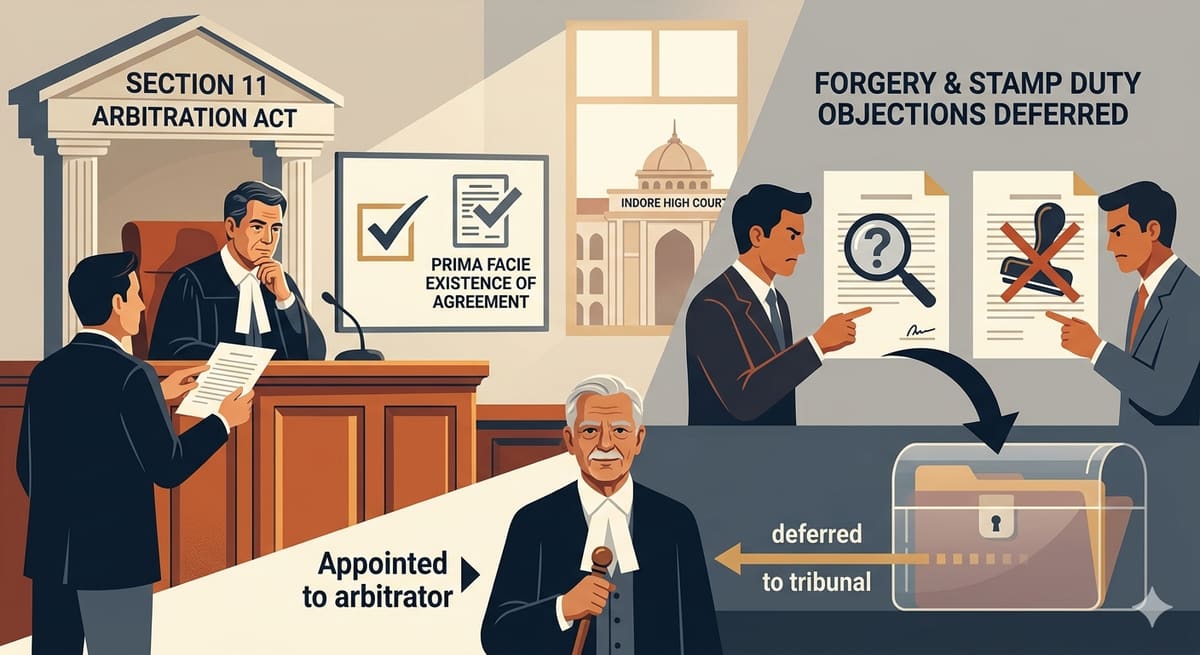
The Madhya Pradesh High Court has clarified that a show-cause notice issued by a party, followed by a reasoned reply denying the allegations, constitutes a live and crystallized dispute under the Arbitration and Conciliation Act, 1996. This ruling affirms that parties need not await a final termination order to invoke arbitration, reinforcing the principle that arbitration clauses must be given effect at the earliest stage of disagreement.
Background & Facts
The Dispute
The applicants, a proprietorship concern and its proprietor, were appointed as retail dealers for petrol and high-speed diesel by Indian Oil Corporation Limited (IOCL) at Thandla, District Jhabua. The dealership was granted pursuant to a public advertisement dated 14.12.2018, followed by a Letter of Intent dated 20.09.2021 and a formal dealership agreement executed on 16.05.2022. The outlet commenced operations on 30.05.2022 and has been functioning since.
Key Facts
- The applicants obtained all necessary No Objection Certificates (NOCs) from the Revenue Department, MPRDC, Tehsildar, and District Collector prior to commencing operations.
- MPRDC issued an approved map on 27.12.2021 showing the Right of Way (RoW) and the location of the proposed retail outlet.
- The Tehsildar’s NOC dated 14.01.2020 explicitly noted that Government land (Survey No. 492/2, 0.43 hectares) lies between the State Highway-64 and the proposed plot, and that no permanent construction would be permitted on it.
- The District Collector’s final NOC dated 07.03.2022 confirmed the site’s suitability for the retail outlet.
- On 14.12.2024, IOCL issued a notice seeking explanations regarding alleged discrepancies in land ownership.
- The applicants responded on 02.07.2025, asserting that the Land Evaluation Committee (LEC) had inspected and approved the site.
- IOCL issued a second notice dated 02.07.2025, reiterating the same allegations.
- On 25.08.2025, IOCL issued a show-cause notice proposing termination of the dealership, alleging violation of Clause 45(i) of the agreement and Clause 4(1) of the selection brochure, based on alleged suppression of facts regarding Government land.
- The applicants challenged the 02.07.2025 notice via W.P. No. 29826/2025, which was dismissed by this Court on 07.08.2025.
- On 06.11.2025, the applicants invoked Clause 62 of the dealership agreement and proposed two retired District Judges as arbitrators.
- IOCL declined consent to the proposed arbitrators in its reply dated 03.12.2025.
Procedural History
- 14.12.2018: IOCL issued public advertisement for retail dealership at Thandla.
- 20.09.2021: Letter of Intent issued to applicants.
- 27.12.2021: MPRDC issued approved map and NOC.
- 14.01.2020: Tehsildar issued NOC referencing Government land.
- 07.03.2022: District Collector issued final NOC.
- 16.05.2022: Dealership agreement executed.
- 30.05.2022: Retail outlet commenced operations.
- 14.12.2024: First notice issued by IOCL seeking explanation.
- 02.07.2025: Second notice issued; applicants replied.
- 07.08.2025: W.P. No. 29826/2025 dismissed by High Court.
- 25.08.2025: Show-cause notice proposing termination issued.
- 06.11.2025: Applicants invoked arbitration clause and proposed arbitrators.
- 03.12.2025: IOCL declined proposed arbitrators.
- 04.09.2025: Interim order passed under Section 9 by Commercial Court, Indore (MJC AC No. 75/2025).
- 13.05.2026: Present application under Section 11 decided by Madhya Pradesh High Court.
The Parties' Positions
Applicants: Argued that a live dispute exists due to the show-cause notice and their rebuttal, triggering the arbitration clause. They emphasized that the agreement contains no precondition requiring a final order before arbitration.
Respondents (IOCL): Contended that no dispute exists because no termination order has been passed. They argued the application is premature, an abuse of process, and that the applicants are attempting to circumvent administrative proceedings.
Relief Sought
The applicants seek appointment of an arbitrator under Section 11 of the Arbitration and Conciliation Act, 1996, to adjudicate the dispute arising from the proposed termination of the dealership agreement.
The Legal Issue
Does the issuance of a show-cause notice proposing termination of a contract, followed by a detailed reply denying the allegations, constitute a "live dispute" sufficient to invoke arbitration under Section 11 of the Arbitration and Conciliation Act, 1996?
Arguments Presented
For the Appellant/Petitioner
The applicants relied on M/s Sahni Fuels v. Indian Oil Corporation Limited (W.A. No. 869/2025) and Indian Oil Corporation Ltd. v. Tatpar Petroleum Centre (2022 SCC OnLine MP 124), arguing that a dispute arises when one party asserts a claim and the other denies it. They emphasized that Clause 62 of the agreement is broad, covering "any dispute or difference of any nature whatsoever," and contains no requirement for a final order before arbitration. The applicants further cited Kamal Gupta v. L.R. Builders Pvt. Ltd. (2025 SCC OnLine SC 1691) to oppose intervention.
For the Respondent/State
IOCL contended that no dispute exists because no conclusive decision has been taken. It argued that the show-cause notice is merely a preliminary administrative step, and arbitration can only be invoked after a final termination order. It relied on Indian Oil Corporation Ltd. v. Tatpar Petroleum Centre (2022 MPLJ 79) and E. Venkatakrishna v. Indian Oil Corporation (2000) 7 SCC 764 to assert that the applicants are attempting to prematurely freeze administrative proceedings.
The Court's Analysis
The Court examined the definition of "dispute" under the Arbitration and Conciliation Act, 1996, noting that while the Act does not define the term, its dictionary meaning - "an argument, disagreement, or contention" - is decisive. The Court observed that a dispute does not require a final order; it arises when one party makes an assertion and the other refutes it.
"A dispute cannot arise when only one party asserts and other remains silent. Whether the assertion made by one and the denial made by the other leaves to passing of any particular order by one of the party is not necessary for arising of a dispute. An assertion by one and denial/said assertion by another is enough for germination of the concept of a dispute."
The Court found that the facts of the case squarely fit this definition: IOCL issued a show-cause notice alleging suppression of facts regarding Government land, and the applicants responded with a detailed rebuttal, asserting that the LEC had approved the site. This exchange of assertions and denials created a bilateral disagreement - the very essence of a dispute.
The Court rejected IOCL’s argument that arbitration is premature, holding that Clause 62 of the agreement contains no such qualification. The clause explicitly covers "any claim, cross-claim, counter-claim or set-off regarding any right, liability, act, omission or account," without requiring a final order. The Court emphasized that parties are bound by the terms they freely agreed to, and IOCL cannot now impose additional conditions.
Regarding intervention, the Court held that the intervener, though the complainant who triggered the notice, is not a party to the dealership agreement or the arbitration clause. Citing Kamal Gupta v. L.R. Builders, the Court affirmed that non-signatories cannot participate in arbitration proceedings, as arbitral awards bind only parties to the agreement. The Court further noted that permitting intervention would violate Section 42A of the Act, which mandates confidentiality of arbitral proceedings.
The Verdict
The applicants succeeded. The Court appointed Hon’ble Shri Justice Virender Singh (Retd.), Judge of the Madhya Pradesh High Court, as the sole arbitrator. The Court directed the Principal Registrar to obtain a declaration under Section 11(8) read with Section 12(1) and the Sixth Schedule of the Arbitration and Conciliation Act, 1996, from the proposed arbitrator. The matter was listed for further hearing on 15.05.2026.
What This Means For Similar Cases
Show-Cause Notices Can Trigger Arbitration
- Practitioners may now invoke arbitration immediately upon receipt of a show-cause notice if the recipient submits a substantive reply denying the allegations.
- The mere existence of a contractual arbitration clause, without additional procedural conditions, is sufficient to permit arbitration at the earliest stage of disagreement.
- Parties should not delay arbitration proceedings waiting for a final order if the dispute is already crystallized through written assertions and denials.
Non-Signatories Cannot Intervene in Arbitration
- Complaints or third-party allegations, even involving public land or regulatory concerns, do not confer standing to participate in arbitration.
- Arbitration proceedings are strictly confined to signatories of the agreement; non-parties have no legal right to be heard, even if their interests are indirectly affected.
- Any remedy for non-signatories lies in enforcement challenges under Section 36, not in participation during arbitral proceedings.
Arbitration Clauses Must Be Interpreted Broadly
- Courts will uphold broad arbitration clauses covering "any dispute or difference of any nature whatsoever" without imposing restrictive interpretations.
- Attempts to limit arbitration to post-termination stages will be rejected if the contract does not expressly require it.
- Parties must carefully draft arbitration clauses if they intend to impose procedural preconditions - silence will be construed as permissive.