The Madhya Pradesh High Court has clarified that an arbitration clause embedded in commercial invoices can constitute a valid arbitration agreement when accepted by the parties through their conduct, including payment and continued performance. This ruling reinforces the principle that arbitration agreements need not be confined to formal contracts but may arise from the parties' course of dealing.
Background & Facts
The Dispute
The applicant, M/s. Supreme Transport Company, a partnership firm engaged in transportation, warehousing, and logistics services across India, provided freight services to the respondent, M/s. Climax Enterprises Pvt. Ltd., a company registered under the Companies Act. The services were initiated following mutual agreement on financial terms communicated via email dated 21.10.2021. The applicant commenced services and issued invoices periodically, which the respondent partially paid, albeit with delays.
Key Facts
- Services commenced on or after 21.10.2021 based on email agreement
- Invoices issued by applicant contained arbitration clause: "Any dispute regarding this transaction shall be referred to arbitration to be held at Indore"
- Payments were made intermittently against invoices, though not always on time
- On 29.06.2022, applicant proposed revised rates via email; respondent did not respond
- By January 2023, outstanding dues accumulated to Rs. 21 lakhs
- Respondent issued debit notes dated January 2023 totaling Rs. 7,91,160/-, unilaterally deducting amounts without consent
- Applicant objected via email dated 02.02.2023, asserting the deductions were invalid
- On 30.05.2023, respondent agreed to revised terms effective retroactively from 01.07.2022 via email
- On 29.08.2023, respondent paid Rs. 1,00,000 via NEFT and Rs. 2,00,000 via cheque
- No further payments made after August 2023
- Outstanding dues claimed by applicant: Rs. 22.50 lakhs as of 29.11.2023
- Two cheques of Rs. 2 lakhs and Rs. 1 lakh issued by respondent were dishonored
- Notice invoking arbitration was sent on 08.11.2021; respondent replied on 29.11.2024 denying existence of arbitration clause
- Invoices (Annexure A/8) were acknowledged by respondent’s accounts staff for payment verification
- No document from respondent expressly rejected or disclaimed the arbitration clause
Procedural History
- 21.10.2021: Initial service agreement via email
- 29.06.2022: Applicant proposes revised rates
- January 2023: Outstanding dues reach Rs. 21 lakhs; respondent issues debit notes
- 02.02.2023: Applicant objects to unilateral deductions
- 30.05.2023: Respondent confirms revised terms retroactively
- 29.08.2023: Partial payments of Rs. 3,00,000 made
- 29.11.2023: Final demand for Rs. 22.50 lakhs; respondent raises objections
- 08.11.2021: Notice invoking arbitration sent
- 29.11.2024: Respondent replies denying arbitration clause
- 17.02.2026: Application under Section 11(5) of the Arbitration and Conciliation Act, 1996 heard
- 23.03.2026: Judgment pronounced
The Parties' Positions
The applicant contends that the arbitration clause in the invoices, which were accepted and acted upon by the respondent through payment and correspondence, constitutes a binding arbitration agreement. It relies on the principle that conduct can evidence consent to contractual terms.
The respondent argues that no formal arbitration agreement exists, as the initial email did not contain the clause, and the invoices were merely acknowledged for payment verification by accounts staff, not as binding contractual terms.
Relief Sought
The applicant seeks appointment of a sole arbitrator under Section 11(5) of the Arbitration and Conciliation Act, 1996, to adjudicate the outstanding payment dispute of Rs. 19,62,333/-.
The Legal Issue
Can an arbitration clause printed on commercial invoices constitute a valid arbitration agreement under Section 7 of the Arbitration and Conciliation Act, 1996, when the recipient acknowledges the invoices, makes partial payments, and engages in correspondence without objecting to the clause?
Arguments Presented
For the Appellant/Petitioner
The applicant relied on the principle that arbitration agreements may be inferred from conduct and course of dealing. It cited the arbitration clause in Annexure A/8, which was included in every invoice issued from the outset. The respondent’s repeated acceptance of invoices, partial payments, and email correspondence acknowledging the dispute demonstrated implied consent to the arbitration clause. The applicant emphasized that the respondent never objected to the clause in writing, even when disputing the amounts.
For the Respondent/State
The respondent contended that the arbitration clause was a unilateral, standard term printed on invoices without mutual assent. It argued that the invoices were received only for payment verification by accounts staff, who lacked authority to bind the company to arbitration. The respondent relied on the absence of the clause in the initial email agreement and asserted that mere receipt of an invoice does not equate to acceptance of its terms.
The Court's Analysis
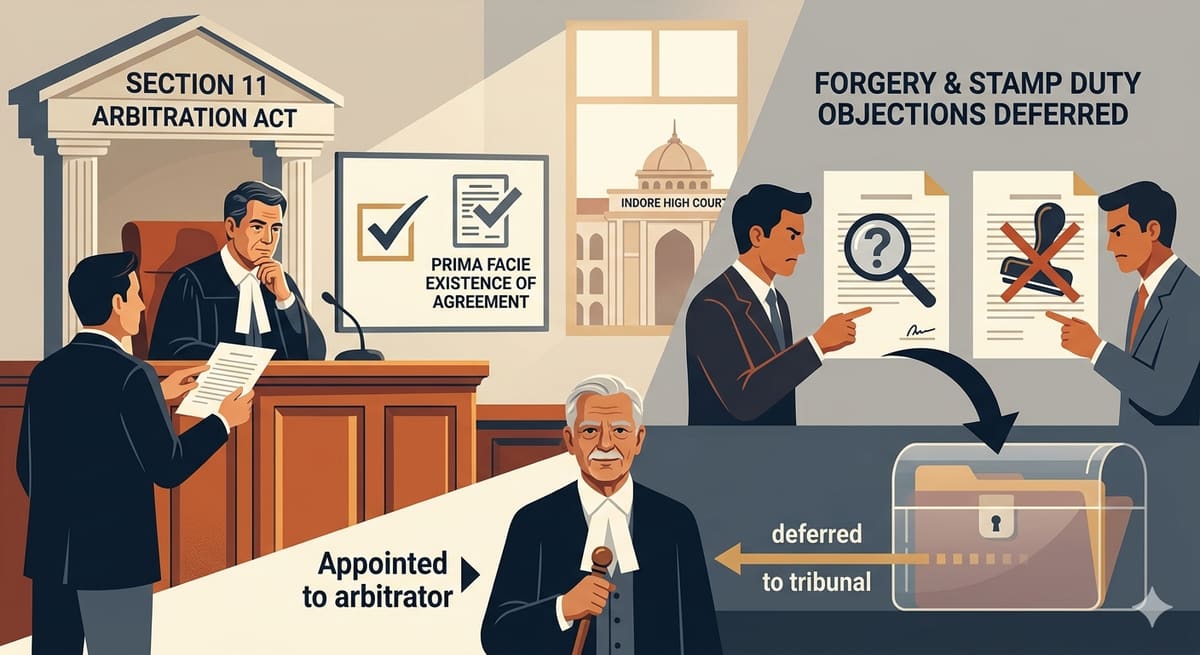
The Court examined the nature of arbitration agreements under Section 7 of the Arbitration and Conciliation Act, 1996, which permits agreements in writing, including those contained in exchange of communications such as emails or documents referenced in the contract. The Court held that the arbitration clause in the invoices was not a mere boilerplate term but a clear, unambiguous provision stating that disputes "shall be referred to arbitration to be held at Indore."
"There is no such clarification on record which would expressly or even impliedly exclude the arbitration clause mentioned on the invoices issued by the applicant."
The Court noted that the respondent did not dispute receiving the invoices, nor did it deny that its accounts staff acted within the scope of their duties. The fact that payments were made against these invoices, and that the respondent engaged in detailed email negotiations regarding the disputed amounts, indicated acquiescence to the terms contained therein. The Court rejected the argument that the clause was hidden or unilaterally imposed, observing that the respondent had ample opportunity to object but chose not to.
The Court further held that the initial email agreement was not the sole source of contractual terms. Subsequent conduct, including the issuance and acceptance of invoices containing the arbitration clause, formed part of the evolving agreement between the parties. The Court cited the doctrine of "conduct as acceptance" and emphasized that silence in the face of repeated communication may constitute implied consent.
"It cannot be gathered from invoices Annexure A/8 that there was any denial of the part where arbitration agreement was mentioned."
The Court also dismissed the respondent’s reliance on the absence of the clause in the initial proposal, noting that the applicant was not relying on the initial email but on the invoices, which were the operative documents governing the transaction.
The Verdict
The applicant succeeded. The Court held that a valid arbitration agreement exists and appointed Shri H.M. Gupta (Former Chief Engineer, Urban Administration) as the sole arbitrator. The Court directed the Principal Registrar to obtain a declaration in the prescribed form under Section 11(8) read with Section 12(1) and the Sixth Schedule of the Act before the next hearing. The matter was listed for 31.03.2026.
What This Means For Similar Cases
Arbitration Clauses in Invoices Are Enforceable Through Conduct
- Practitioners may now rely on arbitration clauses printed on invoices where parties have accepted them through payment, correspondence, or continued performance
- Silence or failure to object to repeated invoices containing arbitration clauses may constitute implied consent
- The burden shifts to the party denying the clause to prove express rejection, not mere non-acknowledgment
Conduct Trumps Formality in Commercial Arbitration
- Courts will examine the totality of dealings, not just the initial contract
- Email exchanges, payment history, and dispute correspondence can form part of the arbitration agreement
- Standard terms in invoices are not automatically void if they are routinely accepted without protest
Practical Takeaways for Drafting and Dispute Resolution
- Businesses should ensure arbitration clauses are clearly printed on all invoices and terms of service
- Parties receiving invoices with arbitration clauses must explicitly object in writing if they do not wish to be bound
- Legal notices invoking arbitration should reference the specific invoice(s) containing the clause
- In arbitration applications under Section 11, evidence of conduct (payments, emails, acknowledgments) is critical to proving agreement