The Madhya Pradesh High Court has firmly closed the door on attempts to review orders appointing arbitrators under Section 11 of the Arbitration and Conciliation Act, 1996. In a decisive ruling, the Court held that such orders are final and immune from review, reinforcing the legislative intent to minimize judicial interference in arbitration proceedings. This judgment reinforces the principle that arbitration must proceed without procedural delays, even when parties raise objections after participation in the arbitral process.
Background & Facts
The Dispute
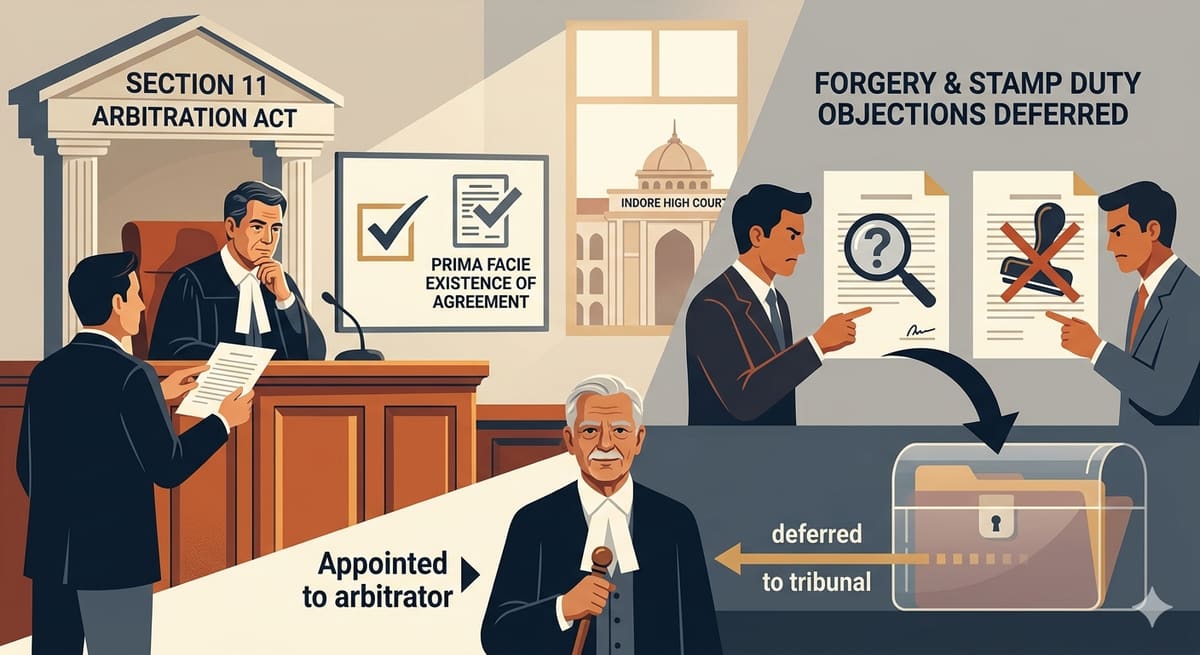
The petitioner, Shri Randhir Singh Saluja, challenged the appointment of Justice Mohd. Rafiq (Retd.) as sole arbitrator in Arbitration Case No. 03/2024. He contended that the underlying agreement between the parties was unregistered and that no original or certified copy of the agreement had been filed with the Court at the time of the Section 11 application. He sought to set aside the appointment order and initiate perjury proceedings against the respondent’s signatory.
Procedural History
- March 2024: High Court appointed Justice Mohd. Rafiq as arbitrator under Section 11 of the Arbitration and Conciliation Act, 1996.
- November 2024: Petitioner raised a jurisdictional challenge before the appointed arbitrator under Section 16(2), which was dismissed.
- January 2025: Petitioner filed a review petition before the same High Court, over nine months after the appointment order.
- February 2026: Review petition heard and dismissed.
Relief Sought
The petitioner sought to set aside the arbitrator appointment order, restore the arbitration case, and initiate criminal proceedings for alleged falsification of documents.
The Legal Issue
The central question was whether a review petition under Order XLVII Rule 1 of the CPC is maintainable against an order passed under Section 11 of the Arbitration and Conciliation Act, 1996, particularly when the petitioner had already participated in the arbitral proceedings and raised jurisdictional objections before the arbitrator.
Arguments Presented
For the Petitioner
The petitioner argued that the absence of a registered agreement or certified copy rendered the arbitration agreement invalid, thereby vitiating the appointment of the arbitrator. He contended that the Court’s failure to verify the document’s authenticity amounted to a procedural irregularity warranting review. He relied on general principles of natural justice and the Court’s inherent power to correct errors.
For the Respondent
The respondent countered that Section 5 of the Arbitration Act explicitly bars judicial intervention except as expressly provided. No provision in the Act permits review of a Section 11 order. Counsel cited Interplay Between Arbitration Agreements (2024) 6 SCC 1 and Hindustan Construction Company Ltd. v. Bhartiya Rajya Pul Nirman Nigam (2025) INSC 1365 to establish that review is impermissible unless an error apparent on the face of the record exists. Further, the petitioner’s participation in arbitral proceedings and prior challenge under Section 16(2) estopped him from seeking review at this stage.
The Court's Analysis
The Court undertook a rigorous statutory interpretation of the Arbitration and Conciliation Act, 1996, emphasizing the legislative intent to ensure expeditious dispute resolution. It held that Section 5 operates as a comprehensive bar to judicial interference, including review, unless explicitly permitted. The Court noted that while High Courts possess inherent powers of review, these are severely circumscribed in matters governed by special statutes like the Arbitration Act.
"While High Courts, as courts of record, do possess a limited power of review, such power is extremely circumscribed in matters governed by the Arbitration Act. It may be exercised only to correct an error apparent on the face of the record or to address a material fact that was overlooked. It cannot be used to revisit findings of law or reappreciate issues already decided."
The Court distinguished between procedural review and merits-based review, citing Grindlays Bank Ltd v. Central Government Industrial Tribunal. It found no patent error in the appointment order, as the validity of stamping or registration is a matter for the arbitrator under Section 16, not the appointing court under Section 11. The Court further held that the petitioner’s conduct - raising jurisdictional objections before the arbitrator and then seeking review after the arbitrator’s adverse ruling - constituted an abuse of process and an attempt to delay proceedings.
The Verdict
The petitioner’s review petition was dismissed. The Court held that no statutory remedy of review exists for orders under Section 11, and any attempt to circumvent this bar through procedural devices is impermissible. The petitioner was directed to pay a cost of Rs. 5,000 to the High Court Employees Union.
What This Means For Similar Cases
Review Is Not a Backdoor Appeal
- Practitioners must understand that Section 11 appointment orders are final and not subject to review under CPC.
- Any challenge to the validity of the arbitration agreement must be raised before the arbitrator under Section 16, not through collateral review petitions.
- Delayed challenges after participation in arbitral proceedings will be viewed as an abuse of process.
Arbitrator’s Jurisdiction Is Presumptively Valid
- Courts appointing arbitrators under Section 11 are not required to adjudicate the enforceability of the underlying contract.
- Issues of stamp duty, registration, or authenticity are matters for the arbitral tribunal to determine under Section 16.
- Parties cannot use review petitions to re-litigate issues already decided by the arbitrator.
Judicial Restraint Is Mandatory
- Courts must resist the temptation to intervene in arbitration even when procedural irregularities are alleged.
- The doctrine of kompetenz-kompetenz is firmly entrenched: the arbitrator decides his own jurisdiction.
- Review petitions filed solely to delay arbitration will attract costs and adverse inference.