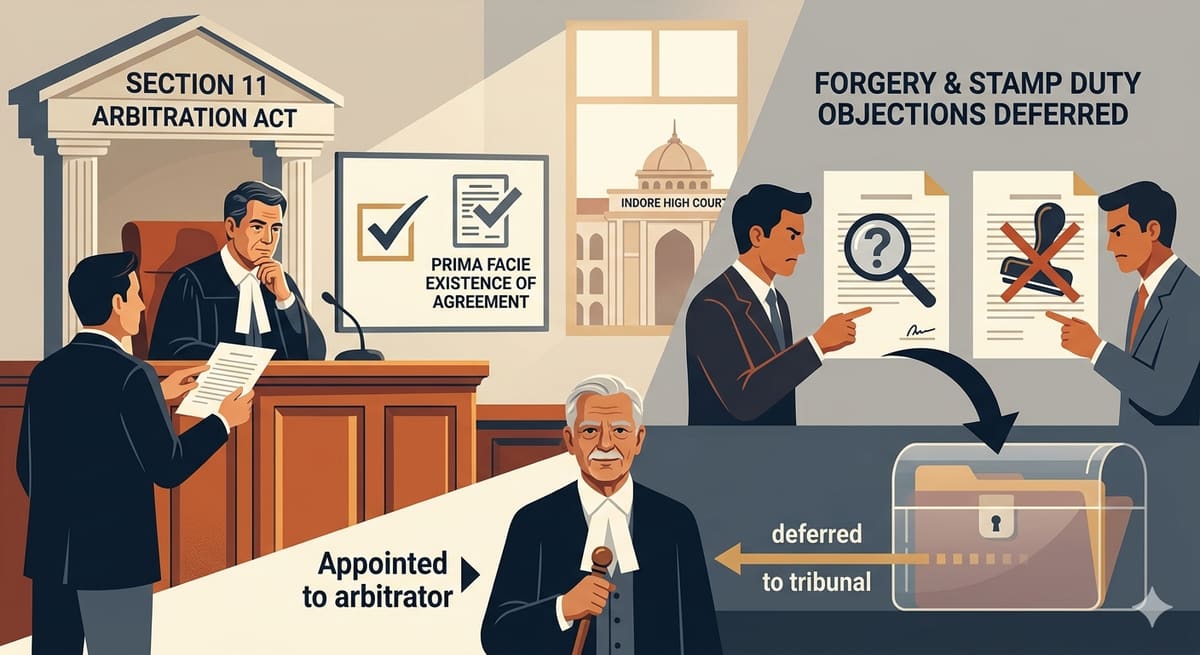
The Bombay High Court has reaffirmed the narrow scope of judicial intervention under Section 11 of the Arbitration and Conciliation Act, 1996, holding that the referral court’s role is limited to ascertaining the prima facie existence of an arbitration agreement. The judgment clarifies that issues such as limitation, abandonment of the agreement, or substantive validity must be adjudicated by the arbitral tribunal, not the court at the pre-arbitral stage.
Background & Facts
The Dispute
The applicant, Palwinder Singh Samra, and the respondent, Sukhvinder Singh Samra, are real brothers who entered into a Family Settlement Deed dated 15.11.2017 to resolve disputes arising from their joint partnership businesses. Clause 15 of the deed provided for arbitration as the mechanism for dispute resolution. Despite invoking the arbitration clause via a notice under Section 21 of the Arbitration Act on 28.01.2026, the parties failed to agree on the appointment of an arbitrator, leading to the filing of the present application under Section 11(6) of the Act.
Key Facts
- The parties executed the Family Settlement Deed on 15.11.2017, which included an arbitration clause (Clause 15) for resolving disputes.
- The applicant issued a notice under Section 21 of the Arbitration Act on 28.01.2026, invoking arbitration.
- The respondent raised objections, including:
- The application was barred by limitation, as the alleged breach occurred on 09.02.2018, and the notice was issued nearly eight years later.
- The Family Settlement Deed and its arbitration clause were abandoned due to the applicant’s conduct, including:
- Filing Civil Suit No. 2335 of 2022 before the Civil Judge, Junior Division, Amritsar, Punjab, on 29.07.2022, seeking relief related to the same subject matter.
- Withdrawing the suit without liberty to file an arbitration application, which the respondent argued barred the present application under Order XXIII, Rule 1 of the Code of Civil Procedure.
- Filing an application under Section 111 of the Punjab Land Revenue Code for partition of the subject property.
- Alleging that the original Family Settlement Deed was destroyed, rendering the arbitration clause non-existent.
Procedural History
- 28.01.2026: Applicant issued notice under Section 21 of the Arbitration Act invoking arbitration.
- 2026: Present Arbitration Application (L) No. 15700 of 2026 filed before the Bombay High Court under Section 11(6) of the Arbitration Act.
- 29.06.2026: Arguments heard; judgment reserved.
- 02.07.2026: Judgment pronounced.
Relief Sought
The applicant sought the appointment of a sole arbitrator to adjudicate disputes arising from the Family Settlement Deed dated 15.11.2017, as the parties failed to agree on an arbitrator.
The Legal Issue
The central question was whether the referral court under Section 11 of the Arbitration Act could adjudicate issues beyond the prima facie existence of an arbitration agreement, including:
- Whether the application was barred by limitation.
- Whether the arbitration agreement was abandoned due to the applicant’s conduct.
- Whether the original agreement was destroyed, rendering the arbitration clause non-existent.
Arguments Presented
For the Applicant
- The role of the referral court under Section 11 is limited to ascertaining the prima facie existence of the arbitration agreement, as held in In Re: Interplay Between Arbitration Agreements under The Arbitration and Conciliation Act, 1996 and The Indian Stamp Act, 1899 and SBI General Insurance Company Ltd. v. Krish Spinning.
- The respondent did not dispute the existence of the arbitration agreement in its response to the Section 21 notice; the objection regarding destruction of the agreement is a matter for the arbitral tribunal.
- Issues of limitation and abandonment must be decided by the arbitral tribunal, not the referral court.
For the Respondent
- The application under Section 11 was barred by limitation, as the alleged breach occurred on 09.02.2018, and the notice was issued on 28.01.2026, beyond the three-year limitation period under Article 137 of the Limitation Act, 1963.
- The arbitration agreement was abandoned due to the applicant’s conduct, including:
- Filing and withdrawing Civil Suit No. 2335 of 2022 without liberty to file an arbitration application, which barred the present application under Order XXIII, Rule 1 of the CPC.
- Filing an application for partition under Section 111 of the Punjab Land Revenue Code, which was inconsistent with the arbitration clause.
- The original Family Settlement Deed was destroyed, and the applicant failed to produce the original or a certified copy, as required under Rule 8.3.3 of the High Court (Original Side) Rules.
The Court's Analysis
The Court relied on the Seven-Judge Bench decision in In Re: Interplay Between Arbitration Agreements under The Arbitration and Conciliation Act, 1996 and The Indian Stamp Act, 1899 and the Three-Judge Bench decision in SBI General Insurance Company Ltd. v. Krish Spinning to hold that the scope of enquiry under Section 11 is extremely limited. The Court observed:
"The scope of examination under Section 11(6-A) is confined to the existence of an arbitration agreement on the basis of Section 7. The examination of validity of the arbitration agreement is also limited to the requirement of formal validity such as the requirement that the agreement should be in writing."
The Court further noted:
"The Referral Court should limit its enquiry to examining whether Section 11(6) application has been filed within the period of limitation of three years or not. The date of commencement of limitation period for this purpose shall have to be construed as per the decision in Arif Azim Co. LTD v. Aptech Ltd., wherein it was held that the limitation period for filing a petition under Section 11(6) of the 1996 Act can only commence once a valid notice invoking arbitration has been sent by the applicant to the other party, and there has been a failure or refusal on the part of that other party in complying with the requirements mentioned in such notice."
The Court clarified that the referral court cannot examine whether the claims sought to be arbitrated are barred by limitation or whether the arbitration agreement was abandoned. These issues must be left to the arbitral tribunal, as held in In Re: Interplay and SBI General Insurance Company Ltd..
Regarding the respondent’s argument that the arbitration agreement was abandoned, the Court held:
"Considering the judgment of Interplay and Tata Capital Ltd. v. Priyanka Communications, this Court finds it difficult to enter into the question of abandonment of the arbitration clause based on the objection taken by the Respondent that the Applicant had filed a Civil Suit against the Respondent and another third party and the same amounts to waiver of the arbitration clause. This enquiry could travel beyond the power of the Reference Court under Section 11."
The Court also rejected the respondent’s reliance on Rajiv Gaddh v. Subodh Parkash and HPCL Bio-Fuels v. Shahaji Bhad, noting that these judgments dealt with subsequent applications under Section 11 after withdrawal of an earlier application without liberty, which was not the case here.
The Verdict
The Court allowed the Arbitration Application (L) No. 15700 of 2026 and appointed Mr. Aseem Naphade, Advocate, as the sole arbitrator to adjudicate the disputes between the parties. The Court directed:
- The applicant to communicate a copy of the order to the arbitrator within one week of uploading.
- The seat of arbitration to be governed by the agreement between the parties.
- The arbitrator to forward the statutory Statement of Disclosure under Section 11(8) read with Section 12(1) of the Arbitration Act to the applicant’s advocates for filing.
- The parties to appear before the arbitrator for directions on pleadings, evidence, and hearings.
- The arbitral costs and fees to be borne equally by the parties in the first instance, subject to the final award.
All contentions of the parties were expressly kept open for adjudication by the arbitral tribunal.
What This Means For Similar Cases
Scope of Referral Court Under Section 11 Is Strictly Limited
- The referral court’s jurisdiction under Section 11 is confined to examining the prima facie existence of an arbitration agreement under Section 7 of the Arbitration Act. Issues such as limitation, abandonment, or substantive validity must be left to the arbitral tribunal.
- Practitioners must avoid raising substantive objections (e.g., limitation, accord and satisfaction) before the referral court, as these will not be entertained.
Arbitral Tribunal to Adjudicate Substantive Issues
- The arbitral tribunal has exclusive jurisdiction to decide:
- Whether the claims are barred by limitation.
- Whether the arbitration agreement was abandoned due to the parties’ conduct.
- Whether the original agreement was destroyed or remains valid.
- Parties should reserve all substantive arguments for the arbitral proceedings.
Compliance with Procedural Requirements Is Critical
- The applicant must ensure strict compliance with procedural requirements, such as:
- Issuing a valid notice under Section 21 before filing a Section 11 application.
- Filing the Section 11 application within three years of the Section 21 notice to avoid dismissal on limitation grounds.
- Producing the original or certified copy of the arbitration agreement if its existence is disputed, though the Court may still proceed if the existence is prima facie established.