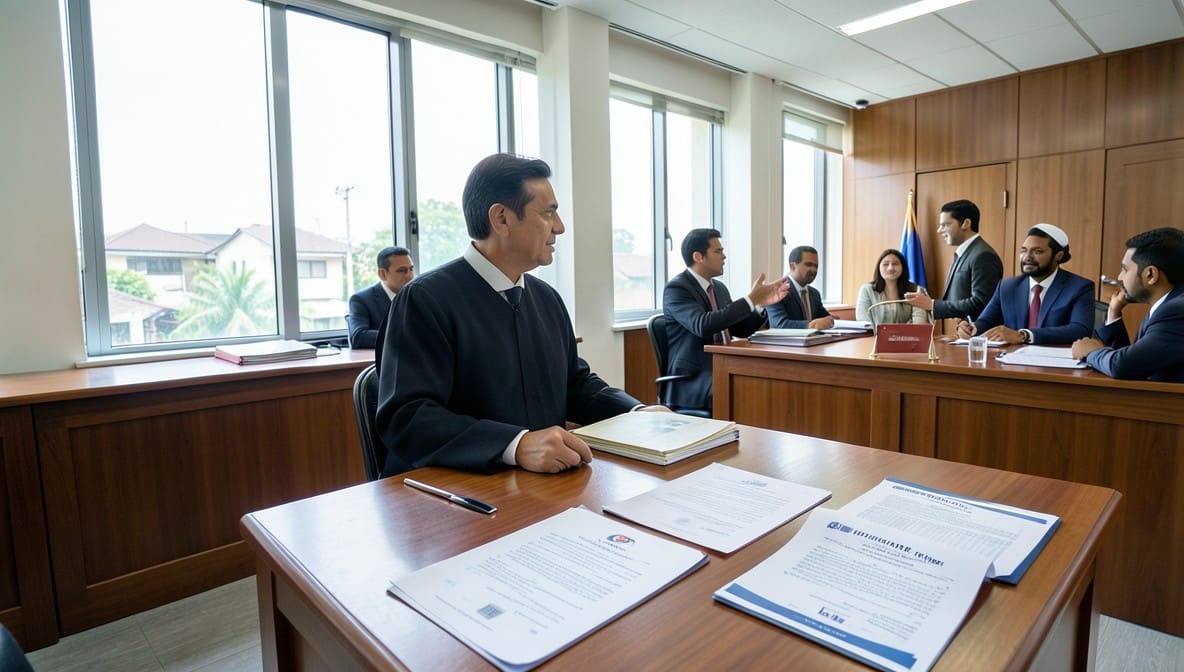
The Madhya Pradesh High Court has clarified that a non-signatory to an arbitration agreement cannot be compelled to arbitrate unless there is clear evidence of consent, privity of contract, or veritable party status. This ruling reinforces the foundational principle that arbitration is consensual and cannot be imposed through indirect conduct or commercial arrangements alone.
Background & Facts
The Dispute
The applicant, M/s Star D.G. Home Proprietorship Firm, sought appointment of a sole arbitrator under Section 11(6) of the Arbitration and Conciliation Act, 1996, to resolve a dispute concerning the supply of scrap material from a solvent extraction plant in Ratlam. The applicant claimed to be the assignee of rights under two agreements executed between respondent No.1 (M/s Khaitan Chemicals and Fertilizers Ltd.) and respondents No.2 and No.3 (companies incorporated under the Companies Act, 1956).
Key Facts
- Respondent No.1 owned a solvent extraction plant at Ratlam, operations of which ceased in 2014.
- On 24.09.2021, respondent No.1 passed a Board Resolution to sell plant, machinery, iron scrap, and building scrap on an 'as is where is' basis.
- Agreement dated 23.05.2022 was executed between respondent No.1 (seller) and respondent No.2 (buyer) for sale of scrap for a total consideration of Rs.20 crores.
- Clause 17 of the 23.05.2022 agreement expressly prohibited assignment without the prior written consent of the other party.
- Respondent No.2, facing GST litigation in Maharashtra, proposed to involve its group concern, respondent No.3 (Popular Ispat Industries Private Limited), to fulfill obligations under the agreement.
- Tripartite agreement dated 09.09.2022 was executed between respondents No.1, No.2, and No.3, incorporating all terms of the original agreement, including Clause 17.
- On 29.12.2022, respondent No.3 issued a unilateral letter to respondent No.1 requesting that payments be accepted from the applicant and invoices be raised in the applicant’s name for Rs.14,61,50,000/-.
- From 03.01.2023 to 17.04.2023, the applicant deposited Rs.6,68,91,527/- into respondent No.1’s bank account.
- Respondent No.1 issued 16 invoices to the applicant referencing the 23.05.2022 agreement, the 09.09.2022 tripartite agreement, and the 29.12.2022 letter.
- Respondent No.1 discontinued supply after 20.04.2023, citing non-payment of balance by respondents No.2 and No.3.
- On 30.05.2023, respondent No.1 issued a termination notice to respondent No.3 for failure to complete payment and performance.
- On 25.07.2023, respondent No.1 formally terminated the agreement and forfeited the entire deposit under Clause 4 of the original agreement.
- Respondent No.1 deposited Rs.3,81,03,443/- with the Economic Offences Wing, Mumbai, as directed by the EOW, which had registered FIR No.0332/2023 against a director of respondents No.2 and No.3.
Procedural History
- 23.05.2022: Original agreement executed between respondent No.1 and respondent No.2.
- 09.09.2022: Tripartite agreement executed between respondents No.1, No.2, and No.3.
- 29.12.2022: Unilateral assignment letter issued by respondent No.3 to respondent No.1, naming the applicant as recipient of payments and invoices.
- 03.01.2023 to 17.04.2023: Applicant deposited Rs.6,68,91,527/- with respondent No.1.
- 20.04.2023: Last supply of scrap material by respondent No.1.
- 28.06.2023: Applicant requested permission to lift remaining 249 MT of scrap; denied by respondent No.1.
- 24.09.2024: Applicant invoked arbitration clause under Section 21 of the Arbitration Act.
- 25.09.2024: Commercial Court, Indore, granted interim relief under Section 9 in MJC (AV) No.67/2024.
- 24.03.2026: Hearing held before the Madhya Pradesh High Court.
- 29.06.2026: Judgment pronounced.
The Parties' Positions
For the Applicant
- Claims to be the lawful assignee of rights under the 23.05.2022 and 09.09.2022 agreements.
- Argues that the 29.12.2022 letter constitutes a valid assignment, binding respondent No.1 to arbitrate.
- Relies on invoices issued by respondent No.1 referencing the agreements and assignment letter as evidence of implied consent.
- Invokes Cox and Kings Ltd. v. SAP India and Vidya Drolia v. Durga Trading Corporation to argue that non-signatories can be bound by arbitration agreements through conduct.
For the Respondent No.1
- Denies any privity of contract with the applicant.
- States that the 29.12.2022 letter was merely a commercial arrangement to facilitate payment, not an assignment.
- Emphasizes that Clause 17 of the original agreement required written consent for assignment, which was never obtained.
- Highlights that respondent No.3 failed to complete payment obligations, leading to lawful termination of the agreement.
- Cites Indowind Energy Ltd. v. Wescare and Hindustan Petroleum Corp. Ltd. v. BCL Secure Premises to argue that mere invoice references and payment flows do not create arbitration obligations.
Relief Sought
The applicant sought appointment of a sole arbitrator under Section 11(6) of the Arbitration and Conciliation Act, 1996, to adjudicate its claim for:
- Delivery of remaining scrap material worth Rs.1,82,00,491/-
- Refund of excess payments made
- Compensation for losses incurred due to non-supply
- Costs of litigation
The Legal Issue
Can a non-signatory to an arbitration agreement, who has not obtained the written consent of the original contracting party, be bound by the arbitration clause merely through unilateral assignment, payment of funds, and receipt of invoices referencing the original contract?
Arguments Presented
For the Appellant/Petitioner
The applicant relied on Cox and Kings Ltd. v. SAP India and Vidya Drolia v. Durga Trading Corporation to argue that non-signatories can be bound by arbitration agreements if their conduct demonstrates clear intent to be bound. It contended that the 29.12.2022 letter, coupled with respondent No.1’s issuance of 16 invoices referencing the original agreement and assignment, constituted implied consent. The applicant further argued that the tripartite agreement of 09.09.2022 incorporated the original arbitration clause and that respondent No.1’s acceptance of payments from the applicant amounted to acquiescence. It asserted that the doctrine of veritable party, as interpreted by the Supreme Court, permits binding non-signatories where their involvement in performance is substantial and direct.
For the Respondent/State
Respondent No.1 countered that the 29.12.2022 letter was not an assignment but a commercial instruction to receive payment on behalf of respondent No.3. It emphasized that Clause 17 of the original agreement explicitly prohibited assignment without written consent, and no such consent was ever given. Respondent No.1 relied on Hindustan Petroleum Corp. Ltd. v. BCL Secure Premises to argue that the applicant was merely a third-party payer, not a party to the contract. It highlighted that respondent No.3 had defaulted on payment obligations, leading to lawful termination of the agreement, and that the applicant’s involvement was incidental and commercial, not contractual. The respondent further pointed to the Economic Offences Wing’s involvement and the forfeiture of deposits under Clause 4 as evidence that the contractual relationship had been lawfully extinguished.
The Court's Analysis
The Court undertook a meticulous examination of the contractual chain and the nature of the 29.12.2022 letter. It observed that while the tripartite agreement of 09.09.2022 permitted respondent No.3 to step into respondent No.2’s shoes, it expressly preserved Clause 17 of the original agreement, which barred assignment without written consent. The Court held that the letter dated 29.12.2022 was a unilateral communication from respondent No.3, not a consensual assignment, and contained no request for respondent No.1’s consent.
"It is thus, clear that this unilateral letter was without the consent of respondent No.1. Thus, it in no way can be termed as an assignment of interest under the original agreement dated 23.05.2022. But it clearly is an arrangement made by the respondent no. 3 to discharge its obligation under the Contract, which in no way can be termed as an assignment of obligation creating binding contractual relationship between the applicant and the respondent no. 1."
The Court rejected the applicant’s reliance on invoice references as evidence of consent, noting that invoices merely reflected commercial transactions and did not constitute acceptance of assignment. It emphasized that the Supreme Court in Hindustan Petroleum had clarified that the referral court under Section 11 must prima facie determine whether a non-signatory is a veritable party, and that mere payment flows or invoice acknowledgments do not satisfy this threshold.
"The referral court under Section 11 is not deprived of its jurisdiction from examining whether the non-signatory is in the real sense a party to the arbitration agreement. The answer thereof will depend on the facts and circumstances of each case after examining the documents pertaining thereto."
The Court further noted that respondent No.3 had engaged multiple entities - including Royal Traders and Varun Infratech - to perform parts of the contract, indicating that the applicant’s role was one among many commercial arrangements, not a contractual succession. The Court concluded that the applicant’s involvement was neither direct, substantial, nor indicative of mutual intent to be bound by arbitration.
The Verdict
The application under Section 11(6) of the Arbitration and Conciliation Act, 1996, was dismissed. The Court held that no arbitration agreement existed between the applicant and respondent No.1, as there was no written consent to assignment, no privity of contract, and no veritable party status established. The applicant’s claim for appointment of an arbitrator was rejected in its entirety. No monetary relief or direction for performance was granted.
What This Means For Similar Cases
Consent Is Non-Negotiable in Arbitration Assignments
- Practitioners must ensure that any assignment of contractual rights under an arbitration agreement includes express written consent from the counterparty, as required by the original contract.
- Unilateral assignments, even if accepted through payment or invoicing, will not suffice to bind a non-signatory to arbitration.
- Drafting clauses must explicitly state whether assignment is permitted and under what conditions.
Invoices and Payment Flows Do Not Create Arbitration Obligations
- Receipt of payments or issuance of invoices referencing underlying contracts does not constitute implied consent to arbitration.
- Courts will distinguish between commercial facilitation and legal assignment; the latter requires clear intent and formal agreement.
- Practitioners should avoid relying on conduct alone to establish arbitration jurisdiction; documentary evidence of consent remains paramount.
Veritable Party Doctrine Requires Substantial, Direct Involvement
- To invoke the veritable party doctrine, a non-signatory must demonstrate direct, positive, and substantial participation in negotiation, performance, or termination of the contract.
- Incidental involvement, such as making payments on behalf of a principal, is insufficient.
- The Hindustan Petroleum standard now governs Section 11 referrals: the referral court must conduct a prima facie assessment of veritable party status before appointing an arbitrator.