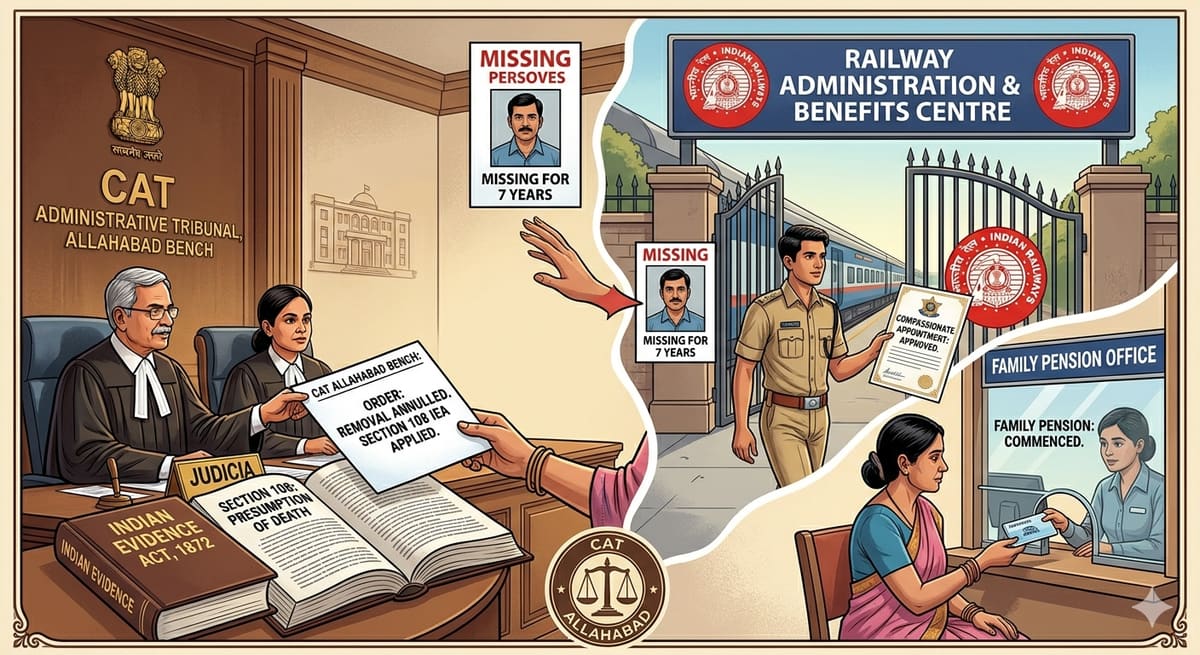
The Central Administrative Tribunal, Allahabad, has reaffirmed the primacy of a deceased employee’s widow in the hierarchy of beneficiaries for compassionate appointment, rejecting a recall application filed by the deceased’s sister who alleged procedural irregularities and fraudulent conduct. The judgment clarifies that statutory entitlements under railway service norms cannot be overridden by familial claims absent legal disqualification of the primary beneficiary.
Background & Facts
The Dispute
The dispute arose over the entitlement to a compassionate appointment following the death of Late Anoop Singh Rajpoot, a contractual fitter with the North Central Railway. The applicant, Smt. Pooja Rajpoot, his widow, sought appointment under the compassionate employment scheme after his alleged disappearance and presumed death. The respondent No. 3, Km. Sadhana Rajpoot, the deceased’s sister, contested this entitlement, alleging that the widow had fabricated the circumstances of death to secure the appointment.
Key Facts
- Late Anoop Singh Rajpoot was engaged on contractual basis as an Fitter with North Central Railway, Jhansi
- He completed a mandatory three-year training period, qualifying him for regular status under railway service norms
- On 18.10.2014, he was allegedly kidnapped from his residence in Jhansi by two unidentified persons
- The applicant, Smt. Pooja Rajpoot, lodged an FIR at Police Station Chirgaon on 23.12.2014 (Crime No. 450/2014) under Section 365 IPC
- A charge sheet was filed on 17.07.2015 under Sections 302, 201, 365 IPC and Sections 22/23 of the Prevention of Money Laundering Act
- A death certificate for Late Anoop Singh Rajpoot was issued on 18.10.2014, the same day of his disappearance
- The body was never recovered
- The applicant applied for compassionate appointment on the basis of the death certificate and was granted the appointment by the Railway authorities
- The respondent No. 3, Km. Sadhana Rajpoot, filed a separate application for compassionate appointment on behalf of her mother, the widow of Late Haripat Singh (father of deceased)
- The mother of the deceased had previously been granted compassionate appointment upon the death of her husband, Late Haripat Singh, and her right to further appointment ceased upon the son’s regularisation
Procedural History
- 18.10.2014: Alleged kidnapping of Late Anoop Singh Rajpoot
- 23.12.2014: FIR lodged by applicant at Police Station Chirgaon
- 17.07.2015: Charge sheet filed by police
- 2023: Original Application No. 457/2023 filed by applicant before CAT Allahabad seeking recognition of compassionate appointment
- 29.02.2024: CAT directed registry to issue notice to respondent No. 3 within 7 working days
- 01.03.2024: Notice dispatched to respondent No. 3 via registered post (Dispatch No. 453)
- 30.06.2025: CAT passed order granting compassionate appointment to applicant, directing Railway authorities to complete the process within three months
- 21.08.2025: High Court observed that notice to respondent No. 3 appeared defective and permitted her to file a recall application before CAT
- 25.08.2025: Respondent No. 3 filed Misc. Application No. 4626/2025 seeking recall of CAT’s order dated 30.06.2025
- 19.05.2026: CAT delivered judgment on the recall application
The Parties' Positions
Applicant (Smt. Pooja Rajpoot): Asserted her legal entitlement as the lawful widow of a deceased regular employee. Cited Section 27 of the General Clauses Act, 1897 and Section 114 of the Indian Evidence Act, 1872 to establish that notice was duly served via registered post, which was not returned. Denied all allegations of fraud, stating that the charge sheet implicates third parties, not her.
Respondent No. 3 (Km. Sadhana Rajpoot): Alleged that the applicant provided a false address to evade service of notice. Claimed the death certificate was forged. Asserted that the applicant absconded with Rs. 10 lakhs in jewellery and a motorbike on the eve of the incident. Argued that as the daughter of the deceased’s father, and given that the mother’s prior compassionate appointment had lapsed, she was entitled to the vacancy.
Relief Sought
The respondent No. 3 sought recall of the CAT’s order dated 30.06.2025 and a direction to the Railway authorities to grant compassionate appointment to her instead of the applicant. She also sought cancellation of the appointment granted to the applicant on grounds of fraud and procedural illegality.
The Legal Issue
The central question was whether the widow of a deceased railway employee retains primacy for compassionate appointment under R.B.E. No. 87/2007 over a sister, even when the sister alleges procedural defects in service of notice and substantive fraud in obtaining the appointment.
Arguments Presented
For the Appellant/Petitioner
The applicant relied on R.B.E. No. 87/2007 and settled jurisprudence that the widow is the first in line for compassionate appointment upon the death of a regular employee. She argued that the notice was duly served under Section 27 of the General Clauses Act, 1897, which creates a rebuttable presumption of service when sent by registered post to the correct address. The applicant submitted that the Tribunal’s order was based on the deceased’s regular status after training, and that the sister’s claim was secondary and legally untenable. She further cited Section 114 of the Indian Evidence Act to affirm the presumption of regular postal delivery.
For the Respondent/State
The respondent No. 3 contended that the Tribunal’s order was ex parte and vitiated by non-service of notice. She argued that the applicant’s conduct - allegedly absconding with valuables and producing a forged death certificate - disqualified her from entitlement. She further claimed that since the mother (her own mother) had previously received compassionate appointment upon the death of her husband, and that appointment had ceased upon the son’s regularisation, the vacancy should now be available to the daughter as the next eligible dependent.
The Court's Analysis
The Tribunal examined the competing claims under the framework of R.B.E. No. 87/2007, which governs compassionate appointments in the railways. It held that the widow’s right is primary and statutory, and cannot be displaced by a sibling unless the widow is legally disqualified or deceased.
"It is settled that wife has first right for compassionate appointment in case of death of her husband."
The Tribunal rejected the allegation of fraud as unsubstantiated. While acknowledging the High Court’s observation regarding notice, it noted that the registry had dispatched notice via registered post on 01.03.2024 (Dispatch No. 453), and no return receipt was received. Under Section 27 of the General Clauses Act, 1897, this created a presumption of service, which the respondent failed to rebut with evidence of non-receipt.
The Tribunal further clarified that the mother’s prior compassionate appointment, granted upon the death of her husband, had extinguished her claim upon the son’s subsequent regularisation. The sister, therefore, had no independent claim under the scheme. The Tribunal observed:
"Interpretation regarding right of sister in pursuance to R.B.E. No. 87/2007 for subsequent opportunity to nominee has no significance and the widow of Late Haripat Singh and mother of respondent No. 3 cannot recommend for job under compassionate appointment quota and for subsequent appointment."
The Tribunal concluded that the applicant’s entitlement was not contingent on the recovery of the body or the outcome of the criminal trial, but on the fact of death and regular status. The allegations of fraud, while serious, were not adjudicated by any competent authority and could not override the statutory hierarchy.
The Verdict
The recall application was dismissed. The Tribunal upheld its order dated 30.06.2025 granting compassionate appointment to Smt. Pooja Rajpoot as the widow of Late Anoop Singh Rajpoot. The appointment remains valid, and the Railway authorities are directed to complete the formalities within the stipulated three-month period. No costs were awarded.
What This Means For Similar Cases
Widow’s Priority Is Statutorily Absolute
- Practitioners must treat the widow as the first and primary beneficiary under R.B.E. No. 87/2007 unless she is legally disqualified (e.g., divorce, remarriage, or proven fraud by a court of law)
- Siblings, parents, or other dependents cannot claim compassionate appointment if the widow is alive and not disqualified
- Any attempt to bypass the widow’s claim on grounds of alleged misconduct must be substantiated by a criminal conviction or civil adjudication
Service by Registered Post Creates Presumption of Validity
- Service via registered post, with no return receipt, satisfies the requirement of due process under Section 27 of the General Clauses Act, 1897
- Tribunals and courts will presume service unless the recipient provides credible evidence of non-receipt (e.g., postal return slips, affidavits from post office)
- Allegations of wrong address must be supported by documentary proof of incorrectness at the time of dispatch
Fraud Allegations Require Independent Adjudication
- Unproven allegations of forgery or conspiracy cannot be used to set aside administrative orders
- The burden lies on the challenger to initiate criminal proceedings or file a separate civil suit for cancellation
- Administrative tribunals are not forums for adjudicating criminal allegations unless formally referred