The Himachal Pradesh High Court has reaffirmed the limited scope of second appeals under Section 100 of the Code of Civil Procedure, holding that appellate courts cannot interfere with concurrent findings of fact regarding the execution of a Will unless those findings are perverse or involve a substantial question of law. This judgment reinforces the principle that fact-finding courts are best positioned to assess witness credibility and documentary evidence in testamentary disputes.
Background & Facts
The Dispute
The plaintiff, Laxmi Dutt, filed a civil suit seeking a declaration that a Will dated 15.01.1994, propounded by the defendant, was forged and null and void, and that a subsequent Will dated 06.07.1997, executed by the deceased Bhadar Singh, was his last valid testament. The suit also sought a permanent prohibitory injunction to restrain the defendants from interfering with the suit property, comprising Khewat No. 109, Khatauni Nos. 127-133, bearing Khasra numbers 13, measuring 7-15-11 big has, located in Muhal Bhadyal, Illaqa Balh, Tehsil Sadar, District Mandi, H.P. The plaintiff claimed a 1/4th share in this property, which he alleged was coparcenary in nature. The defendant contested the validity of the plaintiff’s Will and asserted that the 1994 Will was genuine and that the 1997 Will was fabricated.
Key Facts
- Bhadar Singh died on 20.02.1999, leaving behind two legal heirs: the plaintiff (his son) and the defendant (his grandson).
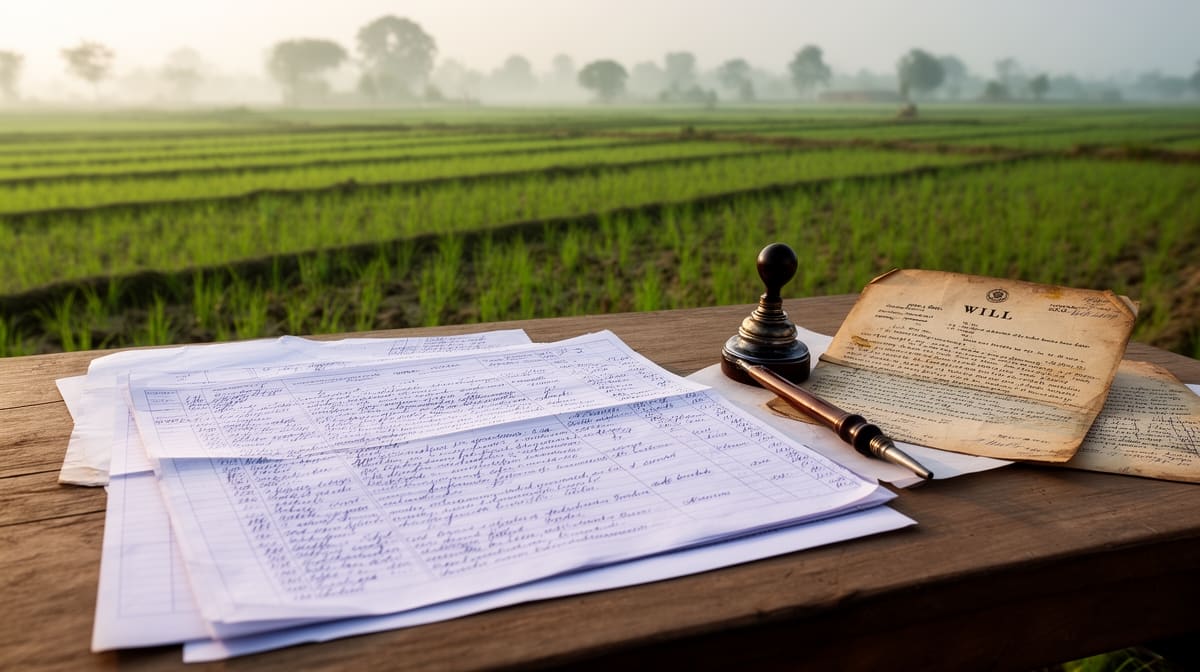
- The plaintiff produced a Will dated 06.07.1997 (Ex.PW-2/A), allegedly executed by Bhadar Singh, bequeathing the suit property equally to the plaintiff and the defendant.
- The defendant produced a Will dated 15.01.1994 (Ex.DW-3/A), bequeathing the entire suit property to himself.
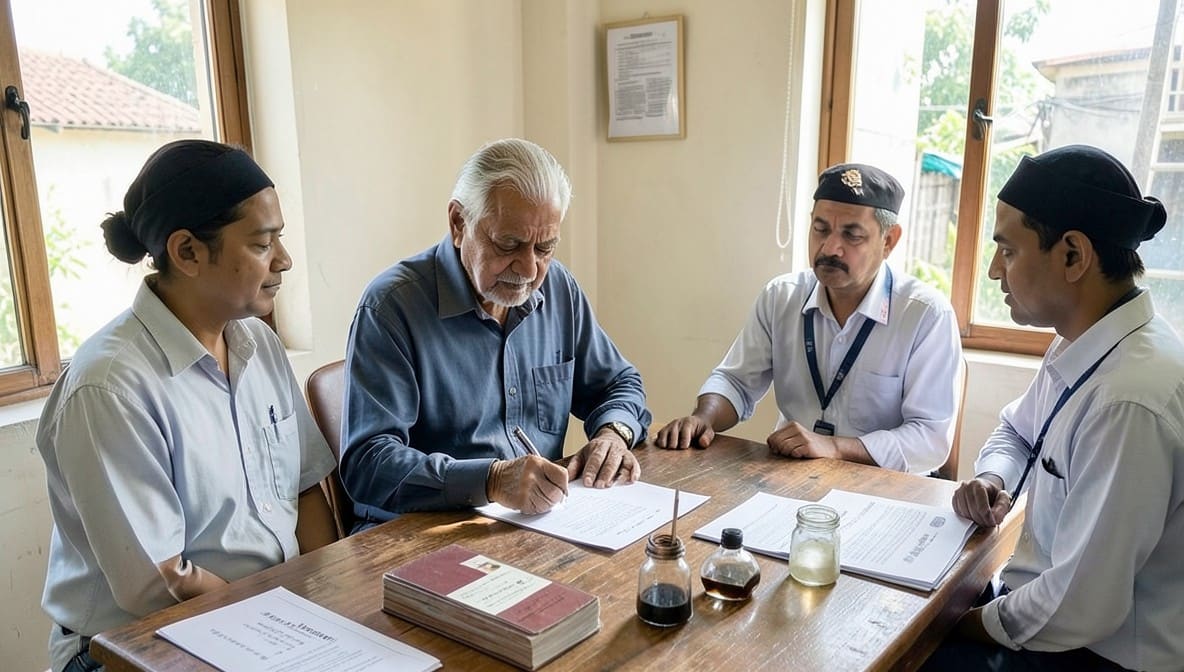
- The 1997 Will was scribed by Yadvinder Sharma (PW-3) and attested by Uttam Singh Thakur (PW-2) and Khinu Ram (who affixed his thumb impression).
- The defendant claimed that Bhadar Singh had gifted the property in Mauza Paunta to the plaintiff during his lifetime, and that the plaintiff and his family neglected Bhadar Singh, while the defendant and his family cared for him.
- The defendant’s version of the Paunta property gift was not supported by any documentary evidence or Jamabandi records.
- Nand Kishore (DW-5), a witness for the defendant, admitted in cross-examination that all of Bhadar Singh’s property was located in Bhadyal, contradicting the defendant’s claim of a prior gift.
- The scribe and one attesting witness (Uttam Singh Thakur) were known to Rakesh Wallia, the plaintiff’s son, who had previously practiced law with Uttam Singh Thakur.
Procedural History
- 30.09.2009: Trial Court (Civil Judge, Senior Division, Mandi) dismissed the plaintiff’s suit, holding that the 1997 Will was shrouded in suspicious circumstances and that the 1994 Will was genuine.
- 24.03.2012: First Appellate Court (Additional District Judge, Fast Track Court, Mandi) reversed the Trial Court’s findings, holding that the 1997 Will was duly executed and valid, and decreed the plaintiff’s suit.
- 03.07.2012: The present Second Appeal (RSA No. 339 of 2012) was admitted by the High Court on two substantial questions of law.
- 12.05.2026: Judgment delivered by the High Court.
The Parties' Positions
Plaintiff (Appellant in Appeal): Argued that the 1997 Will was validly executed, with proper attestation and no suspicious circumstances. Contended that the Trial Court erred in rejecting the Will based on alleged associations between witnesses and the plaintiff’s family.
Defendant (Respondent in Appeal): Argued that the 1997 Will was forged, that the witnesses were interested parties, and that the 1994 Will was genuine. Asserted that the plaintiff had been gifted property in Paunta and had abandoned Bhadar Singh.
Relief Sought
The plaintiff sought a declaration that the 1994 Will was forged and void, that the 1997 Will was valid, and a permanent injunction against interference with the suit property. The defendant sought dismissal of the suit.
The Legal Issue
Whether the High Court, in a second appeal under Section 100 of the Code of Civil Procedure, can interfere with the concurrent findings of fact made by the Trial Court and the First Appellate Court regarding the due execution and validity of a Will, in the absence of perversity or a substantial question of law.
Arguments Presented
For the Appellant
The appellant, through Senior Advocate Bhupinder Gupta, submitted that the First Appellate Court erred in reversing the Trial Court’s finding that the 1997 Will was shrouded in suspicious circumstances. He argued that the scribe and attesting witnesses were closely associated with the plaintiff’s family, creating a conflict of interest. He relied on Sarwan v. Ashok Kumar (AIR 2007 NOC 607) to contend that such associations render a Will suspect. He further argued that the First Appellate Court failed to examine the 1994 Will’s validity before setting aside the Trial Court’s order.
For the Respondent
The respondent, through Advocate G.R. Palsra, submitted that the First Appellate Court correctly held that no suspicious circumstances were pleaded or proved. He emphasized that the witnesses’ association with the plaintiff’s son was not concealed and was common in testamentary matters. He cited Indu Bala Bose v. Manindra Chandra Bose (1982) 1 SCC 20 and Prem Singh v. Padam Singh (1999 SCC OnLine HP 40) to show that known persons are routinely called as witnesses. He further argued that the 1997 Will was equitable in its disposition, benefiting both parties equally, and that the defendant’s claim of a prior gift of Paunta property was unproven.
The Court's Analysis
The Court undertook a comprehensive review of the legal principles governing the proof of Wills and the scope of second appeals under Section 100 of the CPC. It began by affirming the requirements for proving a Will under Section 63 of the Indian Succession Act and Section 68 of the Indian Evidence Act: execution by the testator, attestation by two witnesses, and examination of at least one attesting witness.
"The test of judicial conscience has evolved for dealing with those cases where the execution of the will is surrounded by suspicious circumstances. It requires consideration of factors such as awareness of the testator as to the content as well as the consequences, nature and effect of the dispositions in the will; a sound, certain and disposing state of mind and memory of the testator at the time of execution; the testator executed the will while acting on his own free will."
The Court noted that while suspicious circumstances may shift the burden to the propounder to dispel doubt, such circumstances must be pleaded and proved. The First Appellate Court correctly held that no such circumstances were pleaded by the defendant, and the Trial Court’s reliance on the association of witnesses was misplaced.
The Court then turned to the central issue: whether the High Court could interfere with the concurrent findings of the two lower courts. It cited Kashibai v. Parwatibai (1995) 6 SCC 213, Rur Singh v. Bachan Kaur (2009) 11 SCC 1, and C. Doddanarayana Reddy v. C. Jayarama Reddy (2020) 4 SCC 659 to emphasize that Section 100 CPC does not permit reappreciation of evidence in second appeals. The Court observed:
"The High Court, while exercising its jurisdiction under Section 100 of the Code of Civil Procedure, exercises a limited jurisdiction. It may interfere with a finding of fact arrived at by the trial court and/or the first appellate court only in the event that a substantial question of law arises for its consideration."
The Court found that the First Appellate Court had independently reappraised the evidence, addressed the Trial Court’s reasoning, and provided cogent reasons for its conclusion. There was no perversity, no illegality, and no violation of law. The mere fact that another view was possible did not justify interference.
The Court also dismissed the plaintiff’s application for amendment of the plaint to include additional property details, holding that the proviso to Order VI Rule 17 requires due diligence, which was absent. The plaintiff had access to the details at the time of filing and failed to act for over 15 years.
The Verdict
The appeal was dismissed. The judgment and decree of the First Appellate Court dated 24.03.2012 were upheld. The plaintiff’s suit was decreed, recognizing the Will dated 06.07.1997 as valid and binding. The application for amendment of the plaint was dismissed. The record of the lower courts was directed to be returned along with a copy of this judgment.
What This Means For Similar Cases
Concurrent Findings Are Binding in Second Appeals
- Practitioners must recognize that second appeals under Section 100 CPC are not platforms for reappreciating evidence.
- A finding of fact by two lower courts cannot be disturbed merely because the High Court might have reached a different conclusion.
- Only perversity, illegality, or a substantial question of law permits interference.
Suspicious Circumstances Must Be Plead and Proved
- Allegations of suspicious circumstances (e.g., witness bias, unequal disposition) must be specifically pleaded in written statements.
- Courts cannot raise or infer suspicious circumstances sua sponte without a pleading.
- Associations between witnesses and beneficiaries are not inherently suspicious, as held in Indu Bala Bose and Prem Singh.
Amendment of Pleadings After Trial Is Disfavored
- Applications for amendment under Order VI Rule 17 must demonstrate due diligence.
- Delay in seeking amendment, especially after conclusion of evidence and judgment, will be fatal.
- Inadvertence or ignorance of counsel does not constitute due diligence.