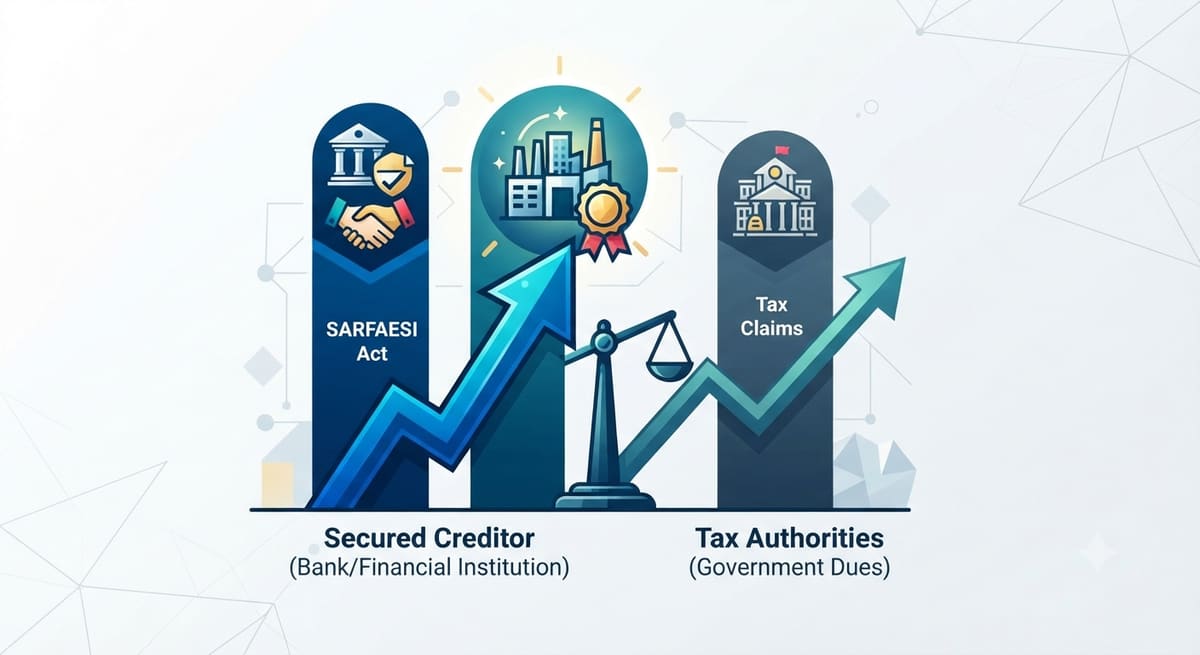
The Bombay High Court has affirmed that a secured creditor with prior CERSAI registration holds superior rights over statutory dues such as Central Goods and Services Tax, even where the property is sold through private treaty after multiple failed auctions. This ruling reinforces the statutory priority framework under the Securitisation and Reconstruction of Financial Assets and Enforcement of Security Interest Act, 2002, and clarifies the limits of tax authorities' claims against encumbered assets.
Background & Facts
The Dispute
The petitioner, TJSB Sahakari Bank Limited, is a secured creditor that extended loans against three properties, including Gat No.1537 in village Chikhali, Pimpri Chinchwad, Dist. Pune. The bank registered its security interest with the Central Registry of Securitisation Asset Reconstruction and Security Interest of India (CERSAI) on 18 December 2012. Subsequently, the borrower defaulted, prompting the bank to initiate recovery proceedings under the Securitisation and Reconstruction of Financial Assets and Enforcement of Security Interest Act, 2002. Despite six failed auction attempts, no bidder emerged. The bank then sold the properties, including Gat No.1537, by private treaty under a Memorandum of Understanding dated 26 November 2020. Respondent No.1, the Assistant Commissioner of CGST, recorded a tax charge on the property in the revenue record (7/12 extract) based on outstanding GST dues, despite the bank’s prior CERSAI registration.
Key Facts
- The bank’s security interest was registered with CERSAI on 18.12.2012
- Six public auction attempts for the properties were conducted between 2016 and 2020, all of which failed due to lack of bidders
- The Memorandum of Understanding (MoU) for private treaty sale was executed on 26.11.2020
- The CGST department issued a notice regarding its dues on 21.02.2017
- The tax charge was recorded in the revenue record (Mutation Entry No.28746) after the bank’s CERSAI registration and before the private sale
- The bank filed this writ petition to remove the tax charge and prevent interference with the MoU sale
Procedural History
- 21.02.2017: CGST Department issued notice of tax dues and recorded charge on property
- 26.11.2020: Petitioner sold property via private treaty under MoU after six failed auctions
- 16.12.2025: Division Bench directed petitioner to file additional affidavit detailing auction process and valuation
- 20.12.2025: Additional affidavit and supporting documents filed, including auction notices and valuation reports
- 10.04.2026: Writ Petition No.1123 of 2025 heard and decided by Division Bench
Relief Sought
The petitioner sought: (1) quashing of the tax charge recorded in Mutation Entry No.28746; (2) restraint on Respondent No.1 from interfering with the disposal of the property under the MoU; and (3) direction to the revenue authority to remove the encumbrance.
The Legal Issue
The central question was whether a secured creditor’s priority under the Securitisation and Reconstruction of Financial Assets and Enforcement of Security Interest Act, 2002, established by prior CERSAI registration, overrides the claim of the Central Government for GST dues under the CGST Act, 2017, particularly when the secured asset is sold via private treaty after failed auctions.
Arguments Presented
For the Petitioner
The petitioner relied on the Full Bench judgment in Jalgaon Janta Sahakari Bank Ltd. v. Joint Commissioner of Sales Tax (2022 SCC OnLine Bom 1767), which held that the dues of a secured creditor with prior CERSAI registration take precedence over all other dues, including taxes, cesses, and revenues payable to the Central or State Government. It was submitted that the bank’s CERSAI registration on 18.12.2012 predates the CGST notice of 21.02.2017, thereby establishing a clear priority. The bank further argued that the private treaty sale was lawful under Section 13 of the Securitisation Act, triggered only after six failed auction attempts, and that the terms of the auction notices were not designed to deter bidders.
For the Respondent
The respondent contended that the private treaty sale under the MoU appeared suspicious, suggesting the bank may have structured auction conditions to ensure no bids were received, thereby enabling a below-market sale. It was argued that the valuation of the property was significantly lower than market rates, potentially prejudicing the revenue interest. The respondent urged the Court to consider the fairness of the sale process and to allow the tax charge to remain pending further inquiry.
The Court's Analysis
The Court began by affirming the binding precedent set by the Full Bench in Jalgaon Janta Sahakari Bank Ltd. In paragraph 85 of that judgment, it was categorically held that the dues of a secured creditor with prior CERSAI registration shall have priority over all other dues, including those of the Central Government. The Court noted that the bank’s registration on 18.12.2012 was unquestionably prior to the CGST department’s notice on 21.02.2017, placing this case squarely within the ambit of the Full Bench ruling.
"The dues of the secured creditor shall have priority over all other dues including revenues, taxes, cesses and other rates payable to the Central Government, or State Government or local authority."
The Court further examined the petitioner’s compliance with the Securitisation Act. It noted that six auction attempts had been conducted, as mandated by Section 13(2), and that no bidder appeared. The Court accepted the affidavit filed on 20.12.2025, which detailed the auction notices and valuation reports, and found no evidence of mala fide intent or manipulation of terms to suppress bidding. The Court emphasized that the respondent, as a tax authority, was not an aggrieved auction participant and had no standing to challenge the sale process in this forum.
The Court also noted that a coordinate Division Bench had previously granted similar relief in respect of another property under the same MoU, reinforcing consistency in the application of the law. The Court concluded that the CGST charge recorded in the revenue record was legally unsustainable in light of the bank’s prior perfected security interest.
The Verdict
The writ petition was allowed. The Court quashed the encumbrance/charge recorded in Mutation Entry No.28746 in respect of Gat No.1537, village Chikhali, Pimpri Chinchwad, Dist. Pune. The concerned revenue authority was directed to remove the charge within four weeks from the date of judgment. The Court also granted a permanent restraint on Respondent No.1 from interfering with the disposal of the property under the MoU dated 26.11.2020.
What This Means For Similar Cases
Secured Creditor Priority Is Absolute After CERSAI Registration
- Practitioners must now treat CERSAI registration date as the decisive factor in determining priority over tax claims, regardless of the nature of the tax (GST, VAT, stamp duty, etc.)
- Tax authorities cannot record charges or initiate recovery proceedings against properties where a prior CERSAI-registered security interest exists
Private Treaty Sales Are Lawful After Six Failed Auctions
- Banks and financial institutions may proceed with private treaty sales under Section 13 of the Securitisation Act without fear of tax claims invalidating the sale, provided the six-auction requirement is met
- The burden shifts to the tax authority to prove mala fide intent in the auction process - mere suspicion or low valuation is insufficient
Revenue Records Cannot Override CERSAI
- Entries in revenue records (7/12 extracts, mutation entries) have no legal force to override a perfected security interest under the Securitisation Act
- Banks must proactively file writ petitions to quash erroneous tax charges, as revenue authorities rarely act on their own to remove them