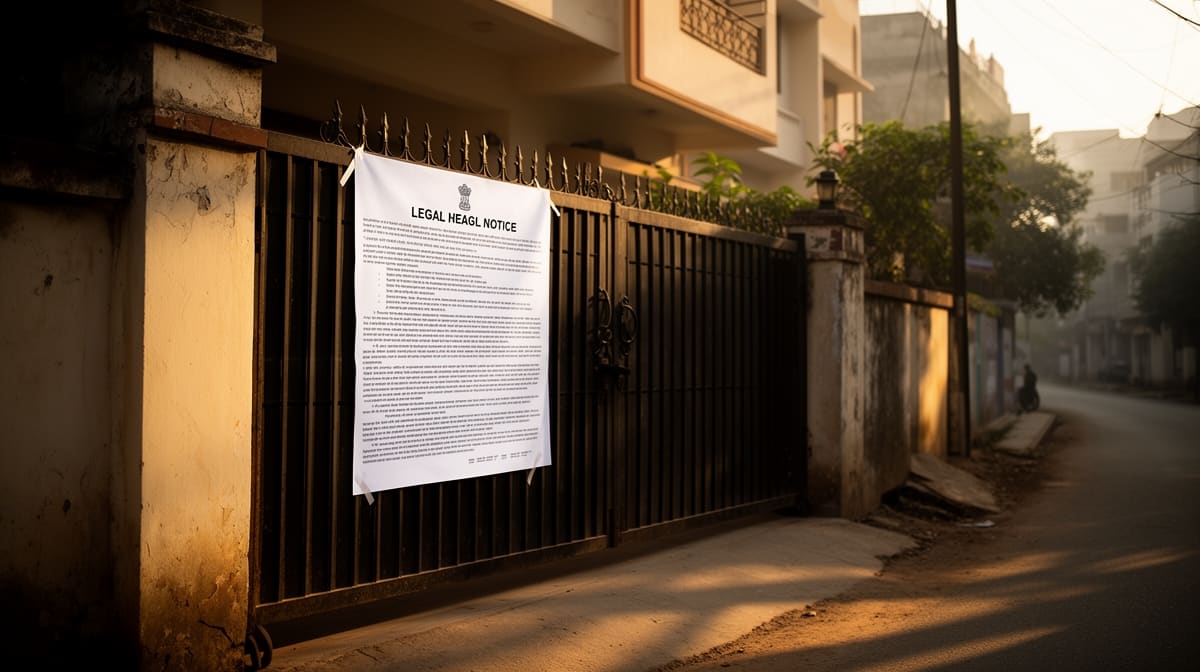
The National Consumer Disputes Redressal Commission has clarified that even in cases of clear loan default, financiers must adhere to due process before repossessing a vehicle. This judgment reinforces that contractual rights cannot override procedural fairness under the Consumer Protection Act, setting a critical precedent for financial institutions across India.
Background & Facts
The Dispute
The dispute arose from the repossession of a Toyota Innova G-3 vehicle financed by ICICI Bank Limited. The respondent, Sumeet Kaeley, purchased the vehicle on 27.10.2005 for Rs.8,94,745.13, paying Rs.94,745.13 as margin money and availing a loan of Rs.8,00,000 from ICICI Bank under Loan Agreement No. LADEL00004936273. The loan was repayable in 60 equated monthly instalments (EMIs) of Rs.16,584 at an interest rate of 9.27% per annum, with one EMI paid in advance at disbursement.
Key Facts
- The vehicle was registered with RTO Delhi under registration number DL-4C-9131.
- The vehicle was insured for the period 28.10.2006 to 27.10.2007.
- The respondent paid EMIs regularly until October 2006.
- The respondent defaulted on three consecutive EMIs due to a medical emergency requiring travel abroad.
- On 21.12.2006, ICICI Bank, through recovery agents, repossessed the vehicle from the respondent’s residence.
- The respondent immediately lodged a police complaint on 21.12.2006 alleging forcible repossession and threats by bank agents.
- On 22.12.2006, the respondent wrote to the Bank requesting release of the vehicle upon payment of arrears; no response was received.
- The Bank claimed to have issued demand notices on 11.11.2006 and 24.11.2006, a loan recall notice on 07.12.2006, and a pre-sale notice on 22.12.2006.
- The Bank asserted that the repossession was peaceful and in accordance with the loan agreement and legal provisions.
- The Bank later auctioned the vehicle and adjusted the proceeds against the outstanding loan.
- The respondent was never provided with copies of any notices, nor was proof of service established.
Procedural History
- 27.10.2005: Vehicle purchased by respondent with bank financing.
- October 2006: Last regular EMI paid by respondent.
- 21.12.2006: Vehicle repossessed by ICICI Bank; police complaint filed same day.
- 22.12.2006: Respondent’s written request to Bank for vehicle release; no reply.
- 30.05.2011: District Consumer Disputes Redressal Commission (Central), Kashmere Gate, Delhi, allowed the complaint (CC No.754/2008), directing the Bank to pay insured value of vehicle (Rs.6,76,210) with 9% interest from 21.12.2006, compensation of Rs.25,000, litigation costs of Rs.5,000, and prohibiting recovery of balance loan amount.
- 23.10.2017: State Consumer Disputes Redressal Commission, Delhi, dismissed ICICI Bank’s appeal (FA No.287/2011), affirming the District Forum’s order.
- 01.06.2026: Revision Petition reserved.
- 16.06.2026: Judgment pronounced by National Consumer Disputes Redressal Commission.
Relief Sought
The respondent sought: (1) refund of all EMIs paid (Rs.1,99,008), (2) insured value of vehicle (Rs.6,76,210), (3) margin money (Rs.94,750), (4) insurance premium (Rs.21,813), totaling Rs.9,91,781 with 12% annual compound interest from 21.12.2006, and (5) compensation of Rs.7,50,000 for mental agony, harassment, and litigation expenses.
The Legal Issue
The central question was whether a financier’s right to repossess a hypothecated vehicle upon default absolves it of the obligation to follow due process, including prior notice, and whether failure to do so constitutes deficiency in service under the Consumer Protection Act, 1986.
Arguments Presented
For the Appellant/Petitioner (ICICI Bank)
ICICI Bank contended that the respondent had defaulted on three consecutive EMIs, triggering its contractual right to repossess under the loan agreement. It relied on judicial precedents including Orix Auto Finance v. Jagminder Singh, Amarjit Singh v. ICICI Bank, and M/s Magma Fincorp Ltd. v. Rajesh Kumar Tiwari to assert that financiers are legal owners of the vehicle and may repossess upon default. It argued that notices were issued on 11.11.2006, 24.11.2006, and 07.12.2006, and that a pre-sale notice dated 22.12.2006 was sent. The Bank further claimed that police were informed, and that the repossession was peaceful. It contended that the lower fora erred in ignoring admitted defaults and in awarding excessive relief without balancing equities.
For the Respondent/Complainant (Sumeet Kaeley)
The respondent argued that despite his temporary default, the Bank acted illegally by repossessing the vehicle without serving any notice, using recovery agents who threatened his family. He emphasized that no proof of notice service was produced before the District Forum or State Commission. He relied on City Corp. Mart Finance Ltd. v. S. Vijaya Laxmi and Magma Fincorp Ltd. v. Rajesh Kumar Tiwari to assert that repossession without notice constitutes deficiency in service. He highlighted that the Bank’s failure to produce notices or evidence of delivery rendered its claims unsubstantiated, and that the lower fora correctly applied settled law.
The Court's Analysis
The National Commission acknowledged that the respondent had defaulted on three EMIs, a fact admitted by both parties. However, it emphasized that the right to repossess, even as a secured creditor, is not absolute and must be exercised in accordance with due process. The Court noted that the Bank failed to produce any evidence - such as postal receipts, courier records, or affidavits - demonstrating that the notices were dispatched or received by the respondent.
"The requirement of issue of notice before repossession is not only embedded within the contractual arrangement between the parties but has also been consistently recognized in judicial precedents governing repossession of financed vehicles."
The Court relied on Magma Fincorp Ltd. v. Rajesh Kumar Tiwari (2020), which held that while financiers may repossess upon default, they cannot do so by "physical violence, assault and/or criminal intimidation" or by engaging "gangsters, goons and musclemen." The Court further cited the Delhi High Court’s guidelines in Dr. Amitabh Varma v. Commissioner of Police and the Patna High Court’s 2023 judgment in Dhananjay v. Union of India, which explicitly mandated that repossession must follow legal procedure and cannot be unilateral.
The Commission observed that the lower fora had erred in completely denying the Bank’s right to recover the outstanding loan amount, despite the respondent’s admitted default. It held that while the Bank’s failure to serve notice constituted deficiency in service and warranted compensation, the respondent’s persistent default could not be ignored. The Court rejected the award of the full insured value of the vehicle as excessive, noting that the respondent had already paid Rs.94,745.13 as margin money and had benefited from the use of the vehicle for over a year.
"The failure of the OP Bank to establish delivery of repossession notice verges to violation of the prescribed procedure. Although the financier may have a right to repossess a hypothecated vehicle upon default, such right can only be exercised by following due process of law and not by unilateral action."
The Court concluded that the appropriate remedy was to balance the equities: the Bank must compensate for procedural illegality, but the respondent must bear the consequences of his default.
The Verdict
The Revision Petition was partly allowed. The National Commission set aside the orders of the District and State Commissions and modified the relief. ICICI Bank is directed to pay the respondent a consolidated compensation of Rs.2,50,000 for deficiency in service and mental harassment. This amount shall be paid within one month from the date of this order. If unpaid, it shall carry interest at 12% per annum from the date of default until realization. The Bank retains the right to recover the outstanding loan balance, subject to lawful recovery procedures under the SARFAESI Act, 2002. No costs are awarded. All pending applications are disposed of.
What This Means For Similar Cases
Due Process Is Non-Negotiable
- Practitioners must now argue that any repossession without proof of notice - whether by post, courier, or personal service - is per se deficient under consumer law.
- Financial institutions must maintain auditable records of notice issuance and delivery; mere assertions in pleadings are insufficient.
- Courts will not presume service; the burden of proof lies squarely on the financier.
Compensation Must Be Proportionate
- Awards of full vehicle value or complete waiver of loan balance are no longer automatic upon illegal repossession.
- Tribunals must now balance the financier’s contractual rights against the consumer’s right to procedural fairness.
- Compensation should reflect the harm caused by procedural violation, not the total value of the asset.
SARFAESI Compliance Is Implicit
- Even before invoking SARFAESI, financiers must comply with basic consumer law obligations.
- This judgment reinforces that consumer forums retain jurisdiction over repossession disputes, regardless of whether SARFAESI applies.
- Banks must train recovery agents to avoid any conduct resembling intimidation or force, as such actions may trigger criminal liability under IPC and consumer law.