The Madhya Pradesh High Court has reaffirmed that financial institutions cannot bypass statutory safeguards under the SARFAESI Act by resorting to coercive measures without procedural compliance, even after rejecting settlement proposals. This judgment underscores the necessity of adherence to due process in debt recovery actions affecting essential healthcare infrastructure.
Background & Facts
The Dispute
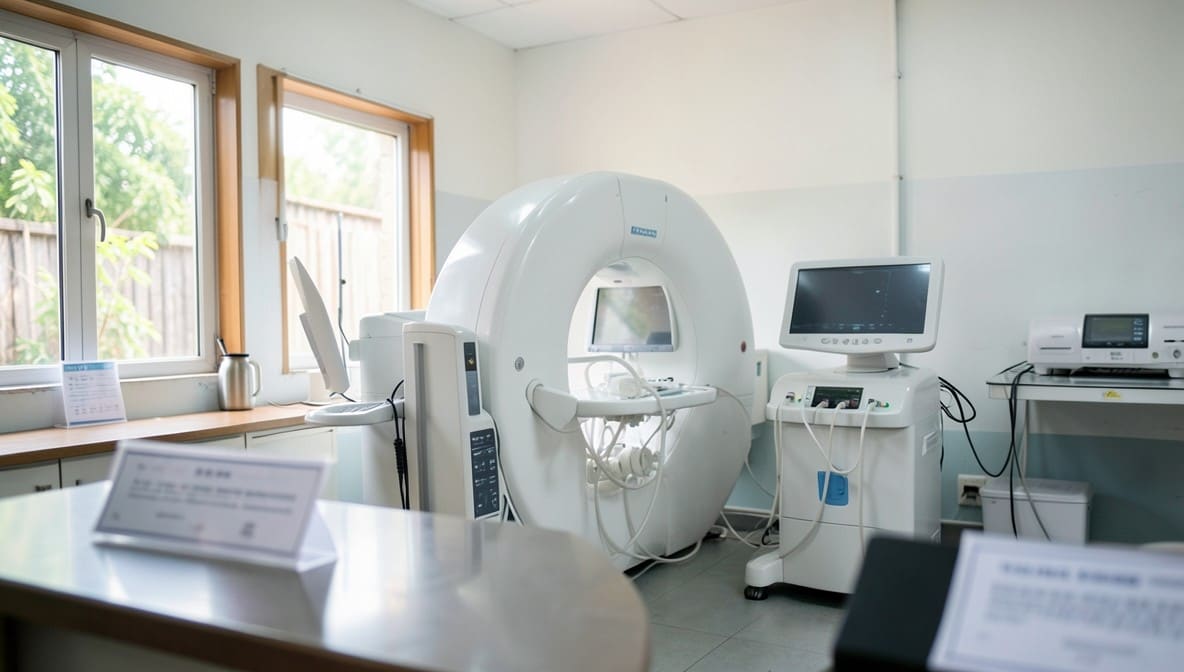
The petitioners, M/s Accurate Diagnostic Centre operated by Mrs. Jyoti Yadav, run a diagnostic facility within Sanjeevani Hospital, Village Siroliya, District Dewas. The centre is equipped with advanced medical diagnostic machinery, financed through a term loan extended by the Central Bank of India. The loan account was initially classified as a Non Performing Asset (NPA) on 18.02.2026, triggering the bank’s intent to enforce security under Section 13(2) of the Securitisation and Reconstruction of Financial Assets and Enforcement of Security Interest Act, 2002 (SARFAESI Act).
Key Facts
- The diagnostic centre provides critical healthcare services to a rural population, with equipment subject to regulation under the Clinical Establishments (Registration and Regulation) Act, 2010.
- On 19.02.2026, the bank issued a notice under Section 13(2) of the SARFAESI Act, indicating intention to take possession of the secured assets.
- On 20.02.2026, the bank internally withdrew the Section 13(2) notice, but did not communicate this withdrawal to the petitioners until 13.03.2026 - a delay of approximately 20 days.
- The bank’s internal records reflected conflicting NPA dates: 18.02.2026 in the formal notice, but 09.02.2026 in internal documentation.
- On 06.03.2026, this Court, in W.P. No. 8242/2026, directed the bank to consider the petitioners’ One Time Settlement (OTS) proposal within 10 days and maintain status quo over the property.
- On 09.03.2026, the bank rejected the OTS proposal (Annexure P/6) in a mechanical manner without substantive evaluation.
- On the same day (09.03.2026), the bank issued a fresh seizure notice without initiating fresh proceedings under Section 13(2), and threatened to involve local authorities.
- The bank claimed its officers merely visited the site and took possession of the deed of hypothecation, but no formal seizure or possession notice was issued under Section 13(4).
Procedural History
- 18.02.2026: Loan account classified as NPA by the bank.
- 19.02.2026: Section 13(2) notice issued by the bank.
- 20.02.2026: Bank internally withdrew the Section 13(2) notice.
- 13.03.2026: Petitioners received the withdrawn notice (delayed by 20 days).
- 06.03.2026: High Court ordered bank to consider OTS proposal within 10 days and maintain status quo (in WP No. 8242/2026).
- 09.03.2026: Bank rejected OTS proposal without reasoned evaluation; issued fresh seizure notice without fresh Section 13(2) proceedings.
- 10.03.2026: Writ Petition No. 11039/2026 filed before the High Court seeking stay on coercive action.
- 31.03.2026: Judgment delivered by the Division Bench.
Relief Sought
The petitioners sought immediate stay on the bank’s coercive actions, quashing of the seizure notice dated 09.03.2026, and direction to the bank to comply with statutory procedure under the SARFAESI Act before any enforcement. They also sought continuation of status quo to prevent disruption of essential healthcare services.
The Legal Issue
The central question was whether a bank can initiate coercive enforcement under the SARFAESI Act without following the mandatory procedural requirements of Section 13(2) and Section 13(4), particularly after a court has directed maintenance of status quo and rejection of an OTS proposal without substantive consideration.
Arguments Presented
For the Petitioner
Counsel argued that the bank’s conduct was arbitrary and violative of natural justice. The delayed disclosure of the withdrawn Section 13(2) notice, conflicting NPA dates, and issuance of a fresh seizure notice without initiating fresh proceedings under Section 13(2) amounted to abuse of process. The bank’s mechanical rejection of the OTS proposal, despite the Court’s specific direction to consider it, demonstrated bad faith. The diagnostic equipment forms part of a public healthcare facility, and any seizure would violate Article 21 rights to health. Reliance was placed on Mardia Chemicals Ltd. v. Union of India and Saraswati Co-operative Bank Ltd. v. State of Haryana to emphasize procedural fairness.
For the Respondent
The bank’s counsel contended that the OTS proposal was legally unsustainable and that the bank was merely exercising its statutory right under SARFAESI Act. The visit to the premises was described as a routine inspection, and the taking of the hypothecation deed was not tantamount to possession. The bank argued that the Court’s earlier order did not preclude it from rejecting the OTS if it found the proposal inadequate.
The Court's Analysis
The Court observed that the SARFAESI Act is a self-contained code that mandates strict adherence to procedural safeguards. The bank’s withdrawal of the Section 13(2) notice on 20.02.2026, followed by its delayed communication to the petitioners until 13.03.2026, deprived them of the opportunity to respond meaningfully. The issuance of a fresh seizure notice on 09.03.2026 - without any fresh notice under Section 13(2) - was held to be a clear violation of statutory procedure.
"The bank cannot circumvent the mandatory requirements of the SARFAESI Act by relying on an expired or withdrawn notice, especially after a court has directed it to consider a settlement proposal and maintain status quo."
The Court further noted that the bank’s internal inconsistency in NPA dates (18.02.2026 vs. 09.02.2026) undermined the credibility of its claim. The mechanical rejection of the OTS proposal, without any evaluation of financial viability or negotiation, was deemed contrary to the spirit of the Court’s earlier order dated 06.03.2026. The Court emphasized that the diagnostic equipment is not merely collateral - it is integral to a public healthcare service, and any coercive action risks violating the right to health under Article 21 of the Constitution.
The Court rejected the bank’s argument that a site visit and taking of the hypothecation deed constituted lawful possession. Under Section 13(4), possession can only be taken after a valid notice under Section 13(2) and after the expiry of the 60-day period, with a formal possession notice issued. No such procedure was followed.
The Verdict
The petition succeeded. The Court directed the Central Bank of India to proceed against the petitioners only in strict accordance with the procedural requirements of the SARFAESI Act. Until such lawful action is taken, the status quo regarding the diagnostic centre and its equipment shall be maintained. The bank is prohibited from taking possession, seizing equipment, or involving local authorities without issuing a fresh notice under Section 13(2), observing the 60-day period, and issuing a formal possession notice under Section 13(4). The bank shall not interfere with the functioning of the diagnostic facility.
What This Means For Similar Cases
Procedural Compliance Is Non-Negotiable
- Banks cannot rely on withdrawn or expired SARFAESI notices to initiate enforcement.
- Any fresh action requires a fresh notice under Section 13(2), with full compliance to the 60-day timeline.
- Internal withdrawals must be communicated to borrowers without delay.
OTS Rejection Must Be Reasoned and Timely
- Rejection of settlement proposals must be based on substantive evaluation, not mechanical refusal.
- Courts may treat mechanical rejection as bad faith, especially after a judicial direction to consider the proposal.
- Banks must document reasons for rejection and provide opportunity for rebuttal.
Healthcare Infrastructure Receives Enhanced Protection
- Medical equipment used in public healthcare facilities is treated as essential infrastructure.
- Courts will intervene to prevent disruption of healthcare services, even in debt recovery cases.
- Enforcement actions against such assets will be subject to heightened scrutiny under Article 21.