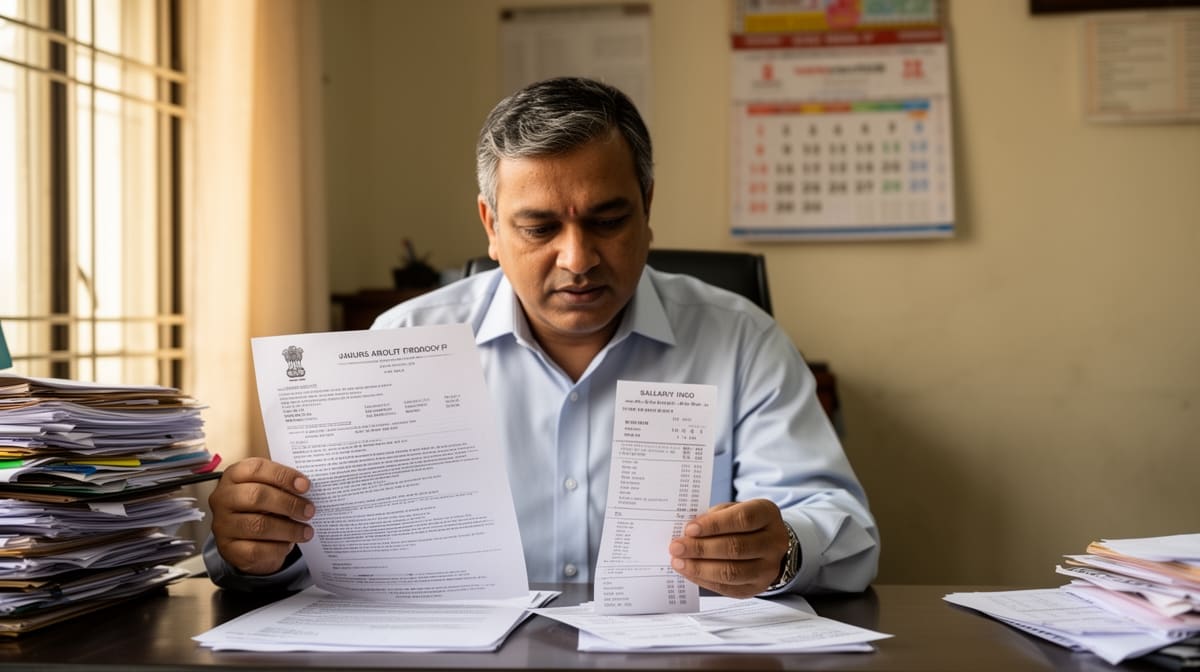
The Rajasthan High Court has reinforced a critical principle in service law: employers cannot withhold an employee's salary without a specific, communicated order, even when the employee is reassigned to lighter duties due to medical unfitness. This judgment clarifies the procedural safeguards required before any salary deduction, providing much-needed protection for employees facing arbitrary financial hardship during medical transitions.
Background & Facts
The Dispute
The petitioner, Om Prakash Choudhary, was appointed as a driver with the Rajasthan State Road Transport Corporation (RSRTC) in 2002. After developing medical complications - specifically, weakness and numbness in his legs - he was declared unfit for driving duties by multiple medical boards. Despite this, he was reassigned to civil duties at the Banswara Depot. However, the respondents began withholding his salary, citing non-compliance with a circular mandating 3000 km of monthly driving for drivers and conductors, even though the same circular exempted medically unfit personnel.
Procedural History
The petitioner approached the Rajasthan High Court under Article 226 of the Constitution of India, seeking:
- Quashing of the illegal salary withholding
- Reinstatement of full salary
- Refund of withheld salary with 18% interest
- Costs of the writ petition
The Parties' Positions
The petitioner argued that his salary could not be withheld without a specific order, relying on a coordinate bench judgment in Azaz Ahmad v. RSRTC. The respondents, while acknowledging the petitioner's medical unfitness, did not dispute that the issue was already settled by the Azaz Ahmad precedent.
The Legal Issue
The central question before the Court was whether an employer can withhold an employee's salary without a specific, communicated order, particularly when the employee has been medically reassigned to lighter duties and continues to perform them.
The Court's Analysis
The Court relied entirely on the reasoning in Azaz Ahmad v. RSRTC, where a coordinate bench had authoritatively settled the issue. The judgment in Azaz Ahmad held that:
"There is no justification for the respondents to withhold the salary of the petitioner when there is no specific order in this regard. As long as the petitioner is discharging his duties in the civil post as per the orders passed by the respondents, they are duty bound to extend the salary unless any other specific order is in force withholding the salary which has been communicated to the petitioner."
The Court emphasized that the absence of a specific order - one that is both legally valid and duly communicated - renders any salary withholding arbitrary and illegal. This principle applies even when an employee is reassigned due to medical unfitness, as long as they continue to perform the duties assigned to them.
The Verdict
The writ petition was disposed of in favor of the petitioner. The Court issued the following directions, mirroring those in Azaz Ahmad:
- The respondents must pay all arrears of salary to the petitioner.
- The petitioner shall continue to receive his regular salary until a fresh medical board examines him.
- The petitioner must appear before a fresh medical board, which will determine his fitness for driving duties.
- If declared unfit, the petitioner shall not be assigned driving duties and shall continue in his current role.
What This Means For Similar Cases
Salary Withholding Requires Specific, Communicated Orders
This judgment establishes a clear procedural safeguard for employees: employers cannot withhold salary based on general circulars or internal policies alone. Practitioners must now ensure that:
- Any salary deduction or withholding is backed by a specific order.
- The order must be communicated to the employee in writing.
- The order must comply with principles of natural justice, including an opportunity to be heard where applicable.
Medical Reassignment Does Not Justify Automatic Salary Cuts
- Employees reassigned to lighter duties due to medical unfitness remain entitled to their full salary unless a specific order states otherwise.
- Employers cannot rely on blanket policies (e.g., driving km requirements) to withhold salary from medically exempted employees.
- The burden lies on the employer to prove the existence of a valid, communicated order if salary withholding is challenged.
Precedent-Based Litigation Strategy
- Practitioners should cite Azaz Ahmad and this judgment to challenge arbitrary salary withholdings.
- Writ petitions under Article 226 are an effective remedy for such grievances, given the Court's willingness to intervene in service law matters.
- Employees facing similar issues should demand copies of any orders justifying salary deductions, as their absence strengthens the case for illegal withholding.