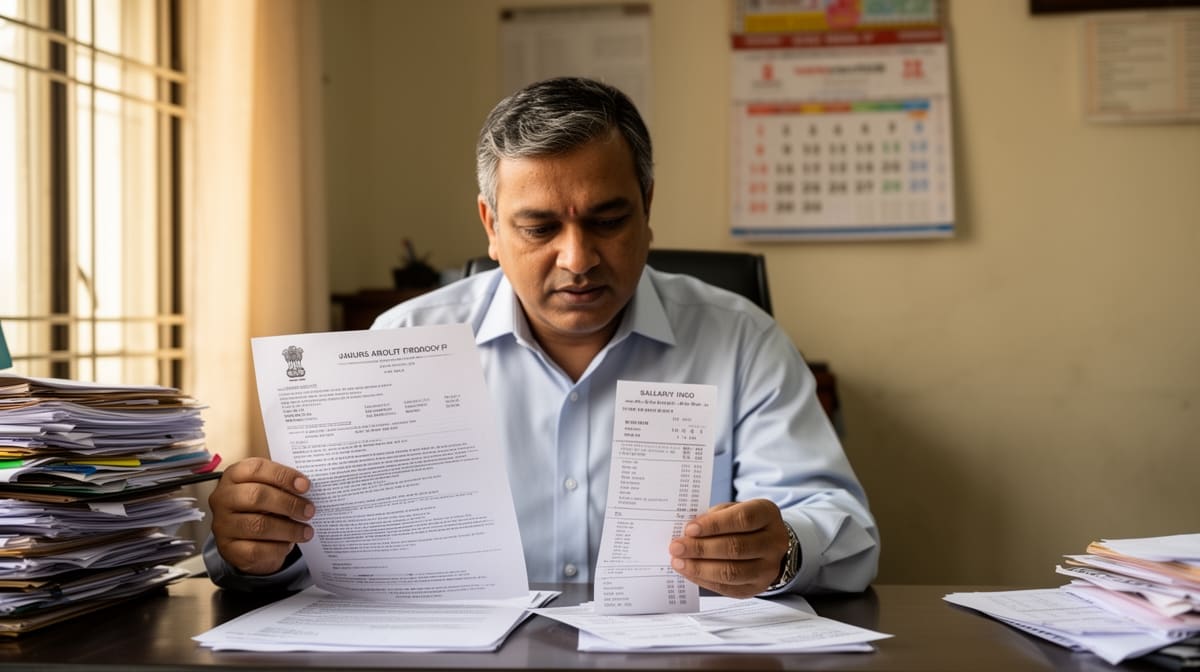
The Rajasthan High Court has reaffirmed a foundational principle of administrative law: salary cannot be withheld from a public employee without a formal, communicated order. In a clear affirmation of audi alteram partem, the Court directed immediate payment of arrears and prohibited unilateral suspension of wages pending medical review, reinforcing that procedural fairness is non-negotiable in service matters.
Background & Facts
The Dispute
Rajendra Singh, a driver with the Rajasthan State Road Transport Corporation, was declared unfit for driving duties by a medical board and reassigned to civil duties. Despite continuing to perform assigned office work, his salary was abruptly withheld without any written order, explanation, or opportunity to be heard.
Procedural History
- The petitioner filed a writ petition challenging the withholding of salary and the lack of procedural compliance.
- The respondents relied on a circular dated 09.10.2025 directing re-evaluation of all drivers previously declared unfit.
- No specific order withholding salary was produced by the respondents.
- The Court took judicial notice of its earlier decision in Mubarak Hussain v. Rajasthan State Road Transport Corporation on similar facts.
Relief Sought
The petitioner sought: (i) immediate release of withheld salary; (ii) direction to forward his representation to headquarters for fresh medical evaluation; (iii) continuation of current duties pending outcome; and (iv) compliance with natural justice norms.
The Legal Issue
The central question was whether withholding salary of a public servant, while continuing to discharge assigned duties, violates the principles of natural justice and Article 311 of the Constitution, particularly in the absence of a formal, communicated order.
Arguments Presented
For the Petitioner
Learned counsel argued that the withholding of salary without any order or notice amounted to a punitive action without due process. He relied on State of U.P. v. Mohd. Noor and K. Sankaran v. State of Kerala, emphasizing that salary is a statutory right and cannot be suspended merely on administrative convenience. The petitioner had been performing duties for months and was entitled to remuneration.
For the Respondent
The State contended that the circular dated 09.10.2025 mandated re-evaluation of all drivers previously declared unfit, and until a fresh medical opinion was received, the petitioner’s status remained uncertain. They argued that salary withholding was a temporary administrative measure to prevent overpayment if the petitioner was ultimately found fit for driving duties.
The Court's Analysis
The Court rejected the State’s argument that uncertainty in medical status justified salary withholding. It held that continuing to perform duties creates an implied contractual obligation to pay wages. The Court emphasized that the respondents had not produced any order under Rule 14 of the Rajasthan State Road Transport Corporation Service Rules or any other statutory provision authorizing salary suspension.
"As long as the petitioner is discharging his duties in the civil post as per the orders passed by the respondents, they are duty bound to extend the salary unless any other specific order is in force withholding the salary which has been communicated to the petitioner."
The Court distinguished between temporary reassignment and punitive suspension. It noted that the circular sought medical review - not termination or suspension - and therefore could not be used as a basis to deny wages. The Court also reaffirmed its earlier ruling in Mubarak Hussain, holding that the petitioner must be given a fair opportunity to appear before a fresh medical board, but this process cannot be used to circumvent statutory wage obligations.
The Court further observed that non-payment of salary in the absence of a lawful order amounts to a violation of Article 14 and Article 21, as it deprives the employee of livelihood without due process.
The Verdict
The petitioner succeeded. The Court held that salary cannot be withheld without a formal, communicated order and directed immediate payment of arrears. The petitioner was to continue his current duties pending fresh medical evaluation, and the respondents were mandated to pay all outstanding wages within 15 days.
What This Means For Similar Cases
Salary Withholding Requires Written Order
- Practitioners must challenge any salary suspension in public employment that lacks a written order citing specific statutory authority.
- Absence of a formal order renders the withholding illegal, regardless of administrative justification.
- Arrears must be paid immediately upon finding of illegality.
Medical Re-evaluation Does Not Justify Non-Payment
- Employers cannot use pending medical reviews as a pretext to withhold wages.
- Employees reassigned to non-driver or non-field duties remain entitled to full pay unless formally suspended under law.
- Any change in duties must be accompanied by a written order; silence or inaction does not equate to lawful suspension.
Natural Justice Applies to Administrative Actions
- Even in non-disciplinary contexts, audi alteram partem applies when livelihood is affected.
- Public employers must provide notice and opportunity to be heard before altering terms of service.
- Courts will intervene where procedural fairness is ignored, even in routine administrative matters.