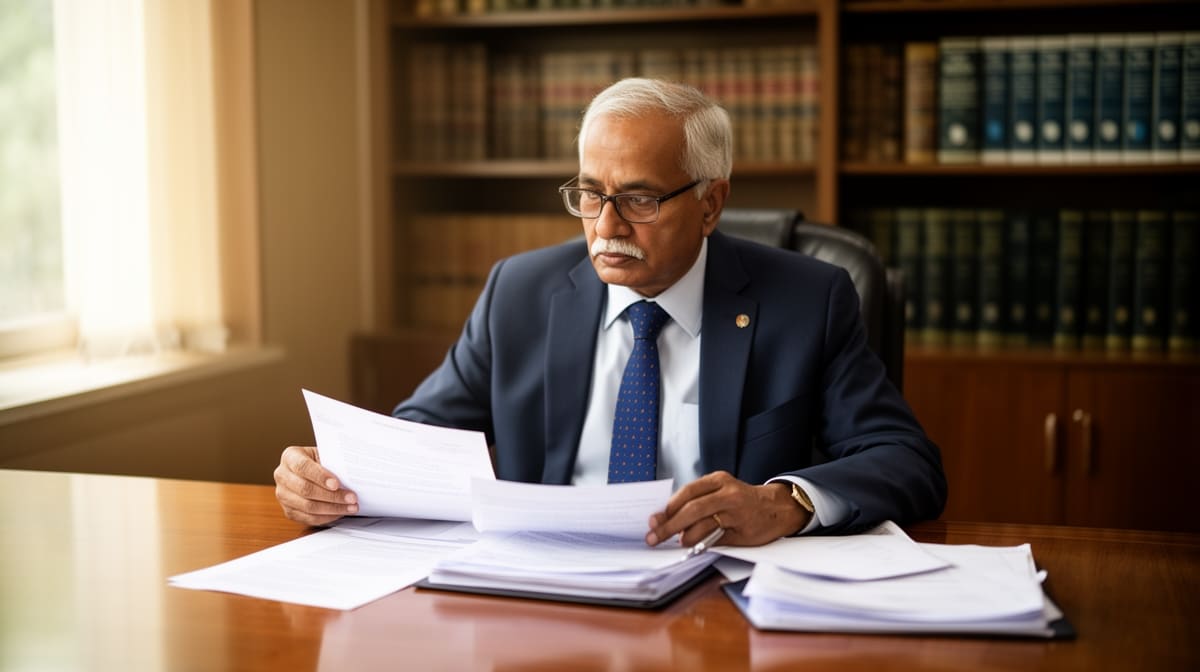
An employee acquitted in criminal proceedings and exonerated in multiple departmental inquiries is entitled to full pay for the period of suspension, even if the acquittal was on the basis of benefit of doubt. The Punjab and Haryana High Court has firmly upheld that administrative authorities cannot deny consequential benefits without cogent reasoning, reinforcing the principle that no penalty may be imposed without proven misconduct.
Background & Facts
The Dispute
The petitioner, Attar Singh, was employed as a Clerk in the Municipal Corporation of Punjab. On 6 December 2000, he was placed under suspension following an FIR registered under Sections 464, 468, 471, 120-B and 511 of the IPC, alleging collusion with a contractor to falsify official records. The criminal trial concluded on 12 October 2010 with his acquittal, the court observing that the prosecution had failed to prove the charges beyond reasonable doubt and granting him the benefit of doubt due to lack of evidence.
Procedural History
The petitioner faced prolonged departmental proceedings spanning over a decade:
- 2012: First Inquiry Officer (Superintending Engineer) exonerated the petitioner and found no charges proved
- 2014: Second inquiry again exonerated him and found no financial loss to the Corporation
- 2016: Third inquiry by Additional Commissioner (R) not only exonerated him but explicitly recommended treating the suspension period as "duty period" for all purposes
- Despite these consistent exonerations, the Commissioner passed an order on 30 August 2016 denying salary for the suspension period, while acknowledging the period as "duty" for other purposes
Relief Sought
The petitioner sought quashing of the impugned order and a writ of mandamus directing payment of full salary and allowances for the suspension period (6 December 2000 to 14 July 2011), along with 18% interest.
The Legal Issue
The central question was whether Rule 7.3-B(3) and (4) of the Punjab Civil Services Rules entitles a government employee to full pay for the suspension period upon acquittal in criminal proceedings and consistent exoneration in departmental inquiries, even when the acquittal is based on "benefit of doubt".
Arguments Presented
For the Petitioner
The petitioner’s counsel relied on Shiv Kumar Goel v. State of Haryana and Ranbir Singh v. D.H.B.V.N.L., arguing that an acquittal on the ground of "lack of evidence" or "benefit of doubt" constitutes an honourable acquittal under service law. He emphasized that three separate departmental inquiries had exonerated the petitioner, and the final inquiry report explicitly recommended treating the suspension as duty. He further contended that the impugned order was non-speaking, violating the principle of reasoned decision-making established in Ram Phal v. State of Haryana.
For the Respondent
The State argued that the petitioner was not "honourably acquitted" as the criminal court had not found him innocent but merely granted benefit of doubt. It relied on Union of India v. K.V. Jankiraman and Greater Hyderabad Municipal Corporation v. M. Prabhakar Rao, asserting that the competent authority’s discretion to determine whether suspension was "wholly unjustified" is not subject to judicial interference unless arbitrary or perverse. It also raised preliminary objections on maintainability and alternative remedy.
The Court's Analysis
The Court rejected the State’s contention that "benefit of doubt" acquittal disentitles an employee to full pay. It held that the distinction between "innocent" and "benefit of doubt" is legally irrelevant in service law when the employee is fully exonerated by the tribunal of fact. The Court observed:
"The petitioner was not merely acquitted in the criminal trial; he was exonerated thrice in departmental inquiries. The final inquiry report not only cleared him but recommended treating the suspension as duty period. To deny salary despite this is to penalise the innocent for the State’s own delay."
The Court emphasized that the Commissioner’s order was non-speaking and failed to address the three exonerating reports. It cited Ram Phal v. State of Haryana to affirm that "reason is the heartbeat of every conclusion" and that arbitrary decisions without reasoning violate natural justice. The Court further relied on S.R. Tewari v. Union of India to hold that where the material on record consistently supports the employee and the authority ignores it without justification, the decision becomes perverse and liable to be set aside.
The Court also dismissed the preliminary objection on maintainability, noting that the petitioner had no efficacious alternative remedy given the prolonged delay and the nature of the grievance.
The Verdict
The petitioner won. The Court held that Rule 7.3-B of the Punjab Civil Services Rules entitles an employee to full pay and allowances for the suspension period upon acquittal in criminal proceedings and consistent exoneration in departmental inquiries. The impugned order was quashed, and the suspension period was directed to be treated as duty for all purposes, including pay.
What This Means For Similar Cases
Suspension Pay Is Not Discretionary After Exoneration
- Practitioners must now argue that once an employee is acquitted and exonerated in departmental proceedings, denial of salary under Rule 7.3-B is legally unsustainable
- The burden shifts to the employer to prove why the suspension was not "wholly unjustified" - not to the employee to prove innocence
- "Benefit of doubt" acquittals are legally equivalent to full acquittals for service law purposes
Non-Speaking Orders Are Per Se Invalid
- Administrative orders denying pay must specifically address exonerating inquiry reports
- Failure to engage with exonerating evidence renders the order arbitrary and liable to be set aside
- Courts will not uphold decisions that ignore consistent findings without explanation
Delay by the State Cannot Penalize the Employee
- Administrative lags in concluding departmental proceedings do not justify withholding pay
- Employees must not bear the cost of institutional inefficiency
- Interest at 6% per annum on arrears is now a standard remedy in such cases