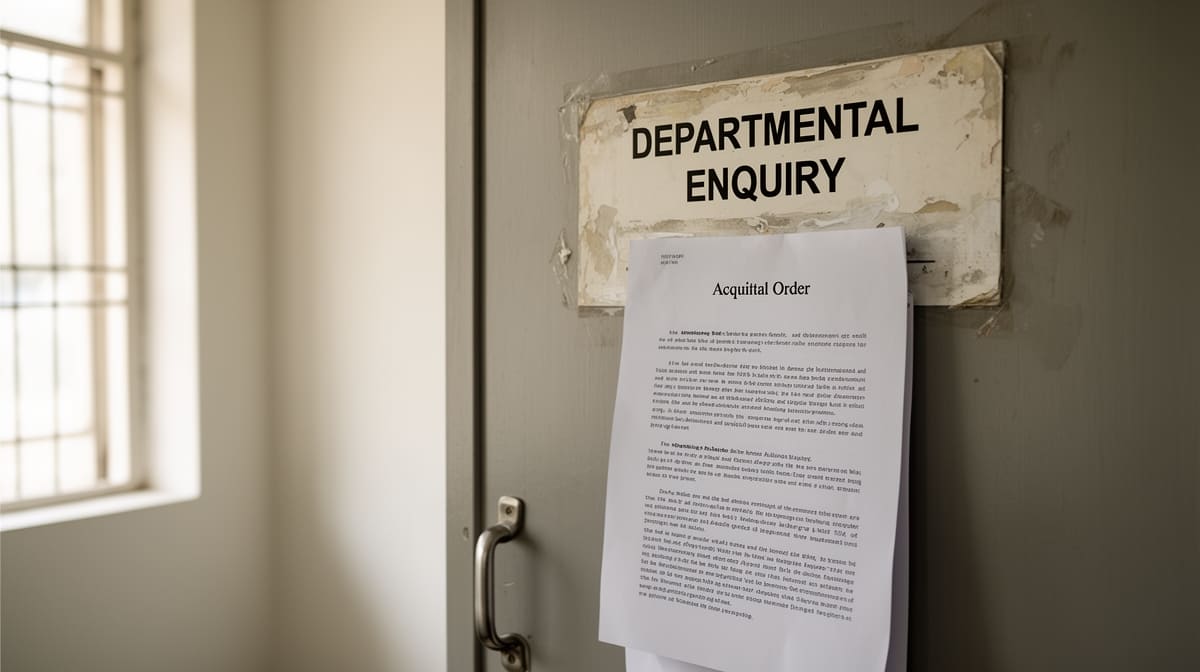
The Allahabad High Court has reaffirmed a foundational principle in service law: once a police officer is acquitted in a criminal trial on merits, departmental proceedings based on the same allegations cannot stand. This judgment reinforces the binding effect of judicial acquittals and the mandatory nature of procedural safeguards under the Uttar Pradesh Police Regulations.
Background & Facts
The Dispute
The petitioner, Balwant Chandra, was serving as a Constable in the Civil Police, District Lucknow, when he was arrested on 10.04.2018 in connection with Crime No. 97 of 2018 registered at Police Station Banthara under Sections 7/13(1)(d)/13(2) of the Prevention of Corruption Act, 1988. The allegations pertained to the demand and acceptance of illegal gratification. Consequent to the arrest, he was suspended on 11.04.2018.
Key Facts
- The petitioner was arrested on 10.04.2018 based on allegations of corruption.
- Suspension order dated 11.04.2018 was issued under Rule 486 of the U.P. Police Regulations.
- The petitioner challenged the suspension in Writ Petition No. 100(S/S) of 2019, which was rendered academic when the suspension was revoked on 28.02.2019.
- A charge sheet dated 12.03.2019 was served upon him, based on the same allegations.
- The petitioner submitted his defence reply on 30.03.2019, invoking judicial precedents.
- The Inquiry Officer submitted a report dated 31.10.2019 finding him guilty.
- A show cause notice dated 12.11.2019 was issued, prompting the petitioner to file Writ Petition No. 34508(S/S) of 2019.
- On 13.12.2019, the High Court directed the disciplinary authority to consider the petitioner’s legal submissions based on State of U.P. v. Babu Ram Upadhyaya, Kedar Nath Yadav v. State of U.P., and Sanjay Rai v. State of U.P., and to pass a reasoned order within two months.
- The petitioner submitted a detailed reply on 27.12.2019, fully complying with the Court’s directions.
- The punishment order was passed on 13.02.2021 - over fourteen months after the deadline.
- The appellate order dated 27.04.2021 upheld the punishment.
- The criminal trial concluded on 30.10.2025, with the Special Judge, P.C. Act-VI, Lucknow, acquitting the petitioner of all charges for failure of prosecution to prove demand and acceptance of bribe beyond reasonable doubt.
Procedural History
- 10.04.2018: FIR No. 97 of 2018 registered under Prevention of Corruption Act.
- 11.04.2018: Suspension order issued.
- 28.02.2019: Suspension revoked.
- 12.03.2019: Charge sheet served.
- 30.03.2019: Petitioner’s defence reply filed.
- 31.10.2019: Inquiry report submitted.
- 12.11.2019: Show cause notice issued.
- 13.12.2019: High Court directs disciplinary authority to consider legal submissions and pass order within two months.
- 27.12.2019: Petitioner submits detailed reply complying with Court’s directions.
- 13.02.2021: Punishment order passed - 14 months after deadline.
- 27.04.2021: Appellate order dismissing appeal.
- 30.10.2025: Criminal court acquits petitioner in C.C. No. 996 of 2018.
- 25.03.2026: Writ Petition No. 11164 of 2021 reserved.
- 08.05.2026: Judgment delivered.
The Parties' Positions
Petitioner: Argued that departmental proceedings were illegal due to violation of Regulation 486(1), non-compliance with the 13.12.2019 Court order, and the binding effect of criminal acquittal under Regulation 493 and Kedar Nath Yadav. Contended that simultaneous proceedings were barred and the delay was inexcusable.
Respondent State: Argued that the Uttar Pradesh Police Officers and Subordinate Ranks (Punishment and Appeal) Rules, 1991 override the Police Regulations and permit concurrent proceedings. Relied on Capt. M. Paul Antony v. Bharat Cold Mills to justify departmental action during pendency of criminal trial.
Relief Sought
The petitioner sought quashing of the punishment order dated 13.02.2021 and appellate order dated 27.04.2021, reinstatement to the post of Constable, and payment of arrears of salary, allowances, and service benefits w.e.f. 11.04.2018.
The Legal Issue
The central question was whether Regulation 493 of the U.P. Police Regulations renders departmental proceedings void upon a criminal acquittal on merits, and whether the disciplinary authority is bound to accept the findings of the criminal court even when the Rules, 1991 are in force.
Arguments Presented
For the Petitioner
The petitioner’s counsel relied on State of U.P. v. Babu Ram Upadhyaya to argue that Regulation 486(1) mandates police investigation as a condition precedent to departmental proceedings. He further invoked Kedar Nath Yadav v. State of U.P. and Sanjay Rai v. State of U.P. to assert that once an officer is acquitted in a criminal trial, the findings are binding and departmental authorities cannot re-examine the facts. He emphasized that the disciplinary authority failed to comply with the specific directions of the High Court dated 13.12.2019, particularly in ignoring the legal submissions and exceeding the two-month deadline without seeking extension.
For the Respondent
The State contended that the Rules, 1991, framed under the Police Act, 1861, supersede the Police Regulations and permit concurrent departmental and criminal proceedings. It relied on Capt. M. Paul Antony v. Bharat Cold Mills to argue that simultaneous proceedings are permissible in public interest. It further submitted that the acquittal did not automatically entitle the petitioner to reinstatement, as departmental proceedings could proceed on grounds of negligence or unfitness distinct from criminal liability.
The Court's Analysis
The Court undertook a meticulous review of the legal framework governing police discipline. It first examined the binding nature of State of U.P. v. Babu Ram Upadhyaya, which held that Regulation 486(1) is mandatory and that departmental proceedings cannot precede criminal investigation. The Court then turned to Regulation 493, which explicitly states: "If the accused has been judicially acquitted... the Superintendent of Police must at once reinstate him... the finding of the Court on these facts must be taken as final."
The Court emphasized that the acquittal in Criminal Case No. 996 of 2018 was not merely procedural but on merits, with the trial court recording that the prosecution failed to prove demand and acceptance of illegal gratification beyond reasonable doubt. The judgment noted that no appeal was filed against the acquittal, thereby rendering it final.
"The judicial determination rendered in the criminal trial must be treated as conclusive on the issues involved, particularly when the acquittal is on merits."
The Court rejected the State’s reliance on the Rules, 1991, holding that they do not abrogate the specific provisions of the Police Regulations, particularly Regulation 493, which was upheld as binding in Kedar Nath Yadav. The Court observed that the Rules, 1991 govern procedure and appeal, but cannot override the substantive principle that an acquittal is conclusive.
The Court further held that the disciplinary authority’s failure to consider the petitioner’s legal submissions - particularly those based on Babu Ram Upadhyaya, Kedar Nath Yadav, and Sanjay Rai - constituted a clear violation of the 13.12.2019 directions. The delay of fourteen months in passing the punishment order, without seeking extension, was held to be a flagrant disregard of judicial mandate under Abhishek Prabhakar Awasthi v. New India Assurance Co. Ltd.
The Court concluded that the punishment order was vitiated on three grounds: (1) non-compliance with Regulation 493, (2) failure to apply mind to binding precedents, and (3) inordinate and unexplained delay.
The Verdict
The petitioner succeeded. The Court set aside the punishment order dated 13.02.2021 and the appellate order dated 27.04.2021. The petitioner was reinstated to the post of Constable in Civil Police, District Lucknow, and directed to be paid arrears of salary, allowances, and other consequential service benefits w.e.f. 11.04.2018. The Court ordered compliance within four weeks.
What This Means For Similar Cases
Acquittal in Criminal Court Is Conclusive in Departmental Proceedings
- Practitioners must argue that any departmental action based on the same facts as a criminal acquittal is void under Regulation 493 of the U.P. Police Regulations.
- The burden shifts to the department to prove that the acquittal was on technical grounds or that the misconduct alleged is distinct from the criminal charge.
- A mere assertion of "negligence" or "unfitness" cannot override a judicial finding of innocence on the same facts.
Judicial Directions Must Be Strictly Complied With
- Authorities cannot ignore or delay compliance with court orders, even if the delay appears minor.
- Failure to adhere to a stipulated timeline without seeking extension renders the order unsustainable, as per Abhishek Prabhakar Awasthi.
- A mechanical or cursory response to legal submissions constitutes non-application of mind and vitiates the order.
Police Regulations Override General Service Rules
- The U.P. Police Regulations, particularly Regulations 486, 492, and 493, are not repealed by the Rules, 1991.
- Where specific statutory provisions exist (like Regulation 493), they prevail over general rules.
- Practitioners must cite Kedar Nath Yadav as controlling precedent in all police service matters involving acquittals.