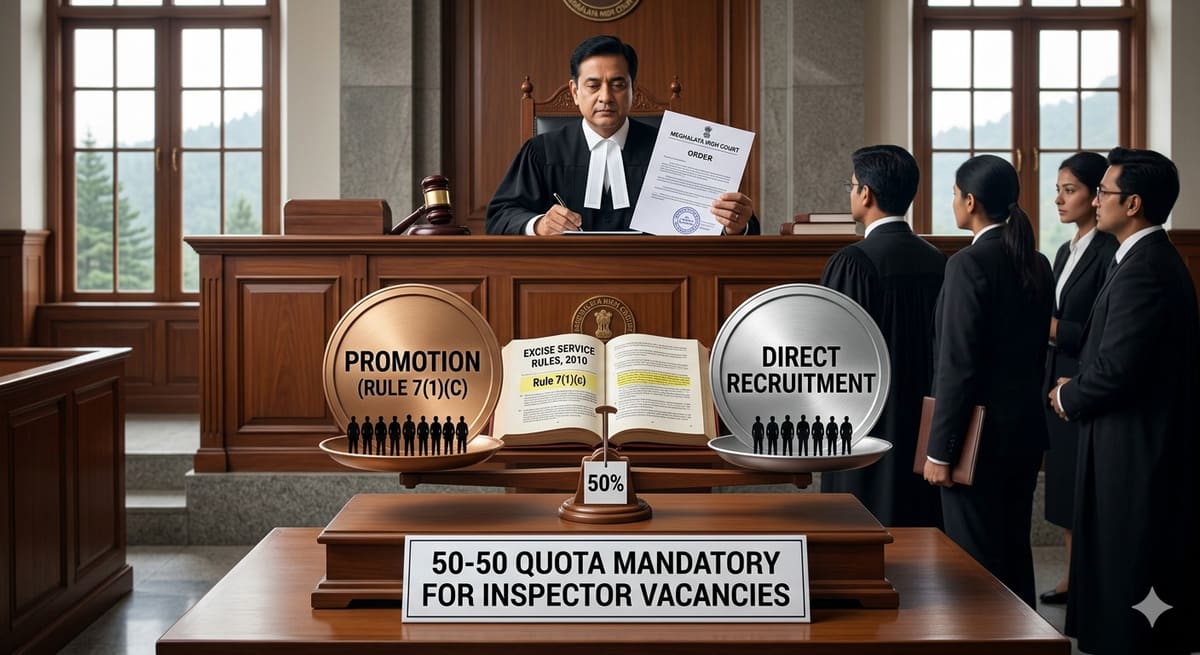
The Meghalaya High Court has reaffirmed the statutory mandate for balanced recruitment in the Excise Department, holding that 50% of Inspector vacancies must be filled by promotion and 50% by direct recruitment. This ruling clarifies a critical procedural obligation for state service commissions and administrative authorities, with direct implications for career progression of subordinate officers.
Background & Facts
The Dispute
The petitioners, all serving as Assistant Inspectors of Excise across various districts of Meghalaya, challenged Advertisement No. 06/2024 dated 19.12.2024, which proposed the recruitment of 12 Inspector of Excise posts exclusively through direct recruitment. The petitioners contended that this violated Rule 7(1)(c) of the Meghalaya Excise (Subordinate) Service Rules, 2010, which prescribes a mandatory 50:50 split between promotion and direct recruitment for every recruitment cycle.
Key Facts
The petitioners are currently employed as Assistant Inspectors of Excise in districts including East Khasi Hills, East Jaintia Hills, South Garo Hills, and East Garo Hills.
The advertisement dated 19.12.2024 advertised 12 vacancies for the post of Inspector of Excise, with no provision for promotion from within the cadre.
Rule 7(1)(c) of the Meghalaya Excise (Subordinate) Service Rules, 2010, mandates that in any year, 50% of Inspector vacancies shall be filled by promotion and 50% by direct recruitment.
The petitioners had been eligible for promotion since completing five years of continuous service as Assistant Inspectors and passing the prescribed departmental examinations.
No prior recruitment for Inspector posts had been conducted in the preceding year, resulting in an accumulation of vacancies.
Procedural History
19.12.2024: Advertisement No. 06/2024 issued by the Commissionerate of Excise, Meghalaya, inviting applications for 12 Inspector of Excise posts through direct recruitment only.
06.01.2025: Writ Petition No. 342 of 2025 filed before the High Court of Meghalaya challenging the advertisement.
19.03.2026: Respondent No. 2 (Commissioner of Excise) filed an affidavit stating that the Government had reviewed the matter and decided to comply with Rule 7(1)(c) by filling 50% of the vacancies through promotion.
06.05.2026: Oral hearing conducted before the High Court.
The Parties' Positions
Petitioners: Argued that the advertisement was illegal, arbitrary, and in direct violation of Rule 7(1)(c). They contended that the exclusion of promotional avenues denied them their legitimate expectation of career advancement and violated the principle of equal opportunity under Article 14 of the Constitution.
Respondents: Initially defended the advertisement but, in the affidavit dated 19.03.2026, conceded that the recruitment process must be re-initiated in strict compliance with Rule 7(1)(c). They submitted that the Government had reviewed the matter and intended to rectify the error.
Relief Sought
The petitioners sought:
Quashing of Advertisement No. 06/2024 dated 19.12.2024.
Direction to the respondents to re-advertise the 12 Inspector vacancies with 50% reserved for promotion from eligible Assistant Inspectors.
Inclusion of only those Assistant Inspectors who were eligible as on 19.12.2024 for consideration under the promotional quota.
Costs of litigation.
The Legal Issue
The central question was whether Rule 7(1)(c) of the Meghalaya Excise (Subordinate) Service Rules, 2010 imposes a mandatory and non-discretionary obligation to fill exactly 50% of Inspector vacancies through promotion, and whether a recruitment advertisement deviating from this ratio is legally sustainable.
Arguments Presented
For the Petitioner
The petitioners relied on the plain language of Rule 7(1)(c), which uses the word "shall" to indicate a mandatory obligation. They cited State of U.P. v. Subhash Chandra to argue that statutory recruitment norms cannot be altered by administrative fiat. They emphasized that the exclusion of promotional avenues violated the principle of reasonable classification under Article 14 and deprived eligible officers of their legitimate expectation of promotion.
For the Respondent
The respondents initially defended the advertisement on grounds of administrative expediency but, upon review, conceded the illegality. The State’s Senior Government Advocate acknowledged that Rule 7(1)(c) is unambiguous and binding. They submitted that the Government had already taken corrective action by issuing the communication dated 19.03.2026, and requested the Court to allow re-advertisement in compliance with the Rules.
The Court's Analysis
The Court undertook a textual and purposive interpretation of Rule 7(1)(c). It observed that the Rule uses the word "shall" in unequivocal terms, leaving no room for discretion or deviation. The Court noted that the Rule was framed to ensure a balanced career progression system, prevent stagnation in the subordinate cadre, and maintain morale among serving officers.
"The proportion of vacancies to be filled up in any year in accordance with clause (a) and clause (b) above shall be fifty percent (50%) by promotion, and fifty percent (50%) by direct recruitment."
The Court held that the use of "shall" transforms the provision into a mandatory directive, not a recommendatory guideline. It distinguished this from discretionary policies, emphasizing that service rules framed under statutory authority bind the administration as strictly as the law itself. The Court rejected any notion that administrative convenience could override a clear statutory mandate.
The Court further noted that the respondents’ affidavit dated 19.03.2026 constituted a voluntary admission of illegality and a commitment to rectify the error. This admission, coupled with the unambiguous language of the Rule, rendered the petition infructuous in its original form but necessitated judicial direction to ensure compliance.
The Verdict
The writ petition is disposed of with the direction that the respondents shall re-advertise the 12 Inspector of Excise vacancies in strict compliance with Rule 7(1)(c) of the Meghalaya Excise (Subordinate) Service Rules, 2010, with exactly six posts filled by promotion and six by direct recruitment. The promotional quota shall be open only to Assistant Inspectors of Excise who were eligible as on 19.12.2024. The re-advertisement must be issued within six weeks from the date of this order. The respondents shall bear the costs of the petition, fixed at Rs. 15,000.
What This Means For Similar Cases
Mandatory Proportions Cannot Be Overridden
Practitioners must challenge any recruitment advertisement that deviates from statutorily mandated promotion-direct recruitment ratios.
The use of "shall" in service rules creates a binding obligation enforceable through writ jurisdiction.
Administrative reviews or internal corrections do not cure illegality unless judicially sanctioned.
Eligibility Cut-Off Must Be Clearly Defined
When a recruitment process is invalidated, the eligibility cut-off date must be explicitly tied to the date of the original illegal advertisement unless otherwise directed.
Officers who became eligible after the advertisement date cannot claim retrospective benefit unless the court permits it.
This prevents endless litigation over eligibility and ensures finality in recruitment cycles.
Precedent for Other State Services
This judgment reinforces the principle that service rules framed under delegated legislation are binding on the State.
Similar rules in Police, Forest, and Excise services across other states (e.g., Assam, Nagaland, Tripura) now face heightened scrutiny for compliance with proportional recruitment norms.
State Public Service Commissions must audit recruitment advertisements for adherence to service rules before publication.