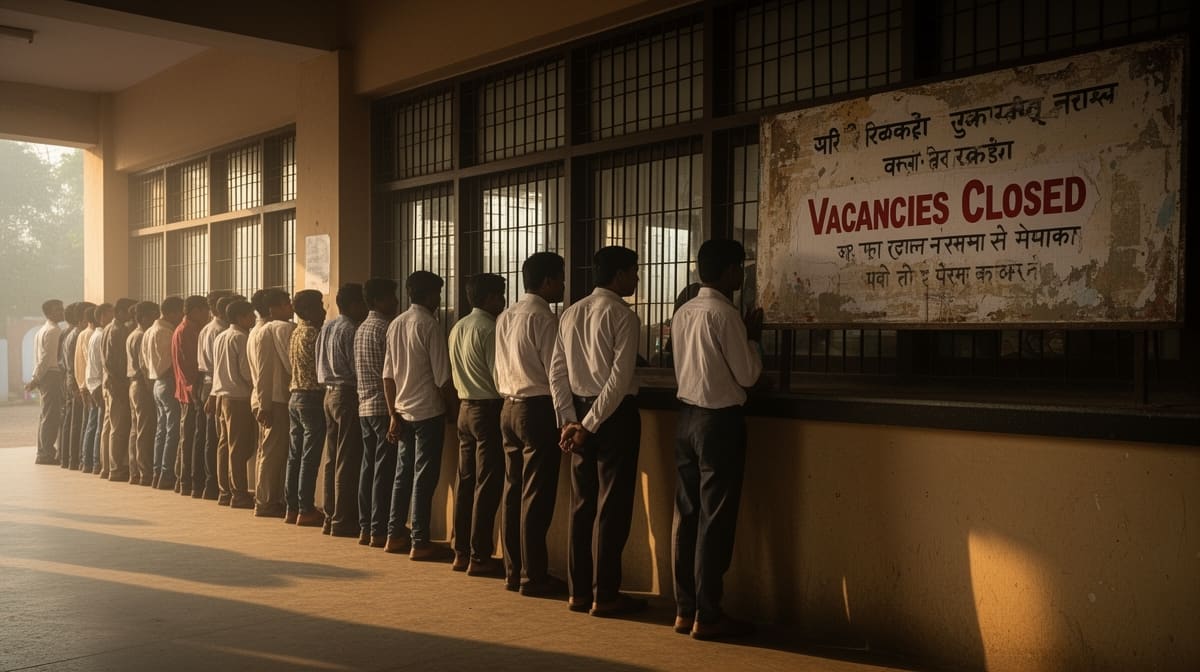
The Jharkhand High Court has clarified a critical ambiguity in state-level teacher recruitment policy, affirming that unfilled reserved quota posts may lawfully be absorbed into the general recruitment pool when no eligible internal candidates are available. This decision resolves long-standing disputes over procedural compliance in government teaching appointments and reinforces the principle that executive instructions cannot override statutory rules but may clarify them.
Background & Facts
The Dispute
The petitioners were appointed as Primary Teachers in various districts of Jharkhand between 2015 and 2016. In 2017, the State issued Advertisement No. 1/16 for recruitment of Trained Graduate Teachers under the Jharkhand Government Secondary School Teaching and Non-Teaching Staff Appointment and Service Conditions Rules, 2015. The Rules mandated that 25% of posts be reserved for eligible Primary Teachers with at least five years of service in government elementary schools, while 75% were open to direct recruitment. At the time of advertisement, none of the petitioners had completed the required five years of service and thus were ineligible for the reserved quota.
Procedural History
Due to prolonged delays in the recruitment process, a significant number of posts under the 25% reserved quota remained unfilled for several years. On 29 August 2019, the Department of School Education and Literacy issued Letter No. 2264 directing that the unfilled 25% quota posts be filled from the remaining eligible candidates on the 75% direct recruitment merit list, without disturbing category-wise, district-wise, or subject-wise merit order.
The petitioners challenged this directive, arguing that it violated Rule 9(i) of the Recruitment Rules and breached Articles 14 and 16 of the Constitution by denying them equal opportunity despite having completed five years of service by the time of appointment.
Relief Sought
The petitioners sought a declaration that the 29 August 2019 notification was ultra vires Rule 9(i) and unconstitutional under Articles 14 and 16. They contended that unfilled reserved posts must be re-advertised separately for eligible Primary Teachers, not filled from the direct recruitment list.
The Legal Issue
The central question was whether Rule 9(i) of the Jharkhand Government Secondary School Teaching and Non-Teaching Staff Appointment and Service Conditions Rules, 2015 permits unfilled 25% reserved quota posts to be filled from the 75% direct recruitment merit list, and whether an executive instruction clarifying this procedure violates statutory provisions or constitutional guarantees.
Arguments Presented
For the Petitioner
The petitioners argued that Rule 9(i) explicitly reserves 25% of posts for teachers with five years of service in government primary schools. They contended that once a candidate completes the qualifying service, they acquire a vested right to be considered for those reserved posts. Filling those posts from the direct recruitment list, they argued, amounted to a de facto cancellation of the reservation, violating Article 16 and the principle of equal opportunity. They relied on State of Punjab v. Davinder Singh to assert that reservation cannot be diluted by executive fiat.
For the Respondent
The State countered that Rule 9(i) contains a clear proviso: if sufficient eligible candidates are not available for the 25% quota, the unfilled posts shall be filled through direct recruitment. The 2019 letter merely operationalized this provision in light of prolonged vacancies. The State cited Union of India v. Ashok Kumar Aggarwal to argue that executive instructions are lawful when they clarify, not contradict, statutory rules. It emphasized that the petitioners were never eligible at the time of advertisement and thus had no enforceable claim.
The Court's Analysis
The Court undertook a detailed textual analysis of Rule 9(i), focusing on the proviso: "if a sufficient number of eligible teachers are not available against the posts reserved for qualified Primary School teachers, in such a situation, action will be taken to fill the reserved posts through direct recruitment." The Court held that the language was unambiguous and contemplated precisely the scenario that arose - unfilled vacancies due to lack of eligible candidates.
"The direction given in the said letter is at paragraph-3(iv), which is extracted as under: (iv) Recommendation of eligible candidates of 75% who could not be recommended, should be done immediately as per the roster of the advertisement on 25% vacant posts without disturbing the order of category wise, district wise and subject wise merit, as per clause 3(ii) and 3(iii)."
The Court observed that the 2019 letter did not create a new method of appointment but merely implemented the existing proviso. It emphasized that the State was not altering the reservation structure but ensuring that vacancies were not left unfilled due to administrative delay. The Court distinguished this from cases where reservation quotas were diluted by reclassification, noting that here the 25% quota was not abolished - it was simply filled by the only available pool of qualified candidates under the Rule.
The Court further relied on Union of India v. Ashok Kumar Aggarwal to affirm that executive instructions may supplement statutory rules where they are silent on operational details, provided they do not contradict them. The letter was found to be consistent with the Rule’s intent and did not override its provisions.
The Verdict
The petitioners’ challenge was dismissed. The Court held that Rule 9(i) permits unfilled reserved quota posts to be filled from the direct recruitment merit list when no eligible internal candidates are available, and that the 2019 executive instruction merely clarified this provision without violating statutory or constitutional norms.
What This Means For Similar Cases
Reserved Quota Vacancies May Be Filled from General Pool
- Practitioners must now assess whether a reserved quota vacancy remains unfilled due to lack of eligible candidates before challenging its absorption into the general pool
- A mere lapse of time or subsequent qualification of candidates does not create a right to reserved posts if they were ineligible at the time of advertisement
- The burden shifts to petitioners to prove that eligible candidates were available but ignored
Executive Clarifications Are Lawful If They Do Not Alter Statutory Text
- Government departments may issue circulars to operationalize statutory rules without re-advertising, provided the circular does not introduce new eligibility criteria or reduce reservation percentages
- Legal challenges to such circulars must focus on textual inconsistency, not perceived inequity
- This precedent applies to all state-level recruitment rules with similar provisos, including police, forest, and health services
Merit Order Must Be Preserved in Merger
- The Court’s emphasis on maintaining category-wise, district-wise, and subject-wise merit order means that even when merging pools, reservation norms for SC/ST/OBC and regional quotas must still be strictly followed
- Practitioners should scrutinize whether the merged appointments comply with roster-based reservation systems under Rule 3
- Non-compliance with these sub-quotas may still render appointments void, even if the main Rule 9(i) is satisfied