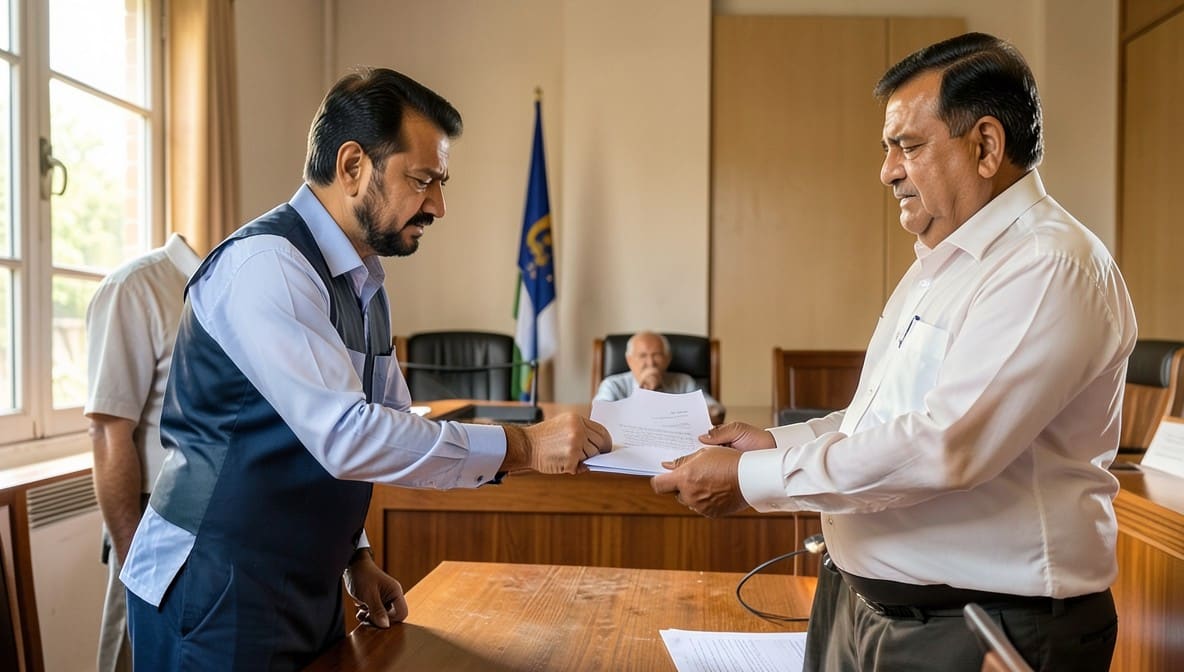
A writ petition filed by advocates enrolled in Delhi, without any local co-counsel or essential case details, was dismissed by the Punjab and Haryana High Court with exemplary costs. The judgment underscores the mandatory requirement for non-local advocates to comply with court-specific practice rules and the duty to file petitions with precision and substantiation.
Background & Facts
The Dispute
The petitioner, through two advocates enrolled with the Bar Council of Delhi, filed Writ Petition No. 10502 of 2026 (O&M) before the Punjab and Haryana High Court seeking declaration that land acquisition proceedings had lapsed under Section 24(2) of the Right to Fair Compensation and Transparency in Land Acquisition, Rehabilitation and Resettlement Act, 2013. The petition also sought restoration of mutation in the petitioner’s favour.
Key Facts
- The petitioners’ advocates, Mr. Bijender Mehla and Mr. Mukesh Kumar Sah, are enrolled with the Bar Council of Delhi and practice exclusively in Delhi courts.
- Neither advocate is enrolled on the Roll of Advocates of the Punjab and Haryana High Court.
- The writ petition was signed solely by the Delhi-based advocates.
- No power of attorney was filed with a local advocate as required under Rule 3-A of Chapter 6-B of the Court’s Rules.
- The petition did not annex copies of notifications under Sections 4 and 6 of the Land Acquisition Act, 1894.
- No dates of acquisition notifications, award announcements, or land details were provided.
- When questioned by the Court, counsel admitted he had no details of the acquisition proceedings being challenged.
Procedural History
- 08.04.2026: Writ Petition No. 10502 of 2026 (O&M) heard before the Division Bench of the Punjab and Haryana High Court.
- During hearing, Court inquired whether counsel was enrolled in the Punjab and Haryana High Court Roll.
- Counsel candidly admitted he was practicing only in Delhi and not in this Court.
- Court examined Rule 3-A of Chapter 6-B of the Rules framed under Section 34(1) of the Advocates Act, 1961.
- Court noted absence of statutory compliance and lack of factual foundation in the petition.
The Parties' Positions
For the Petitioner
The petitioner’s counsel did not dispute non-compliance with Rule 3-A. No application for leave to appear was filed. No local advocate was joined. No substantive grounds were articulated beyond a general prayer for declaration under Section 24(2).
For the Respondent
The State, represented by Mr. Saurabh Mago, DAG Haryana, did not contest the procedural irregularities but supported the Court’s observation regarding the petition’s lack of specificity.
Relief Sought
The petitioner sought:
- A declaration that land acquisition had lapsed under Section 24(2) of the 2013 Act.
- Restoration of mutation in his favour.
- Any other relief the Court deemed fit.
- Exemption from filing certified copies of annexures.
The Legal Issue
The central question was whether an advocate not enrolled on the Roll of Advocates of the Punjab and Haryana High Court may file a writ petition without joining a local advocate as mandated by Rule 3-A of Chapter 6-B, and whether a petition devoid of basic factual details about the acquisition proceedings can sustain judicial scrutiny.
Arguments Presented
For the Appellant/Petitioner
The petitioner’s counsel offered no legal argument to justify non-compliance with Rule 3-A. No application for special leave to appear was filed. No authority was cited to override the Court’s own rules. Counsel conceded he was not enrolled in the Punjab and Haryana High Court Roll and had no details of the acquisition.
For the Respondent/State
The State did not oppose dismissal on procedural grounds. It acknowledged the petition’s failure to meet minimum pleading standards under Order VI Rule 2 of the CPC and the absence of any supporting documents.
The Court's Analysis
The Court examined Rule 3-A of Chapter 6-B of the Punjab and Haryana High Court Rules, which explicitly requires that an advocate not on the Court’s Roll must file the petition along with a local advocate who is enrolled. The Court noted that the rule is not discretionary but mandatory, and its purpose is to ensure accountability, local representation, and procedural integrity.
"The petition as well as the Power of Attorney has been signed only by counsel who are admittedly enrolled with the Bar Council of Delhi and are practicing in Delhi Courts."
The Court further observed that the petition failed to meet the most basic threshold of pleadings. It contained no dates of notifications under Sections 4 and 6 of the Land Acquisition Act, 1894, no details of the award, no land survey numbers, and no reference to the authority that issued the acquisition order. The counsel admitted he had no knowledge of the acquisition proceedings.
"It is strange as to how the present writ petition has been filed without specifying as to which acquisition proceedings are under challenge. The casual manner in which the writ petition has been filed is shocking to say the least."
The Court held that filing a writ petition without essential facts and without compliance with procedural rules constitutes an abuse of process. The Court emphasized that courts cannot be used as forums for speculative or uninformed litigation, particularly when public funds and land rights are involved.
The Verdict
The writ petition was dismissed with exemplary costs of ₹50,000 to be deposited with the Punjab and Haryana High Court Legal Services Committee. All pending applications were disposed of. The Court made clear that future non-compliance with Rule 3-A will attract similar or higher penalties.
What This Means For Similar Cases
Non-Local Advocates Must Comply with Local Rules
- Practitioners from other jurisdictions must file a petition with a local advocate enrolled on the Punjab and Haryana High Court Roll, as mandated by Rule 3-A.
- Applications for special leave to appear must be filed in advance and cannot be an afterthought.
- Failure to comply will result in dismissal and imposition of costs.
Writ Petitions Require Specific, Factual Pleadings
- A petition under Section 24(2) of the 2013 Act must specify the exact notification dates, award details, and land identification.
- Blanket prayers without supporting documents or factual matrix will be dismissed summarily.
- Courts will not entertain speculative litigation, especially in land acquisition matters affecting public interest.
Procedural Non-Compliance Is Not Excused by Good Faith
- Lack of knowledge about the case is not a defense.
- Counsel’s duty to verify facts before filing is non-negotiable.
- Courts will impose costs to deter frivolous or careless litigation.