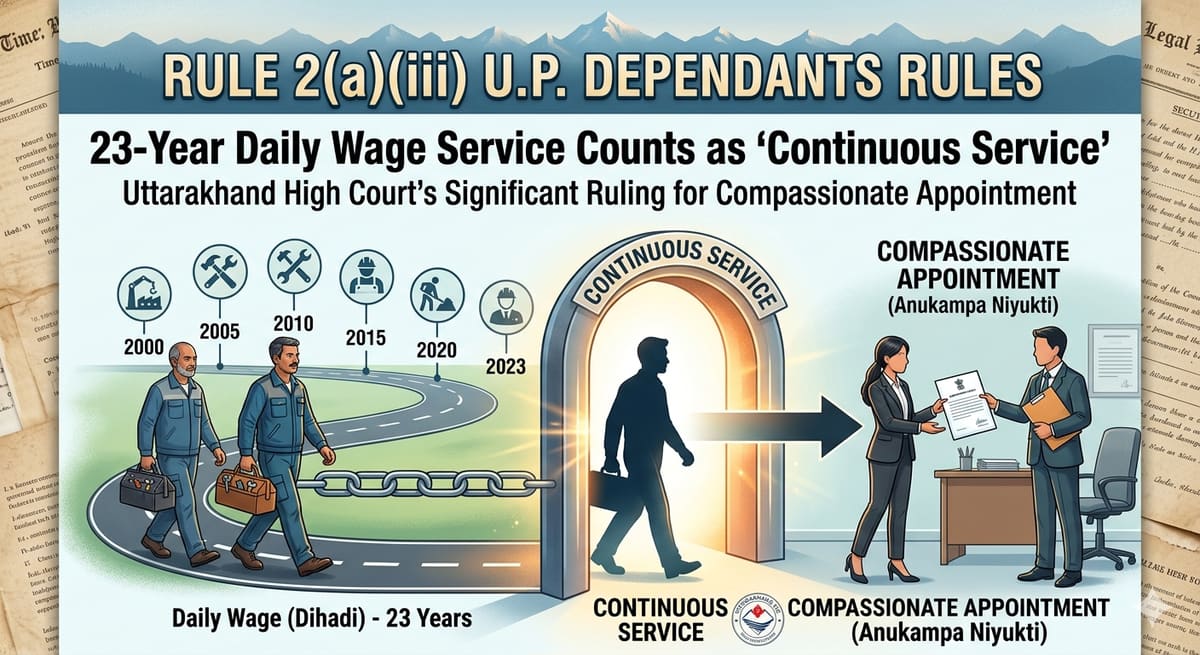
The Uttarakhand High Court has affirmed that long-term service by a non-regular employee in a government department can trigger eligibility for compassionate appointment under statutory rules, even in the absence of formal regularization. This ruling reinforces the principle that substantive service, not merely formal status, must inform administrative decisions in cases of death in harness.
Background & Facts
The Dispute
The petitioner seeks compassionate appointment following the death of his father, who served as a Beat Watcher in the Haldwani Forest Division of the Uttarakhand Forest Department. The father was engaged in this role since July 1990 and died on 04.11.2013 while on duty, having been attacked by a wild elephant. The petitioner applied for compassionate appointment in accordance with the U.P. Recruitment of Dependants of Government Servants (Dying in Harness) Rules, 1974. His application was rejected on 28.10.2020 by the Divisional Forest Officer on the ground that his father was never formally appointed and was merely a daily wager without any regular status.
Key Facts
The petitioner’s father commenced service as a Beat Watcher in July 1990
He served continuously for over twenty-three years until his death on 04.11.2013
His duties involved patrolling forest areas, preventing poaching, and mitigating human-wildlife conflict
He was never issued a formal appointment order and was paid on a daily wage basis
The State did not dispute the factual account of his service in the counter affidavit filed by Mr. Ramesh Chandra Kandpal, Divisional Forest Officer
The rejection order dated 28.10.2020 relied solely on the absence of a regular appointment
Procedural History
04.11.2013: Death of petitioner’s father while on duty
2014 - 2020: Petitioner made repeated representations for compassionate appointment, all unaddressed
28.10.2020: Competent Authority issued rejection order citing lack of regular appointment
05.05.2024: Writ Petition (WPSS/709/2024) filed before the Uttarakhand High Court
05.05.2026: Judgment delivered by Hon’ble Mr. Justice Manoj Kumar Tiwari
Relief Sought
The petitioner sought: (1) quashing of the rejection order dated 28.10.2020; (2) direction for his compassionate appointment as a regular employee or, alternatively, as a daily wager or contractual employee; and (3) recognition of his father’s 23-year service as qualifying under Rule 2(a)(iii) of the U.P. Rules, 1974.
The Legal Issue
The central question was whether a person who has rendered more than three years of continuous service in a regular vacancy, though not formally appointed, qualifies as a "Government Servant" under Clause (iii) of Rule 2(a) of the U.P. Recruitment of Dependants of Government Servants (Dying in Harness) Rules, 1974, and whether the dependant of such a person is entitled to compassionate appointment.
Arguments Presented
For the Petitioner
Learned counsel argued that the petitioner’s father, despite lacking a formal appointment order, had been continuously employed for over twenty-three years in a sanctioned post, performing duties integral to the Forest Department’s operations. Reliance was placed on Clause (iii) of Rule 2(a), which defines a "Government Servant" as one who, though not regularly appointed, had put in three years’ continuous service in a regular vacancy. Counsel cited Jaggo v. Union of India & Others (2024 INSC 1034), where the Supreme Court held that long-term service cannot be disregarded merely due to absence of formal appointment. Counsel further contended that even if regular appointment was not feasible, the Authority was obligated to consider the petitioner for engagement as a daily wager or contractual employee.
For the Respondent
The State, through the Deputy Advocate General, did not dispute the factual duration of service but maintained that the Rules require formal appointment for eligibility. The rejection order was defended on the basis that the deceased was a daily wager without any regular status, and therefore outside the purview of the Rules. No alternative relief or discretionary consideration was offered.
The Court's Analysis
The Court examined the language of Rule 2(a)(iii) and found that its intent was to include those who, despite lacking formal appointment, had rendered substantial and continuous service in a regular vacancy. The Court noted that the deceased had served for over two decades in a fixed role, with no indication of casual or intermittent engagement. The State’s counter affidavit did not challenge the continuity or nature of the service.
"Since petitioner’s father died while discharging duty in Forest Department in a human-animal conflict, therefore, it was incumbent upon the Competent Authority to consider petitioner’s claim for appointment sympathetically."
The Court emphasized that the Rules were designed to provide relief to families of those who sacrificed their lives in public service, regardless of technicalities of appointment. The State’s rigid interpretation would defeat the humanitarian purpose of the scheme. The Court further observed that the Authority had completely overlooked the possibility of offering employment as a daily wager or on contract, which would have been a reasonable and proportionate response.
The Court held that the petitioner’s father met the criteria under Rule 2(a)(iii), and that the rejection on the sole ground of non-regular appointment was legally unsustainable.
The Verdict
The writ petition was allowed. The Court set aside the rejection order dated 28.10.2020 and directed the Competent Authority to re-examine the petitioner’s claim for appointment as a daily wager or on contract. The Authority was directed to pass a necessary order within six weeks from the date of presentation of the certified copy of this order.
What This Means For Similar Cases
Service Duration Overrides Formal Appointment Status
Practitioners must now argue that continuous service exceeding three years in a regular vacancy, even without appointment order, satisfies the definition of "Government Servant" under Rule 2(a)(iii)
Authorities cannot reject compassionate claims solely on the basis of lack of formal appointment when service is long-term and uninterrupted
The Jaggo precedent now binds state departments to recognize substantive service over procedural formality
Compassionate Relief Must Be Proportionate and Discretionary
Even if regular appointment is not feasible, authorities must consider alternative forms of employment such as daily wage or contractual engagement
Failure to consider any alternative relief constitutes a failure of administrative discretion
Courts will intervene where no sympathetic or reasonable alternative is explored, particularly in cases of death in harness
Always document the nature, duration, and regularity of service in such cases
File applications for compassionate appointment within six months of death, but even delayed claims may be considered if service was long and uninterrupted
Cite Jaggo v. Union of India and Rule 2(a)(iii) together to establish entitlement