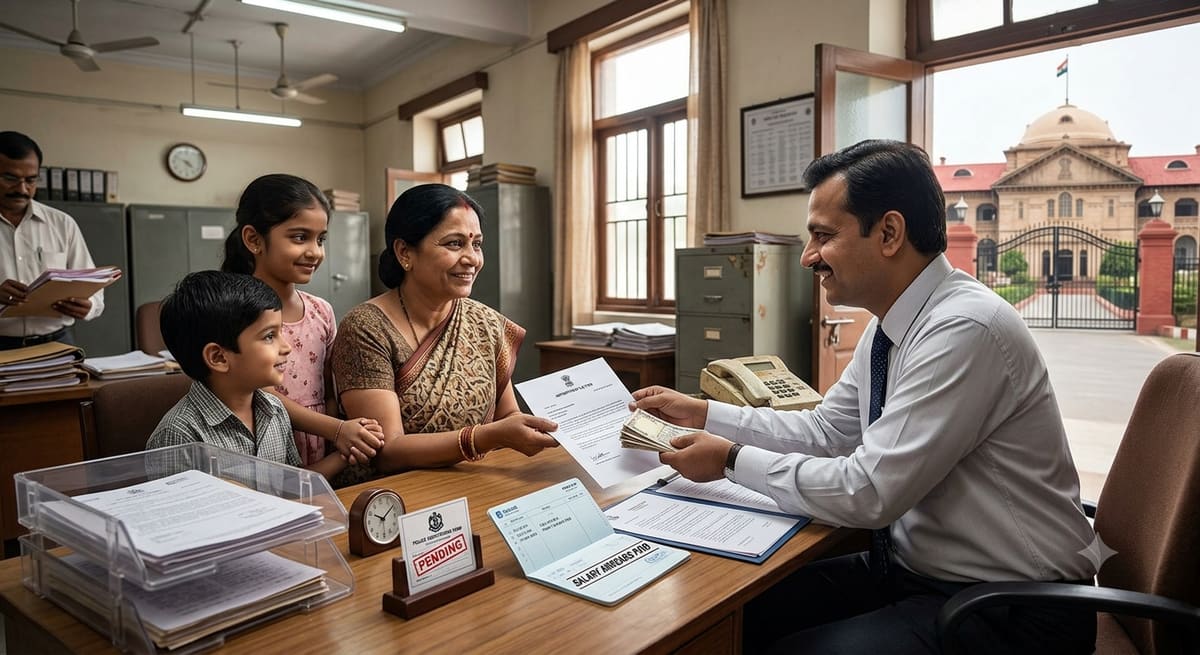
The Allahabad High Court set aside the order dated 17 March 2023 that refused to regularise the deceased father of the petitioner and directed the authorities to consider his regularisation and the petitioner’s claim for compassionate appointment under the Uttar Pradesh Dying-in-Harness Rules, 1974. The judgment underscores that a right to regularisation accrues and survives the employee’s death, and that administrative authorities must act without malice in law.
Background & Facts
The Dispute
The petitioner, Hasan Ahmad, seeks regularisation of his late father, Rifakat Hussain, who was a Junior Assistant in the Rural Engineering Department, Block Hardoi, from 01 Nov 1985 until his death on 11 Aug 2012. The petitioner also seeks a compassionate appointment for himself under the Uttar Pradesh Recruitment of Dependants of Government Servants Dying in Harness Rules, 1974.
Key Facts
- 01 Nov 1985: Rifakat Hussain engaged as Junior Assistant (Work Charge) in Rural Engineering Department, Block Hardoi.
- 07 Jul 2005: Seniority list for regularisation prepared, naming Rifakat Hussain at serial no. 58.
- 21 Jun 2012: Government Order sanctioned 172 Group-C posts for regularisation of daily-wage/work-charge employees.
- 14 Aug 2012: Selection Committee issued a letter directing certification of records and appearance before the committee on 30 Aug 2012.
- 11 Aug 2012: Rifakat Hussain died, before the regularisation process could be completed.
- 23 Mar 2018: Writ Petition No. 10144(SS) of 2017 disposed, directing the petitioner’s mother to file a representation for regularisation within three weeks.
- 08 Oct 2018: Respondent (Director & Chief Engineer, Rural Engineering Dept.) ordered that Rifakat Hussain’s regularisation could not be considered because he had died.
- 27 Jan 2023: Writ-A No. 3792 of 2019 set aside the 08 Oct 2018 order and directed the respondent to consider the claim for regularisation and compassionate appointment within six weeks.
- 17 Mar 2023: Impugned order again refused regularisation, stating no junior to the deceased had been regularised.
- 06 Aug 2026: Present judgment delivered, quashing the 17 Mar 2023 order and directing fresh consideration.
Procedural History
- 12 Jun 2024: Writ-A No. 4739 of 2024 filed before Allahabad High Court.
- 15 Nov 2024: Single Judge heard the matter.
- 23 Mar 2018: Earlier writ order (10144) directed representation for regularisation.
- 08 Oct 2018: Respondent issued order refusing regularisation.
- 27 Jan 2023: Writ-A No. 3792 of 2019 set aside the 08 Oct 2018 order and mandated consideration.
- 17 Mar 2023: Respondent issued another order refusing regularisation.
- 06 Aug 2026: Present judgment delivered.
Parties' Positions
- Petitioner: Argues that the right to regularisation accrued before his father’s death and therefore survives; seeks regularisation of the deceased and compassionate appointment under the 1974 Rules.
- Respondent (State): Contends that the deceased employee was not a “government servant” within the meaning of the 1974 Rules and that the claim is barred by delay and by the father’s death.
Relief Sought
The petitioner seeks:
- Quashing of the impugned order dated 17 Mar 2023.
- Direction to the Director and Chief Engineer, Rural Engineering Department, to consider the father’s regularisation and, if regularised, to consider the petitioner’s claim for compassionate appointment under the 1974 Rules.
- Costs of Rs 50,000.
The Legal Issue
Whether the legal right to regularisation of a daily-wage/work-charge employee survives the employee’s death and can be considered for a compassionate appointment of the legal heir under the Uttar Pradesh Recruitment of Dependants of Government Servants Dying in Harness Rules, 1974.
Arguments Presented
For the Petitioner
- The petitioner relied on the Division Bench decision in Kuldeep Thakur v. State of U.P. and the Full Bench judgment in Pawan Kumar Yadav v. State of U.P. that a right to regularisation, once crystallised, does not extinguish on death.
- Cited Secretary, State of Karnataka v. Umadevi for the principle that accrued rights survive the employee’s demise.
- Emphasised that the seniority list of 07 Jul 2005 already included his father, indicating a vested right to be considered for regularisation.
- Asserted that the respondent’s repeated refusal amounted to “malice in law” as defined by Ratnagiri Gas & Power Pvt. Ltd. v. RDS Projects and West Bengal State Electricity Board v. Dilip Kumar Ray.
For the Respondent
- Argued that daily-wage/work-charge employees are not “government servants” under Rule 2(a)(iii) of the 1974 Rules, citing Pawan Kumar Yadav.
- Maintained that the petitioner's claim is barred by the five-year limitation under Rule 5(iii) of the 1974 Rules and that the delay cannot be condoned.
- Contended that the father’s death precludes any consideration of regularisation, as the employee was not alive to benefit.
The Court's Analysis
The Court first examined the statutory framework governing regularisation of daily-wage employees under the Uttar Pradesh Regularisation of Daily Wages Appointments on Group-C Posts (1998) and the 2001 Rules. It noted that the seniority list prepared on 07 Jul 2005 expressly named the deceased, thereby creating a vested right to be considered for regularisation.
"The consideration of such right, whether had accrued, does not get eclipsed nor could it be abandoned."
The Court then turned to precedent. It distinguished Pawan Kumar Yadav on the ground that the latter dealt with the definition of “government servant” but did not address the survival of a vested regularisation right after death. The Court relied heavily on Kuldeep Thakur where the Division Bench held that a deceased employee’s right to regularisation must be considered before deciding any dependent’s claim for compassionate appointment.
The doctrine of “malice in law” was explored. Citing Ratnagiri Gas and West Bengal State Electricity Board, the Court held that the respondent’s repeated refusal, despite clear mandamus, amounted to administrative malice - an act taken without lawful justification and in contravention of a binding judicial direction.
Statutory interpretation of Rule 5(iii) of the 1974 Rules was undertaken. While the rule imposes a five-year limitation for applications, the Court observed that the proviso allows the State to dispense with the limitation where “undue hardship” is shown. Given the petitioner’s mother had previously filed a representation within the statutory period, the Court found no ground to reject the claim on delay.
Finally, the Court applied the principle from Secretary, State of Karnataka v. Umadevi that accrued rights survive the employee’s death and must be honoured in favour of legal heirs. Accordingly, the deceased employee was deemed to have been regularised from the date he became eligible, and all consequential benefits flow to his heirs.
The Verdict
The petition is allowed. The order dated 17 Mar 2023 refusing regularisation is set aside. The Director and Chief Engineer, Rural Engineering Department, are directed to:
- Consider the deceased father’s claim for regularisation as per the seniority list of 07 Jul 2005.
- If regularisation is confirmed, consider the petitioner’s claim for compassionate appointment under the Uttar Pradesh Recruitment of Dependants of Government Servants Dying in Harness Rules, 1974.
- Complete the entire exercise within two months of receiving a certified copy of this order.
- Pay costs of Rs 50,000 to the petitioner.
What This Means For Similar Cases
Right to Regularisation Survives Death
Practitioners must argue that once a seniority list or statutory provision creates a vested right to regularisation, the right does not extinguish on the employee’s death. Courts will enforce that right in favour of legal heirs.
Administrative Authorities Must Avoid Malice in Law
Repeated refusal of a mandated order, especially after a clear judicial direction, can be characterised as malice in law. Lawyers should highlight such conduct to obtain contempt or punitive relief.
Flexibility in the Five-Year Limitation
The proviso to Rule 5(iii) of the 1974 Rules permits the State to relax the five-year deadline where undue hardship is shown. Evidence of earlier representations can be used to overcome limitation objections.
Actionable Takeaways
- File representation within statutory time-limits and preserve copies for future reliance.
- Cite Kuldeep Thakur and Secretary, State of Karnataka when arguing survival of accrued rights.
- Document any administrative non-compliance to establish malice in law.
- Request specific compliance timelines in writ orders to ensure enforceability.