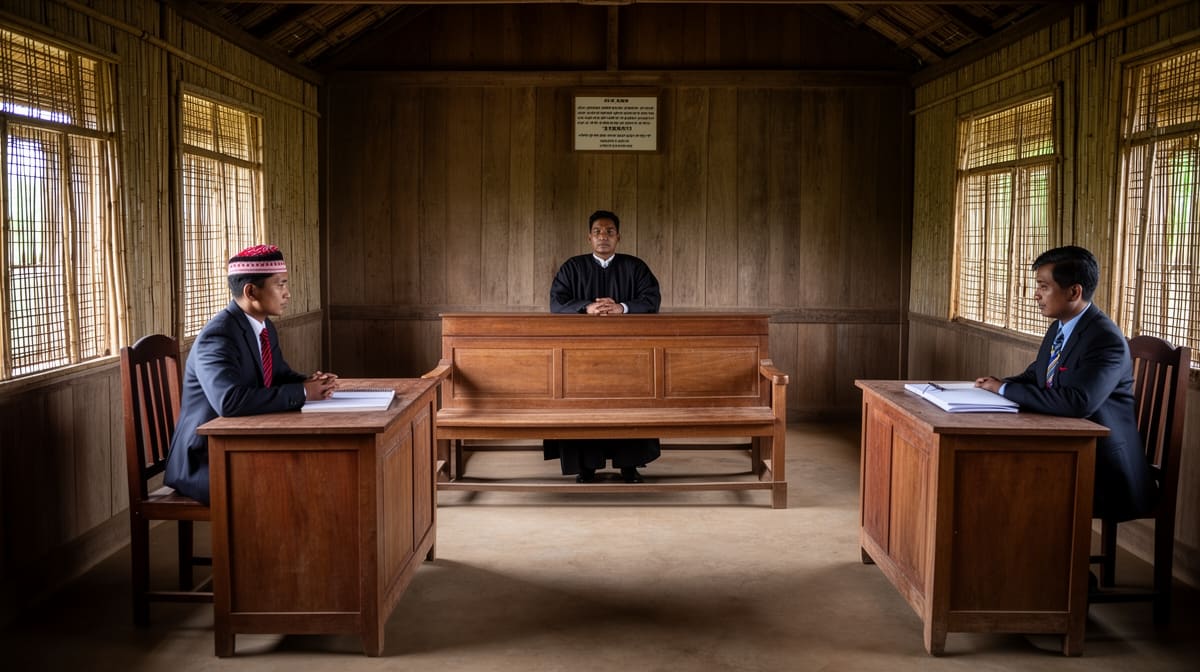
The Meghalaya High Court has clarified the legal authority of the Chief Executive Member of a Khasi Hills Autonomous District Council to sign orders on behalf of the Executive Committee, reinforcing that such authority flows directly from statutory rule, not delegated delegation. This decision resolves a critical ambiguity in the procedural validity of administrative orders under autonomous district governance frameworks.
Background & Facts
The Dispute
The dispute arose from an order dated 21 December 2023, passed by the Executive Committee of the Khasi Hills Autonomous District Council (KHADC), which rejected a petition challenging land allocation. The order was signed by the Chief Executive Member alone. The petitioner challenged this in a writ petition, arguing that under the applicable rules, only orders signed by multiple members of the Executive Committee were valid. The High Court initially agreed, holding the order incompetent for being signed by a single member.
Procedural History
- 21 December 2023: Executive Committee issues order rejecting petitioner’s claim; signed by Chief Executive Member.
- 81 of 2024: Writ petition filed challenging the order’s validity on grounds of improper authentication.
- 24 November 2025: High Court rules order invalid because signed by only one member, not the full committee.
- Review Petition No. 24 of 2025: Filed to correct the error, asserting that Rule 28(2) permits the Chief Executive Member to sign independently.
Relief Sought
The review petitioner seeks recall of the earlier judgment and restoration of the writ petition for adjudication on merits, arguing that the original ruling misinterpreted Rule 28(2) of the Assam and Meghalaya Autonomous Districts (Constitution of District Councils) Rules, 1951.
The Legal Issue
The central question was whether Rule 28(2) of the Assam and Meghalaya Autonomous Districts (Constitution of District Councils) Rules, 1951, requires the Chief Executive Member to obtain written authorization before signing orders of the Executive Committee, or whether such authority is inherent and self-executing.
Arguments Presented
For the Petitioner
Learned counsel relied on Rule 28(2), arguing that it explicitly permits the Chief Executive Member to sign orders in his own capacity without any prior written authorization. He emphasized that the rule distinguishes between the Chief Executive Member and other members - while the latter require delegation, the former do not. He further contended that the original judgment overlooked this textual distinction, leading to a misapplication of the law.
For the Respondent
Respondents argued that Rule 31, which imposes collective responsibility on the Executive Committee, overrides Rule 28(2) in matters of adjudication. They contended that any order affecting rights must reflect the collective will of the committee, and a single signature - even by the Chief Executive Member - undermines this principle. They also cited the 2024 amendment to the Khasi Hills Act as evidence of legislative intent to require multi-member participation.
The Court's Analysis
The Court undertook a textual and structural interpretation of Rule 28(2), noting its deliberate bifurcation: while other members require written authorization from the Chief Executive Member, the Chief Executive Member himself is not subject to any such condition. The Court observed that the rule does not say "the Chief Executive Member or any other member authorized in writing," but rather "signed by the Chief Executive Member or any other Members... authorized in writing." This grammatical structure confirms that the Chief Executive Member stands in a distinct category.
"Every such order or instrument shall be signed by the Chief Executive Member or any other Members of the Executive Committee authorized in writing by the Chief Executive Member in this behalf and such signature shall be deemed to be the proper authentication of such order or instrument."
The Court rejected the argument that Rule 31 imposes a collective signing requirement, clarifying that Rule 31 governs accountability and responsibility, not authentication procedure. It further held that the 2024 amendment to the Khasi Hills Act, though relevant, could not be applied retrospectively to an order passed in December 2023. The Court emphasized that statutory interpretation must respect the plain meaning of the text and the hierarchy of rules.
The Verdict
The review petitioner succeeded. The Court held that the Chief Executive Member has inherent authority under Rule 28(2) to sign Executive Committee orders without written authorization, and that the earlier judgment was based on a misreading of the rule. The order dated 24 November 2025 was recalled, and the original writ petition was restored for fresh hearing.
What This Means For Similar Cases
Signature by Chief Executive Member Is Sufficient
- Practitioners must now treat any order signed by the Chief Executive Member as prima facie valid under Rule 28(2), absent evidence of fraud or ultra vires action.
- Challenges based solely on the absence of multiple signatures will fail unless the rule explicitly requires collective signing.
Statutory Amendments Do Not Apply Retroactively
- Where a rule or statute is amended after an order is passed, the amended version cannot be invoked to invalidate prior actions unless expressly made retrospective.
- Courts must apply the law as it stood at the time of the administrative act.
Rule Hierarchy Matters: Authentication ≠ Accountability
- Rules governing authentication (e.g., Rule 28) are distinct from those governing accountability (e.g., Rule 31).
- A single signature does not imply unilateral decision-making; it merely satisfies procedural formality.
Procedural Compliance Is Non-Negotiable
- Administrative bodies must ensure their orders comply with the precise language of governing rules.
- Courts will not infer requirements not stated in the text, even if policy considerations suggest otherwise.