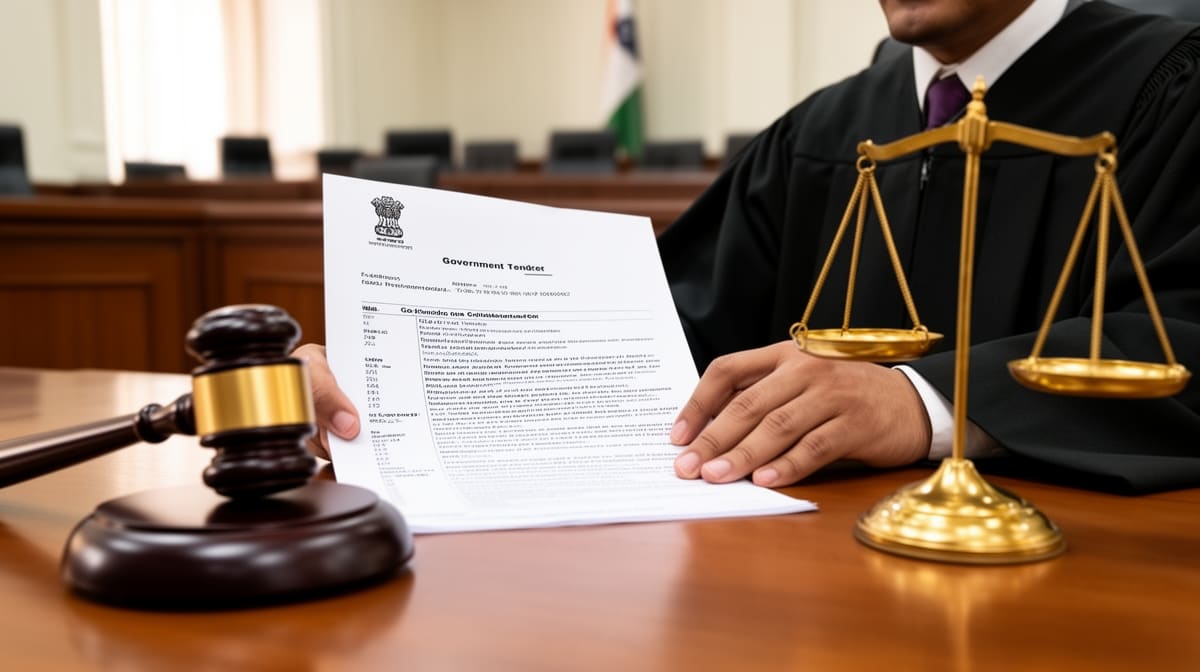
The Madras High Court has affirmed that public tenders exceeding Rs.1 crore must strictly comply with the mandatory 15-day bid submission period under the Tamil Nadu Transparency in Tender Rules, 2000. While declining to quash an already-executed contract, the Court directed a fresh tender to ensure procedural integrity, setting a clear precedent for administrative compliance in public procurement.
Background & Facts
The Dispute
The petitioner challenged the tender notification issued by the Chief Engineer, Udangudi Supercritical Thermal Power Project Stage I, for housekeeping and maintenance services across critical plant areas including BTG, BOP, AHP/CHP, and coal jetty. The tender, specified under document CE/SE/C/USTPP-I/09/2025-26, was published on the official website on 04.03.2026, with a bid submission period of only seven days.
Key Facts
- The contract value exceeded Rs.1 crore, triggering mandatory compliance with Rule 20 of the Tamil Nadu Transparency in Tender Rules, 2000
- Rule 20 requires a minimum bid submission period of 15 days for tenders exceeding Rs.1 crore
- The tender notice did not record any justification for reducing the period from 15 to 7 days
- The tender was issued on 28.02.2026 and published on 04.03.2026
- Bids were opened on 10.03.2026
- A work order was issued to the successful bidder on 13.03.2026
- The contract term is for 120 days, expiring on 12.07.2026
- The interim order dated 10.03.2026 restraining finalization was served on the respondent only on 17.03.2026, after the work order had been issued
Procedural History
- 28.02.2026: Tender notification issued internally
- 04.03.2026: Tender published on official website with 7-day bid window
- 10.03.2026: Technical bids opened
- 13.03.2026: Work order issued to successful bidder
- 10.03.2026: Writ Petition No.6606/2026 filed before Madras High Court
- 10.03.2026: Court issued interim order restraining finalization (returnable 24.03.2026)
- 17.03.2026: Interim order received by respondent via postal acknowledgment
- 08.04.2026: Judgment delivered
Relief Sought
The petitioner sought quashing of the tender notification dated 28.02.2026 on grounds of violation of Rule 20 of the Tamil Nadu Transparency in Tender Rules, 2000, and a direction to conduct a fresh tender with a 15-day bid period.
The Legal Issue
The central question was whether a public tender exceeding Rs.1 crore may lawfully reduce the mandatory 15-day bid submission period to seven days under the Tamil Nadu Transparency in Tender Rules, 2000, without recording any reasons for such deviation.
Arguments Presented
For the Petitioner
The petitioner contended that Rule 20 of the Tamil Nadu Transparency in Tender Rules, 2000, is mandatory and leaves no discretion to reduce the 15-day period. Reliance was placed on the principle of audi alteram partem and the constitutional mandate of transparency under Article 14. The absence of any recorded justification for the reduction rendered the process arbitrary and violative of statutory norms.
For the Respondent
The respondent argued that the tender was for a short-term, time-bound service requirement of 120 days, necessitating expeditious procurement. It was submitted that the work order had already been issued and the contract was being executed, and quashing would cause public inconvenience and financial loss. The delay in service of the interim order was attributed to administrative lapse, not malafide intent.
The Court's Analysis
The Court acknowledged that the tender process was in clear violation of Rule 20 of the Tamil Nadu Transparency in Tender Rules, 2000, which mandates a minimum 15-day bid period for tenders exceeding Rs.1 crore. The absence of any recorded reasons for reducing the period to seven days rendered the decision procedurally flawed and arbitrary.
"No reasons have been recorded for reducing the period from 15 days to 7 days. Therefore, on the face of it, the tender process is in violation of Rule 20 of the Rules."
The Court noted that while the violation was evident, the contract had already been awarded and was being executed. Quashing the tender at this stage would serve no practical purpose, as the existing contract would expire on 12.07.2026 regardless. The Court emphasized that the purpose of the Rules is not merely punitive but to ensure fairness and transparency in public procurement.
The Court further held that permitting the existing contract to continue beyond its term would undermine the statutory framework. Hence, while declining to interfere with the completed process, the Court imposed a remedial direction to ensure future compliance.
The Verdict
The writ petition was disposed of with a direction to the respondent to issue a fresh tender notification for the same work and complete the entire tender process on or before 30.06.2026, to enable commencement of the new contract from 12.07.2026. The respondent was expressly prohibited from extending the contract awarded to the present successful bidder under any circumstances. The fresh tender must strictly conform to the Tamil Nadu Transparency in Tender Act, 1998 and the Rules, 2000, including the mandatory 15-day bid period. No costs were awarded.
What This Means For Similar Cases
Mandatory Periods Cannot Be Circumvented Without Reason
- Public authorities must record specific, justifiable reasons for deviating from mandatory tender timelines under Rule 20
- Absence of recorded justification renders the process legally vulnerable, even if completed
- Courts will not tolerate procedural shortcuts in public procurement, regardless of urgency claims
Remedial Directions Over Quashing in Completed Tenders
- Where a tender is completed but violates statutory norms, courts may issue remedial directions instead of quashing
- Fresh tenders must be initiated with full compliance, not as a mere formality
- Existing contracts cannot be extended to circumvent judicial directions
Compliance Deadlines Are Binding
- Courts are increasingly imposing concrete deadlines for corrective action (e.g., 30.06.2026)
- Practitioners must advise clients to initiate tenders with buffer time to meet judicial timelines
- Non-compliance with court-ordered deadlines may attract contempt proceedings