The Madhya Pradesh High Court has reaffirmed that adult individuals who enter into voluntary marriages are entitled to state protection against familial harassment, reinforcing the constitutional right to personal autonomy under Article 21. This judgment provides critical procedural clarity for couples facing threats due to inter-caste or inter-faith unions, establishing a clear pathway for police intervention without requiring prior judicial approval of marital validity.
Background & Facts
The Dispute
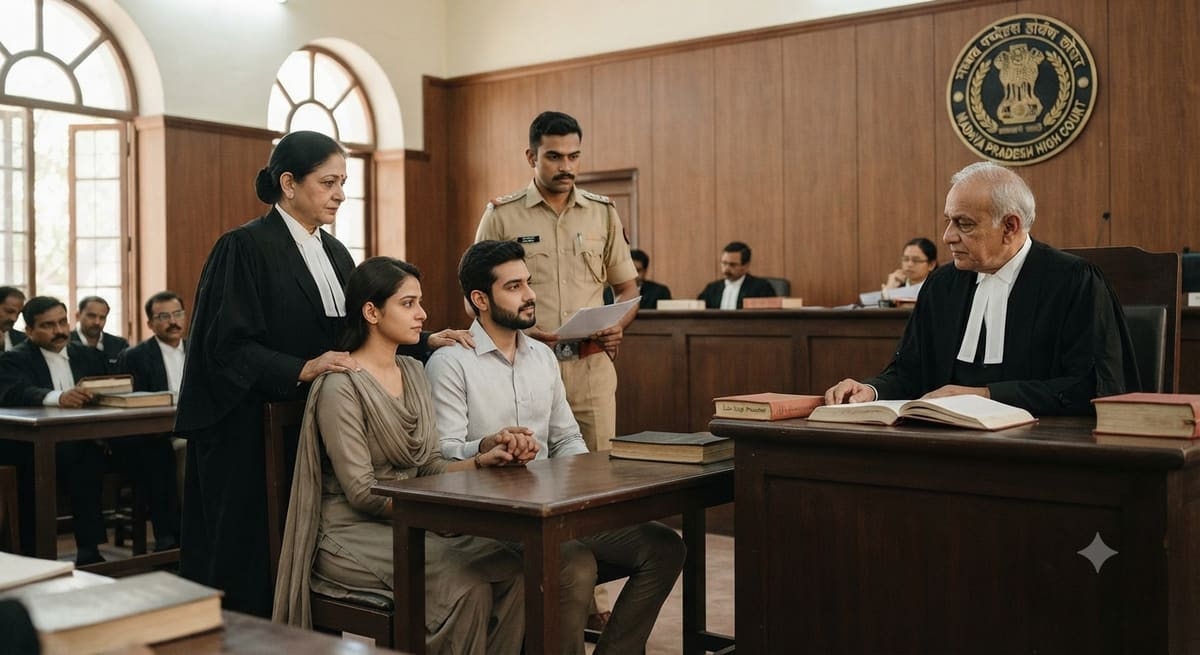
The petitioners, Khushi and others, are adult individuals who have voluntarily entered into a marital relationship. Their families, identified as respondents nos. 3 to 8, are allegedly harassing them on account of the marriage, threatening their safety and well-being. The petitioners, fearing for their lives, sought immediate police protection from the High Court.
Procedural History
The petition was filed under Article 226 of the Constitution seeking urgent relief. The petitioners submitted:
- Photocopies of their Aadhaar cards as proof of age
- Mark sheets of Petitioner No. 1 to corroborate age
- Photographs of the marriage ceremony as evidence of union No formal marriage certificate was produced, but the petitioners asserted the marriage was solemnized in accordance with personal law.
Relief Sought
The petitioners sought:
- Immediate police protection against family members
- Assurance that no FIR would be registered against them by relatives
- Direction to authorities to verify their documents and confirm the legality of their marriage
The Parties' Positions
The petitioners argued that as major adults, their choice of spouse is protected under Article 21 and cannot be overridden by familial objections. The State, through the Advocate General, did not oppose the relief sought but emphasized the need for procedural verification of documents before granting protection.
The Legal Issue
The central question was whether adult petitioners in a voluntary marriage are entitled to police protection against familial harassment, even in the absence of a formal marriage certificate, and whether such protection can be conditioned upon document verification by police authorities.
Arguments Presented
For the Petitioner
The petitioners relied on Lata Singh v. State of U.P. (AIR 2006 SC 2522) to assert that the right to choose a life partner is an integral part of personal liberty under Article 21. They further cited Shakti Vahini v. Union of India (2018) 7 SCC 192, which mandates state intervention to prevent honor-based violence. They argued that police protection is not a privilege but a constitutional obligation when life and liberty are threatened.
For the Respondent
The State did not contest the petitioners’ right to protection but stressed that police action must be based on verified facts. It contended that without authenticated proof of age and marriage, authorities cannot conclusively determine whether the union is lawful or whether harassment claims are genuine. The State emphasized procedural prudence to prevent misuse of judicial orders.
The Court's Analysis
The Court examined the constitutional framework established in Lata Singh and Shakti Vahini, noting that the state’s duty to protect citizens from honor-based violence is non-negotiable. The Court held that the petitioners’ submission of Aadhaar cards and academic records constituted sufficient prima facie evidence of majority and voluntary union.
"If the petitioners are major and have entered into the marriage voluntarily, then they should not be harassed by any one just because they have objection with their marriage."
The Court clarified that while it does not validate the marriage documents, it directs police to verify them as part of their duty to assess threat. The burden of proving illegality or coercion lies with the objecting family members, not the petitioners. The Court emphasized that protection must be immediate and not contingent on exhaustive documentation, especially where life is at risk.
The Court further distinguished between judicial approval of marriage validity and police action to prevent harm. Police are not adjudicators of marital law but protectors of constitutional rights. The directive to approach the Superintendent of Police or nearest station ensures accessibility without compromising due process.
The Verdict
The petitioners succeeded. The Court held that adult couples in voluntary marriages are entitled to immediate police protection against familial harassment, even without formal marriage certificates. The authorities must verify documents and refrain from registering FIRs against petitioners if their age and marriage are confirmed. Protection is confined to the specific union alleged and must be implemented promptly.
What This Means For Similar Cases
Police Protection Is a Constitutional Right, Not a Discretionary Favor
- Practitioners must now argue that any threat to life or liberty due to consensual marriage triggers an automatic duty of the state to intervene
- Delay in granting protection can amount to violation of Article 21, as per Shakti Vahini
- Courts should not require exhaustive documentation before granting interim protection
Verification by Police Is Procedural, Not Prejudicial
- Police may verify documents to assess threat level, but cannot use incomplete paperwork to deny protection
- Absence of a marriage certificate does not invalidate the claim of voluntary union
- If documents are found authentic, authorities must prevent registration of FIRs by objecting relatives
- This creates a clear protocol: verify → protect → prosecute harassers, not victims
No FIR Against Couples for Love Marriages Without Due Cause
- Relatives cannot initiate criminal proceedings merely on grounds of disapproval of inter-caste or inter-faith marriage
- Any FIR filed against petitioners under Sections 498A, 307, or 506 IPC must be scrutinized for mala fide intent
- This judgment empowers lawyers to move for quashing of such FIRs on grounds of abuse of process
- Legal aid organizations should use this order to file model applications for police protection across India