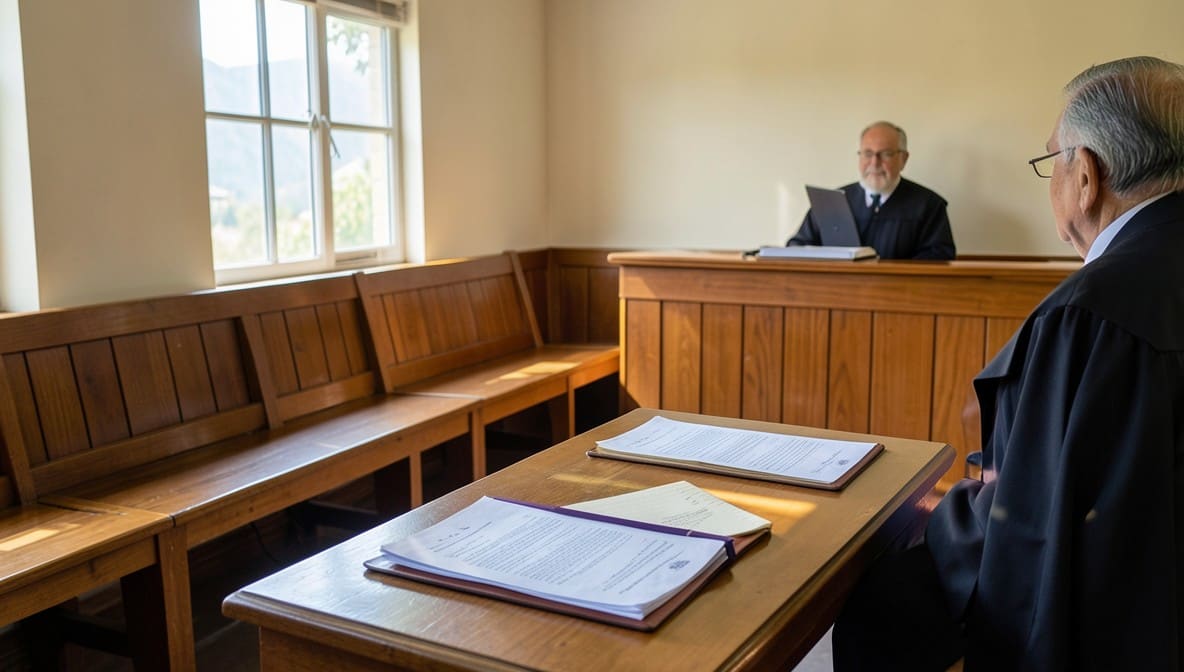
The Bombay High Court has reaffirmed the limited scope of revisional jurisdiction under the Code of Criminal Procedure, holding that appellate re-appreciation of evidence cannot be masked as revisional correction. This judgment reinforces the principle that acquittals are entitled to high deference and cannot be overturned merely because a higher court disagrees with the factual findings of lower courts.
Background & Facts
The Dispute
The dispute arose from allegations that the accused, Sudam s/o Wamanrao Rajbhoj, fraudulently acquired land by forging sale deeds and manipulating land records. The complainant, Shaikh Subhan, claimed that the land in Survey No. 7/1 belonged to his family and that the accused, along with officials, fabricated documents to show ownership of 6750 sq. meters of land that was actually part of a graveyard or owned by Peoples Education Society.
Procedural History
The case progressed through multiple judicial forums:
- 2006: F.I.R. registered under Sections 420, 468, 465, 467, and 471 IPC after complaint by Shaikh Subhan.
- 2008: Trial commenced before the J.M.F.C. under R.C.C. No. 1804 of 2008.
- 2015: J.M.F.C. convicted the accused under Sections 417, 465, 468, and 471 IPC, but acquitted on Sections 420 and 467.
- 2019: Sessions Judge allowed the appeal, acquitted the accused, and set aside the conviction, finding insufficient proof of dishonest intent and deception.
- 2021: Revision petition filed under Section 397 read with Section 401 Cr.P.C. challenging the acquittal.
Relief Sought
The revisionist sought to set aside the acquittal and restore the conviction, arguing that the Sessions Judge had erred in re-appreciating evidence and ignoring material proof of forgery and cheating.
The Legal Issue
The central question was whether the High Court, exercising revisional jurisdiction under Section 397 Cr.P.C., can substitute its own appreciation of evidence to overturn an acquittal granted by the Sessions Court, particularly when no patent legal error or jurisdictional flaw is demonstrated.
Arguments Presented
For the Petitioner
The revisionist contended that the Sessions Judge had improperly acted as an appellate court by re-evaluating witness credibility and documentary evidence. He relied on Amit Kapoor v. Ramesh Chander to argue that the lower court had ignored material evidence - such as the handwriting expert’s partial admission and the Land Record Office’s attested entries - that pointed to fabrication. He asserted that the acquittal was based on a misreading of the prosecution’s case and that revisional powers must be invoked to correct a manifest miscarriage of justice.
For the Respondent
The State and the accused countered that the Sessions Judge had correctly applied the standard of proof beyond reasonable doubt. They cited Pandit Ukha Kolhe v. State of Maharashtra to emphasize that revisional jurisdiction is not a substitute for appeal. They argued that the prosecution failed to establish the essential ingredients of cheating under Section 415 IPC - specifically, that the complainant was deceived into parting with property. The accused also highlighted that the complainant himself admitted to knowing about the sale and not challenging it for decades, undermining any claim of fraud.
The Court's Analysis
The Court examined the scope of Section 397 Cr.P.C. and reiterated the settled principle that revisional jurisdiction is not meant for re-trial or re-appreciation of evidence. It quoted from Amit Kapoor v. Ramesh Chander:
"The object of this provision is to set right a patent defect or an error of jurisdiction or law. There has to be a well-founded error and it may not be appropriate for the court to scrutinise the orders, which upon the face of it bears a token of careful consideration and appear to be in accordance with law."
The Court found that the Sessions Judge had not committed any jurisdictional error, nor had he ignored material evidence. Instead, he had conducted a reasoned re-evaluation of witness testimony, including the admissions of prosecution witnesses in cross-examination. The handwriting expert could not confirm forgery; the Land Record Officer attested the entries as official; and the complainant failed to prove any direct loss or inducement to part with property.
The Court further emphasized Section 401(3) Cr.P.C., which explicitly bars conversion of an acquittal into a conviction except in exceptional circumstances. No such circumstances were present. The Sessions Judge’s order reflected a careful, evidence-based application of the law, not perversity or illegality.
The Court concluded that the revisionist’s grievance was essentially with the factual findings, which lie beyond the purview of revision. To allow such interference would undermine the finality of acquittals and convert revision into a second appeal.
The Verdict
The revision was dismissed. The Court held that revisional jurisdiction under Section 397 Cr.P.C. cannot be invoked to re-appreciate evidence or overturn an acquittal absent a patent legal error or jurisdictional flaw. The acquittal of the accused was upheld.
What This Means For Similar Cases
Revision Cannot Be a Second Appeal
- Practitioners must distinguish between appellate and revisional remedies: if the grievance is factual re-appreciation, file an appeal, not a revision.
- Courts will dismiss revisions that merely reargue evidence, even if the lower court’s findings appear lenient.
- Revision petitions must identify specific legal errors - such as misapplication of burden of proof or exclusion of admissible evidence - not mere disagreement with findings.
Acquittals Are Presumed Correct Unless Manifestly Illegal
- The burden on the revisionist is high: they must show the acquittal was based on no evidence, arbitrary reasoning, or violation of procedure.
- Admissions by prosecution witnesses during cross-examination, if properly noted, can justify acquittal even if the trial court initially convicted.
- Delay in challenging a transaction, as in this case, weakens claims of fraud and supports the legitimacy of the acquittal.
Documentary Evidence Must Be Authenticated, Not Assumed Fake
- Merely alleging forgery is insufficient; the prosecution must prove the accused caused the falsification.
- Official records attested by revenue officers, even if later disputed, carry presumptive validity unless proven fraudulent by the accused’s direct act.
- Handwriting experts must provide conclusive opinions; partial or inconclusive testimony cannot sustain a conviction for forgery.