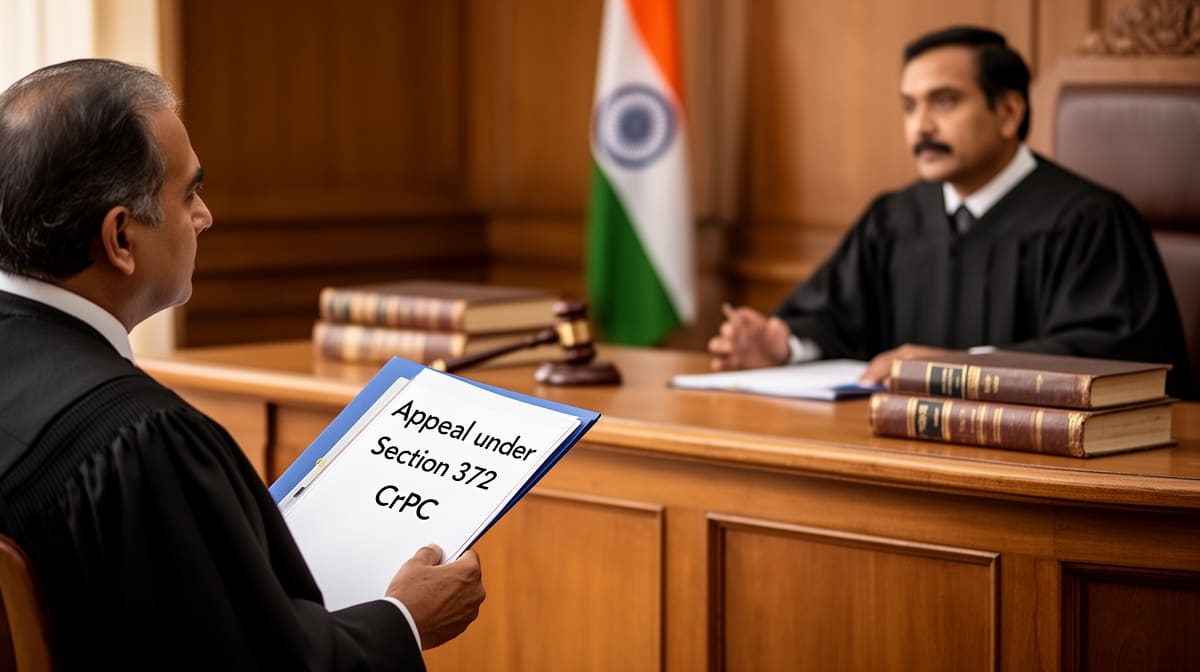
The Allahabad High Court's judgment in M. Khan v. Alam Khan reaffirms the limited scope of revisional jurisdiction against acquittal under Sections 397/401 of the Criminal Procedure Code (CrPC). The Court held that interference in acquittal is warranted only in exceptional cases involving glaring procedural defects, manifest errors of law, or flagrant miscarriage of justice. The judgment underscores the legal principle that the right of private defense extends to protecting both person and property, and that courts must adopt the view favorable to the accused when two reasonable conclusions are possible on evidence.
Background & Facts
The Dispute
The case arises from a violent altercation between two groups over possession of agricultural land in Pokhra fields, Plot Nos. 6785 and 6788, within Police Station Baberu, District Banda. The informant side (complainants) alleged that the accused persons, led by Murad Khan, were grazing cattle on their standing crop. When objection was raised, the accused allegedly called reinforcements and assaulted the complainants with lathis, and Gulam Nabi fired two gunshots with intent to kill.
Key Facts
- Disputed Land: Pokhra fields, Plot Nos. 6785 and 6788, Police Station Baberu, District Banda
- Date of Occurrence: Not explicitly mentioned, but the incident led to simultaneous FIRs from both sides
- Prosecution Allegations: Accused persons assaulted the complainants with lathis and fired gunshots
- Defense Version: Accused Murad Khan and his family were in settled possession of the land, harvesting crops (alsi and wheat), when the complainants unlawfully entered and initiated the assault
- Injuries: Complainant side sustained 11 simple injuries; accused side sustained 43 serious injuries, and one Amin Khan died due to injuries from the same incident
- Documentary Evidence: Khasra and Khatauni entries indicated possession of Murad Khan over the disputed plots
Procedural History
- Sessions Trial No. 140 of 1980 (State vs. Alam & Ors.): Charges under Sections 147, 307/149, 323/149 IPC framed against opposite party nos. 1 to 11
- 03.02.1982: Trial court acquitted all accused, holding they acted in exercise of right of private defense
- Criminal Revision No. 795 of 1982: Filed by the revisionist (complainant side) challenging the acquittal
- 24.04.2026: Matter reserved for judgment
- 23.06.2026: High Court dismissed the revision, affirming the acquittal
Parallel Litigation
- Sessions Trial No. 131 of 1980 (State vs. Mubaraq Khan & Ors.): Complainant side (Chirag, Ata Ullah, Mubarak, and Budda) were convicted under Sections 304 Part II/34, 323/34 IPC for the same incident
- Sentence: Five years rigorous imprisonment under Section 304 Part II/34 IPC and one year rigorous imprisonment under Section 323/34 IPC
- Criminal Appeal No. 315 of 1982: Filed by the convicts; dismissed by the High Court on 04.12.2006, with the sentence modified to fine
Relief Sought
The revisionist sought to set aside the acquittal order dated 03.02.1982 and convict the accused under Sections 147, 307/149, and 323/149 IPC.
The Legal Issue
The central question before the High Court was whether the revisional jurisdiction under Sections 397/401 CrPC permits interference with an acquittal order where:
- The trial court relied on documentary evidence (revenue records) to establish possession of the accused;
- The prosecution failed to explain injuries sustained by the accused and the death of a co-accused;
- The trial court extended the benefit of right of private defense under Sections 96 and 97 IPC to the accused; and
- Two reasonable views of the evidence were possible.
Arguments Presented
For the Revisionist
- The trial court failed to properly appreciate the testimony of injured witnesses and wrongly extended the benefit of right of private defense to the accused
- The findings recorded by the trial court were against the evidence on record and thus liable to be set aside
- The acquittal was perverse and resulted in miscarriage of justice
For the State
- The judgment of acquittal was based on proper appreciation of evidence and did not suffer from perversity, illegality, or jurisdictional error
- The trial court correctly relied on documentary evidence (Khasra and Khatauni) to establish possession of the accused
- The prosecution failed to explain injuries on the accused side, which cast doubt on its version
- The accused acted in exercise of lawful right of private defense, and thus the acquittal was justified
The Court's Analysis
The High Court conducted a detailed examination of the scope of revisional jurisdiction under Sections 397/401 CrPC, emphasizing that interference with an acquittal is exceptional and limited. The Court relied on a series of Supreme Court precedents to delineate the boundaries of its power:
"The revisional jurisdiction against acquittal should be exercised only in exceptional cases where there is glaring defect in procedure or manifest error of law resulting in flagrant miscarriage of justice. The revisional court should not re-appreciate evidence merely because another view is possible."
(D. Stephens v. Nosibolla, AIR 1951 SC 196)
The Court further elaborated on the four exceptional situations where interference is warranted:
- Where the trial court has wrongly shut out admissible evidence;
- Where material evidence has been ignored;
- Where the finding is wholly perverse; or
- Where the acquittal has resulted in gross miscarriage of justice.
(K. Chinnaswamy Reddy v. State of Andhra Pradesh, AIR 1962 SC 1788)
Applying these principles, the Court held that the trial court's findings were fully supported by documentary evidence (Khasra and Khatauni entries), which established the possession of Murad Khan over the disputed land. The prosecution failed to dislodge this evidence or explain the 43 serious injuries sustained by the accused side and the death of Amin Khan in the same incident. The Court observed:
"Non-explanation of injuries sustained by the accused is a very important circumstance which shows that the prosecution has suppressed the genesis and origin of the occurrence. Where injuries on the accused are serious in nature and remain unexplained, the prosecution case becomes doubtful and the defense version gains probability."
(Lakshmi Singh and Others v. State of Bihar, AIR 1976 SC 2263)
The Court also upheld the trial court's finding on right of private defense under Sections 96 and 97 IPC, holding that the accused had a lawful right to defend their person and property against unlawful aggression. The Court noted:
"Once the accused persons were found to be in possession over the disputed land, they had a lawful right to resist trespass and aggression by the complainant side."
The Court further relied on Subramani and Others v. State of Tamil Nadu (2002) 7 SCC 210, which held that acting in exercise of right of private defense is a legal right, not a criminal motive. Thus, where individuals act collectively to protect their property in settled possession, their assembly cannot be termed unlawful, and conviction under Sections 34 or 149 IPC cannot be sustained.
Regarding the allegation under Section 307 IPC, the Court agreed with the trial court that no firearm injury was found on any witness, and no corroborative material (empty cartridges, pellets, or wads) was recovered from the place of occurrence. Thus, the allegation of attempted murder by firearm was disbelieved.
The Court also reiterated the settled principle that when two views are possible on evidence, the view favorable to the accused must be adopted, particularly when the accused have been acquitted by the trial court. This principle was affirmed in Chandrappa and Others v. State of Karnataka (2007) 4 SCC 415 and Pradeep Kumar v. State of Chhattisgarh (2023 LiveLaw (SC) 239).
The Verdict
The High Court dismissed the criminal revision and affirmed the acquittal order dated 03.02.1982 passed by the Ist Additional District & Sessions Judge, Banda. The Court held that:
- The trial court's findings were reasonable and based on evidence, and no manifest illegality, perversity, or jurisdictional error was found;
- The accused acted in exercise of right of private defense under Sections 96 and 97 IPC, and thus the charges under Sections 147 and 149 IPC were unsustainable;
- The allegation under Section 307 IPC was disbelieved due to lack of corroborative evidence;
- The prosecution failed to explain injuries on the accused side, which materially affected its credibility.
What This Means For Similar Cases
Limited Scope of Revisional Jurisdiction Against Acquittal
- Exceptional Circumstances Only: Courts will interfere with acquittal only in exceptional cases involving glaring procedural defects, manifest errors of law, or flagrant miscarriage of justice. Mere disagreement with the trial court's view is not sufficient.
- No Re-Appreciation of Evidence: Revisional courts cannot re-appreciate evidence merely because another view is possible. The trial court's evaluation of evidence carries significant weight.
- Four-Pronged Test: Interference is warranted only if:
- Admissible evidence was wrongly shut out;
- Material evidence was ignored;
- The finding is wholly perverse; or
- The acquittal resulted in gross miscarriage of justice.
Right of Private Defense: A Shield, Not a Sword
- Possession is Key: The right of private defense under Sections 96 and 97 IPC extends to defending person and property. Where the accused is in settled possession of property, they have a lawful right to resist trespass or aggression.
- Unlawful Assembly: An assembly of persons acting to protect their property in settled possession cannot be termed unlawful under Section 141 IPC, and thus Sections 34 or 149 IPC cannot be invoked.
- Burden on Prosecution: The prosecution must explain injuries on the accused side. Failure to do so casts doubt on the prosecution's version and strengthens the defense plea of self-defense or private defense.
Two Views Principle: Favor the Accused
- Acquittal Strengthens Presumption of Innocence: An acquittal reinforces the presumption of innocence, and appellate/revisional courts must adopt the view favorable to the accused when two reasonable conclusions are possible.
- Deference to Trial Court: Appellate courts must exercise caution in interfering with acquittals, as the trial court has already evaluated the evidence. Interference is reserved for cases where the acquittal is clearly unjustified or legally flawed.