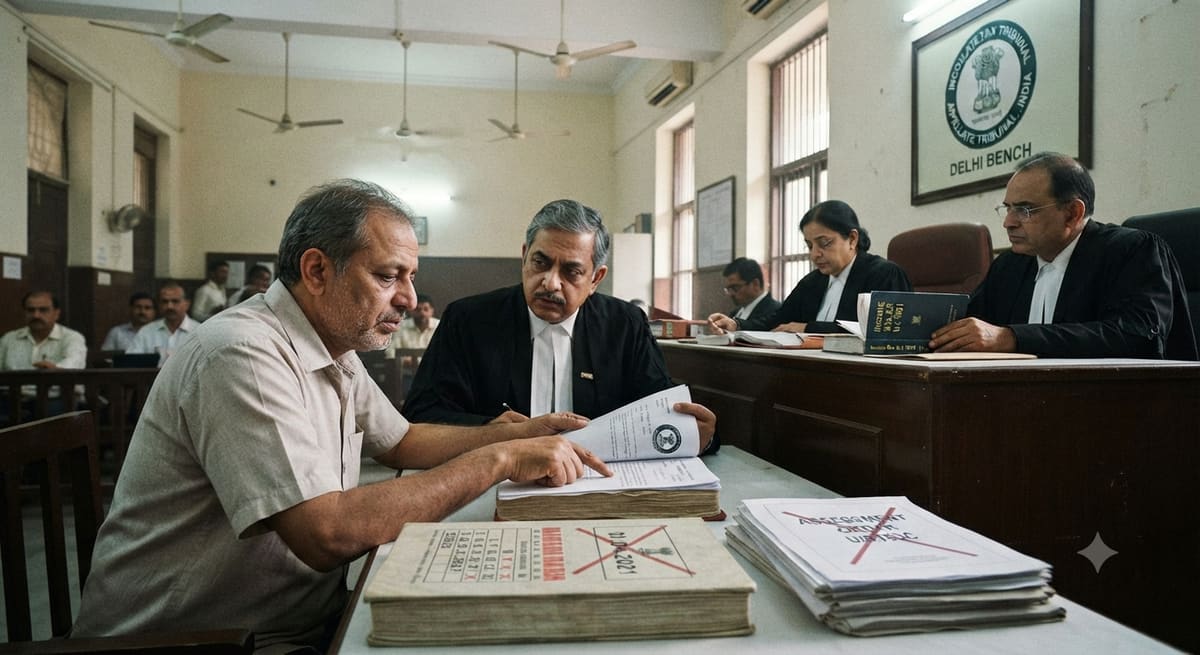
The Gujarat High Court set aside the Income Tax Department's notice under Section 148 and the subsequent order under Section 148A(d), holding that where a search action was initiated before 31 March 2021, the assessment can be reopened only under Section 153C, not under Sections 147/148.
Background & Facts
The Dispute
The petitioner, Necklace Diamond, challenged a notice issued under Section 148 of the Income Tax Act, 1961 dated 28 April 2021 and an order under Section 148A(d) dated 31 July 2022. The revenue department alleged that the petitioner had received accommodation-entry income of Rs 1,33,72,000 from Mr Shripal Vrajlal Vora during FY 2016-17. The petitioner contended that the reopening of the assessment was premised on material discovered during a search action conducted in December 2016, and that such material could not be the basis for a notice under Section 148.
Key Facts
- 01 August 2017: Petitioner filed return of income for AY 2017-18, declaring total income of Rs 4,73,481.
- 14 December 2016: Survey action under Section 133A carried out at the premises of Shripal Vora.
- 16 December 2016: Survey converted into search action under Section 132; incriminating documents seized.
- 28 April 2021: Notice issued under Section 148 alleging escaped assessment.
- 30 May 2022: Notice issued under Section 148A(b).
- 13 June 2022: Petitioner filed a detailed objection letter.
- 31 July 2022: Order passed under Section 148A(d), which the petitioner seeks to quash.
- 07 January 2026: Gujarat HC judgment in Paras Chandreshbhai Koticha v. Income Tax Officer (Special Civil Application No. 17933 of 2018) clarified the interplay of Sections 147/148/153A/153C.
Procedural History
- 2023: Special Civil Application No. 5482 of 2023 filed before the High Court of Gujarat at Ahmedabad.
- 01 September 2026: Judgment delivered by Hon. Mr. Justice A.S. Supehia and Hon. Ms. Justice Vaibhavi D. Nanavati.
Parties' Positions
- Petitioner: Argues that the proper provision for reopening is Section 153C, citing the Paras Chandreshbhai Koticha decision and the fact that the search was initiated before 31 March 2021, rendering Section 148 inapplicable.
- Respondent (Income Tax Officer): Maintains that the notice under Section 148 is valid because the assessing officer relied on incriminating material uncovered during the search.
Relief Sought
The petitioner prayed for:
- Quashing of the notice dated 28 April 2021 issued under Section 148.
- Quashing of the order dated 31 July 2022 issued under Section 148A(d).
- Restoration of the original assessment as filed on 01 August 2017.
The Legal Issue
Whether, when a search action was initiated before 31 March 2021, the assessment of an assessee for the relevant assessment year can be reopened under Section 148 of the Income Tax Act, 1961, or must the reopening be effected only under Section 153C.
Arguments Presented
For the Petitioner
- Relied on Paras Chandreshbhai Koticha v. Income Tax Officer (2026) that a satisfaction note is essential before invoking Section 153C and that Section 148 cannot be used where the search predates the 2021 amendment.
- Cited Section 149(1)(b) limiting the issuance of a notice under Section 148 when the material arises from a search initiated before 31 March 2021.
- Emphasised that the revenue’s reliance on material seized during the 2016 search violates the statutory hierarchy.
For the Respondent
- Asserted that the notice under Section 148 was proper because the assessing officer possessed sufficient material indicating escaped assessment.
- Contended that the search-derived documents provided a legitimate basis for reopening irrespective of the amendment timeline.
- Argued that the petitioner’s objection letter dated 13 June 2022 did not negate the department’s statutory power.
The Court's Analysis
The Court began by examining the statutory scheme governing reopening of assessments. It noted that Section 153C is the specific provision for cases where a “searched person” is involved, requiring the assessing officer to record satisfaction on the incriminating material before proceeding.
"In the absence of any satisfaction note recorded by the Assessing Officer of the searched person, the jurisdictional Assessing Officer of the other person cannot assume jurisdiction under Section 153C of the Act solely on the basis of material sent to him by the Assessing Officer of the searched person."
The Court then referred to the Paras Chandreshbhai Koticha precedent, which laid down four observations. The third observation was pivotal: the jurisdictional assessing officer may invoke Sections 147/148 only on material independent of the search-derived documents, unless a satisfaction note is recorded. Since the search was conducted on 14 December 2016 and converted to a search on 16 December 2016 - well before the 31 March 2021 cut-off - the Court held that the revenue could not rely on Section 148.
Further, the Court analysed Section 149(1)(b), which restricts the issuance of a notice under Section 148 where the escaped income exceeds Rs 50 lakh and the material originates from a pre-2021 search. The Court concluded that the proviso in Section 149 expressly excludes the applicability of Section 148 in such circumstances, making Section 153C the only viable provision.
Consequently, the Court found that the Assessing Officer had failed to record a satisfaction note and had improperly used Section 148. The judgment therefore quashed both the notice and the order, emphasizing that the revenue must adhere to the procedural hierarchy prescribed by the Act.
The Verdict
The petitioner's relief was granted in full. The Court quashed the notice dated 28 April 2021 issued under Section 148 and the order dated 31 July 2022 issued under Section 148A(d). No costs were awarded. The assessment as filed on 01 August 2017 stands.
What This Means For Similar Cases
Reopening Must Follow Section 153C When Search Predates 31 March 2021
- Practitioners should verify the date of any search action before invoking Section 148.
- If the search was initiated before the 2021 amendment, the correct provision is Section 153C.
Satisfaction Note Is Mandatory
- The assessing officer of the searched person must record a satisfaction note on the incriminating material before any reassessment can be effected.
- Absence of such a note bars the jurisdictional officer from proceeding under Section 153C or Section 148.
Limitation Under Section 149 Controls Notice Issuance
- Notices under Section 148 cannot be issued when the material stems from a pre-2021 search, even if the escaped income exceeds Rs 50 lakh.
- Lawyers must assess the applicability of the limitation period before filing a notice.
Practical Takeaways
- Review the chronology of search and seizure actions in tax disputes.
- Ensure a satisfaction note is obtained and documented.
- Align the reopening provision with the statutory timeline to avoid quashal.