The ITAT Delhi has definitively clarified the temporal limits for reopening assessments of non-searched persons under Section 153C of the Income-tax Act, 1961. The ruling anchors the six-year window for reassessment not to the date of the search operation, but to the date the satisfaction note is recorded by the assessing officer. This doctrinal precision curtails arbitrary expansion of assessment periods and reinforces statutory boundaries.
Background & Facts
The Dispute
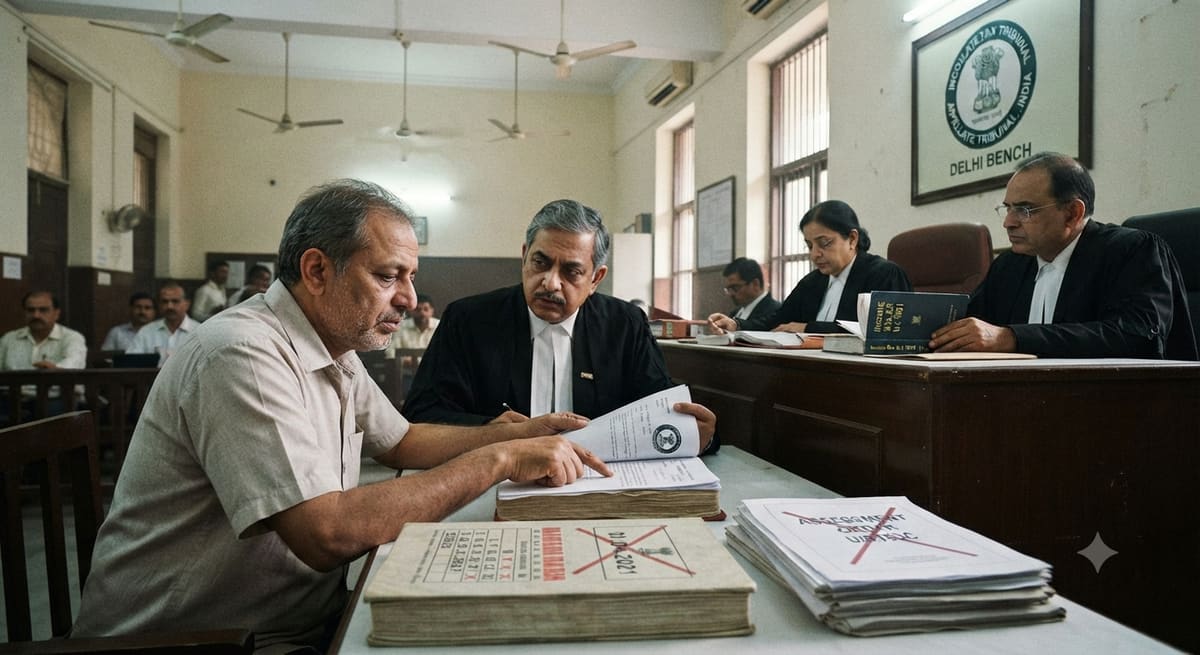
The Revenue appealed against the order of the Commissioner of Income-tax (Appeals)-25, which had set aside the reassessment order for Assessment Year 2015-16 issued under Section 153C of the Income-tax Act. The dispute centered on whether the Assessing Officer (AO) was legally empowered to reopen the assessment for AY 2015-16, which fell outside the six-year window prescribed by law.
Key Facts
- The search and seizure operation was conducted on 18.10.2019 against the Alankit group, including Shri Alok Kumar Agarwal, Shri Ankit Agarwal, Alankit Assignments Ltd., and Alankit Ltd.
- Incriminating documents implicating the assessee, Shri Harish Chandra Agarwal (PAN: ADXPA9236A), were found during the search.
- The assessee was a non-searched person, and proceedings under Section 153C were initiated against him based on the seized material.
- The Satisfaction Note under Section 153C was recorded by the AO on 24.12.2021.
- The notice under Section 153C was issued to the assessee on 30.12.2021.
- The assessee filed his Return of Income on 21.01.2022, declaring income of Rs. 22,59,770.
- The AO passed the assessment order on 26.03.2023, determining total income at Rs. 27,57,260.
- The assessment for AY 2015-16 was reopened based on the search material, despite it being seven years prior to the satisfaction note.
Procedural History
- 18.10.2019: Search and seizure conducted by Income Tax Department against Alankit group.
- 24.12.2021: Satisfaction Note recorded by the AO under Section 153C.
- 30.12.2021: Notice issued to the assessee under Section 153C.
- 21.01.2022: Assessee filed Return of Income.
- 26.03.2023: AO passed assessment order for AY 2015-16, reopening the assessment.
- 14.08.2025: First Appellate Authority (CIT(A)-25) set aside the assessment order, holding that AY 2015-16 was beyond the six-year limit.
- 15.04.2026: ITAT Delhi dismissed the Revenue’s appeal.
Relief Sought
The Revenue sought to restore the assessment order dated 26.03.2023 for AY 2015-16, arguing that the search date (18.10.2019) should be the starting point for computing the six-year period. The assessee contended that the satisfaction note date (24.12.2021) was the correct benchmark.
The Legal Issue
The central question was whether the six-year period for reopening assessments under Section 153C of the Income-tax Act for a non-searched person begins from the date of the search operation or from the date the satisfaction note is recorded by the assessing officer.
Arguments Presented
For the Appellant (Revenue)
The Revenue contended that the six-year period should be computed from the date of the search (18.10.2019), as that was when incriminating material was discovered and the basis for initiating proceedings against the non-searched person was established. It argued that the legislative intent behind Section 153C was to enable reassessment based on evidence unearthed during searches, and delaying the reckoning to the satisfaction note date would defeat this purpose. It relied on broad policy considerations and earlier administrative practices.
For the Respondent (Assessee)
The assessee argued that the statutory language of Section 153C(1) requires the six-year period to be calculated from the assessment year relevant to the previous year in which the satisfaction note was recorded. He cited binding precedents from the Supreme Court and Delhi High Court, emphasizing that the satisfaction note is the formal trigger for jurisdiction under Section 153C. He further submitted that the AO’s delay in recording the satisfaction note until December 2021 could not be used to extend the reopening window retroactively to AY 2015-16.
The Court's Analysis
The ITAT Delhi undertook a detailed statutory interpretation of Section 153C(1), which permits reassessment of a non-searched person for assessment years up to six years preceding the assessment year relevant to the previous year in which the satisfaction note is recorded.
"The date of reckoning for the six-year period under Section 153C is the date of recording of the satisfaction note by the assessing officer of the searched person, not the date of search or issuance of notice."
The Tribunal noted that the Revenue’s reliance on the search date was inconsistent with the statutory framework. The satisfaction note is not a mere procedural formality; it is the legal act that confers jurisdiction upon the AO to initiate proceedings under Section 153C against a non-searched person. Without this formal recording, no reassessment can be validly initiated.
The Tribunal affirmed the reasoning of the First Appellate Authority and relied on two binding precedents: CIT vs. Jasjit Singh (2023) 458 ITR 423 (SC) and PCIT (Central-1) vs. Ojjus Medicare Pvt. Ltd. (2024) 465 ITR 101 (Del). Both cases held that the satisfaction note date is the operative benchmark. The Delhi High Court in CIT vs. RRJ Securities Ltd. (2016) 380 ITR 612 (Del) had similarly ruled that the six-year window cannot be stretched backward beyond the year of satisfaction note recording.
The Tribunal rejected the Revenue’s argument that the search date should prevail, observing that such an interpretation would render the statutory language of Section 153C(1) redundant and open the door to arbitrary reassessments spanning decades. The court emphasized that the legislature deliberately chose the satisfaction note date as the anchor to ensure procedural fairness and legal certainty.
The Verdict
The Revenue’s appeal was dismissed. The ITAT Delhi upheld the order of the First Appellate Authority dated 14.08.2025, confirming that the assessment for AY 2015-16 could not be reopened under Section 153C. The six-year window commenced from AY 2016-17 (the year relevant to the previous year in which the satisfaction note was recorded on 24.12.2021), thereby excluding AY 2015-16. The assessment order dated 26.03.2023 for AY 2015-16 stands set aside.
What This Means For Similar Cases
The Satisfaction Note Is the Jurisdictional Trigger
- Practitioners must now treat the date of recording of the satisfaction note under Section 153C as the definitive starting point for computing the six-year reopening window.
- Any reassessment initiated for an assessment year prior to six years before the satisfaction note year is legally invalid, regardless of when the search occurred.
- Tax officers must ensure satisfaction notes are recorded promptly to avoid losing jurisdiction over recent years.
Non-Search Persons Are Protected Against Retroactive Reopening
- The judgment reinforces that non-searched persons cannot be subjected to reassessments for years far removed from the date the tax department formally decided to act.
- This prevents the use of old search material to resurrect stale assessments, aligning with principles of natural justice and reasonable expectation.
- Taxpayers can now confidently challenge reassessments for years beyond the six-year window anchored to the satisfaction note date.
Procedural Compliance Is Non-Negotiable
- The ITAT reaffirmed that statutory timelines under Section 153C are mandatory, not directory.
- Delays in recording satisfaction notes cannot be cured by invoking the search date.
- Practitioners should scrutinize the date of the satisfaction note in every Section 153C notice and challenge reopening beyond the six-year limit without hesitation.