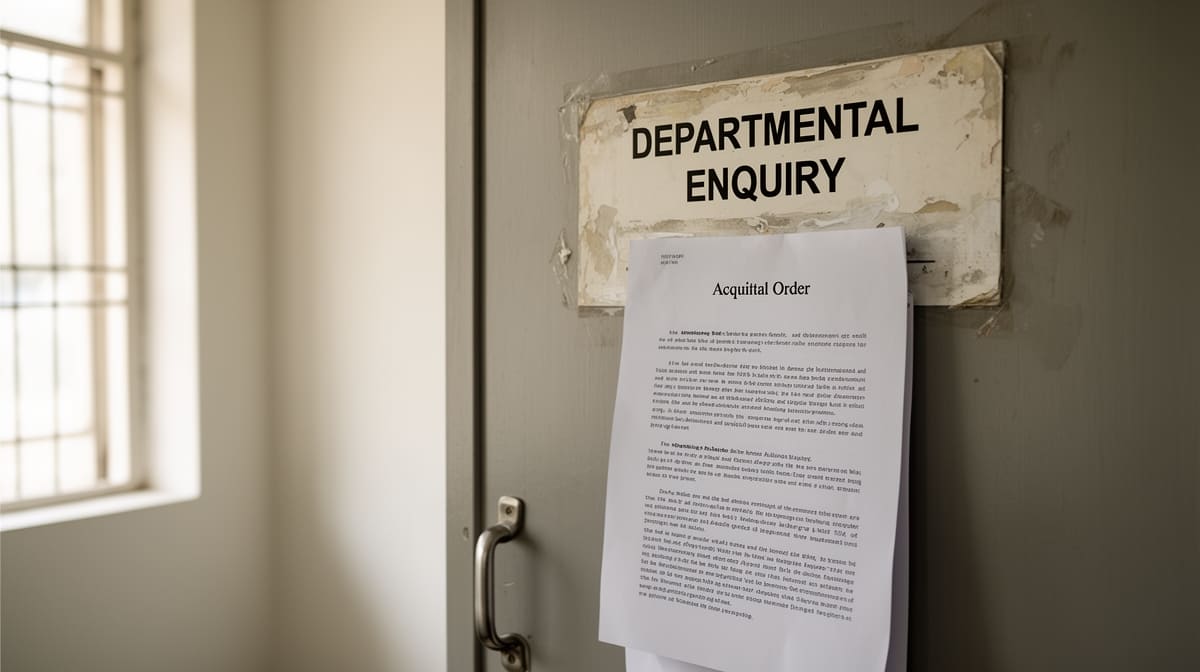
The Madhya Pradesh High Court has reaffirmed that acquittal in criminal proceedings does not automatically absolve a delinquent employee from disciplinary action under service law. This judgment underscores the distinction between criminal trials, which require proof beyond reasonable doubt, and departmental enquiries, which operate on the principle of preponderance of probabilities. The ruling has significant implications for government employees and disciplined forces facing parallel criminal and departmental proceedings.
Background & Facts
The Dispute
The petitioner, Ramphal Ahirwar, a Constable in the Madhya Pradesh Police Department, was accused of threatening a prosecutrix with a knife on 10.06.2017 when she refused to remove her scarf while travelling in an auto. Based on the complaint, a criminal case was registered against him at Police Station Civil Lines, Rewa under Crime No. 376/2017 for offences under Sections 294, 323, 506 of the Indian Penal Code (IPC) and Section 25-B of the Arms Act. Simultaneously, a departmental enquiry was initiated against him.
Key Facts
- The petitioner was serving in Police Lines, Rewa at the time of the incident
- The prosecutrix alleged that the petitioner threatened her with a knife and attempted to remove her scarf
- The petitioner was charged under Sections 294 (obscene acts), 323 (voluntarily causing hurt), 506 (criminal intimidation) of IPC and Section 25-B of the Arms Act
- A departmental enquiry was conducted, and charges were framed against the petitioner
- The enquiry report dated 02.05.2018 found the charges proved against the petitioner
- The petitioner filed a reply to the show-cause notice on 23.05.2018
Procedural History
- 10.06.2017: Crime registered against the petitioner
- 02.05.2018: Departmental enquiry report found charges proved
- 06.06.2018: Superintendent of Police (SP), Rewa dismissed the petitioner from service (Annexure P/4)
- 05.12.2018: Appeal against dismissal order dismissed (Annexure P/2)
- 16.04.2019: Mercy appeal dismissed (Annexure P/1)
- I.A. No. 10820/2023: Petitioner filed an application bringing the acquittal judgment on record
- 30.06.2026: Present writ petition dismissed by the High Court
The Parties' Positions
For the Petitioner: The petitioner contended that he had been acquitted by the competent criminal court, and the judgment of acquittal should be considered in the departmental proceedings. Relying on the Supreme Court judgment in S. Bhaskar Reddy v. Supt. of Police, (2015) 2 SCC 365, the petitioner argued that since the charges in both proceedings were identical and he had been acquitted, the departmental punishment should be quashed.
For the Respondent/State: The State opposed the petition, arguing that the acquittal was based on the benefit of doubt and not honourable acquittal. It contended that the standards of proof in criminal trials (beyond reasonable doubt) and departmental enquiries (preponderance of probabilities) differ, and acquittal in a criminal case does not automatically absolve the delinquent from departmental liability.
Relief Sought
The petitioner sought:
- Quashing of the impugned orders dated 16.04.2019 (P-1), 05.12.2018 (P-2), 06.09.2018 (P-3), and 06.06.2018 (P-4)
- Reinstatement in service
- Any other relief deemed fit by the Court
The Legal Issue
The central question before the Court was whether acquittal in a criminal case, particularly one based on the benefit of doubt, automatically absolves a delinquent employee from disciplinary action under service law, even when the charges in both proceedings are substantially similar.
Arguments Presented
For the Petitioner
- The petitioner relied on S. Bhaskar Reddy v. Supt. of Police, (2015) 2 SCC 365, arguing that honourable acquittal in a criminal case should lead to the quashing of departmental punishment
- It was contended that since the charges in both proceedings were identical, the acquittal should be binding on the departmental enquiry
For the Respondent/State
- The State argued that the acquittal was not honourable but based on the benefit of doubt
- It was submitted that the standards of proof in criminal trials and departmental enquiries differ, and acquittal in a criminal case does not ipso facto absolve the delinquent from departmental liability
- The State relied on Shashi Bhushan Prasad v. CISF, (2019) 7 SCC 797, to argue that departmental proceedings can proceed independently of criminal trials
The Court's Analysis
The Court examined the distinction between criminal trials and departmental enquiries, emphasizing that they operate in different fields with different objectives. While criminal trials aim to punish offenders, departmental enquiries focus on maintaining discipline and imposing penalties under service rules.
"We are in full agreement with the exposition of law laid down by this Court and it is fairly well settled that two proceedings criminal and departmental are entirely different. They operate in different fields and have different objectives. Whereas the object of criminal trial is to inflict appropriate punishment on an offender, the purpose of enquiry proceedings is to deal with the delinquent departmentally and to impose penalty in accordance with the service rules. The degree of proof which is necessary to order a conviction is different from the degree of proof necessary to record the commission of delinquency."
The Court observed that in criminal law, the burden of proof lies on the prosecution to prove guilt beyond reasonable doubt, whereas in departmental enquiries, penalties can be imposed based on preponderance of probabilities. The Court relied on Shashi Bhushan Prasad v. CISF, (2019) 7 SCC 797, which held that acquittal in a criminal case does not automatically absolve the delinquent from departmental liability.
The Court noted that the complainant had turned hostile in the criminal trial and did not identify the petitioner, whereas in the departmental enquiry, she had categorically stated that the petitioner was involved in the offence. This discrepancy highlighted the differing standards of proof in the two proceedings.
The Court further emphasized that the petitioner, as a member of a disciplined force, was expected to conduct himself with utmost integrity. The charges against him involved grave misconduct, including threatening a woman while in uniform, which warranted strict disciplinary action regardless of the criminal trial outcome.
The Verdict
The Court dismissed the writ petition, holding that acquittal in a criminal case, even on the same set of charges, does not automatically absolve a delinquent from departmental proceedings. The impugned orders dated 16.04.2019 (P-1), 05.12.2018 (P-2), 06.09.2018 (P-3), and 06.06.2018 (P-4) were upheld, and the petitioner’s prayer for reinstatement was rejected.
What This Means For Similar Cases
Acquittal Does Not Guarantee Reinstatement
- Practitioners must note that acquittal in a criminal case, even if based on the same charges, does not automatically absolve an employee from departmental liability
- The judgment reaffirms that departmental enquiries and criminal trials operate under different standards of proof, and outcomes in one do not bind the other
Evidence Standards Differ
- In criminal trials, the prosecution must prove guilt beyond reasonable doubt
- In departmental enquiries, charges can be proved based on preponderance of probabilities
- Discrepancies in witness statements (e.g., a witness turning hostile in criminal trial but testifying in departmental enquiry) can lead to different outcomes
Disciplined Forces Held to Higher Standards
- Employees in disciplined forces (police, armed forces, etc.) are expected to maintain exemplary conduct
- Grave misconduct, such as threatening a civilian while in uniform, can warrant dismissal even if criminal charges fail
- The judgment underscores that service rules prioritize discipline and public trust over technical acquittals
Strategic Considerations for Practitioners
- For Employees: Even if acquitted in a criminal case, prepare for parallel departmental proceedings and gather evidence to contest charges on the preponderance of probabilities standard
- For Employers: Departmental enquiries can proceed independently of criminal trials, and dismissal orders can be upheld even if criminal charges fail
- For Advocates: When challenging dismissal orders, distinguish between honourable acquittal and benefit of doubt, as the latter may not suffice to quash departmental punishment