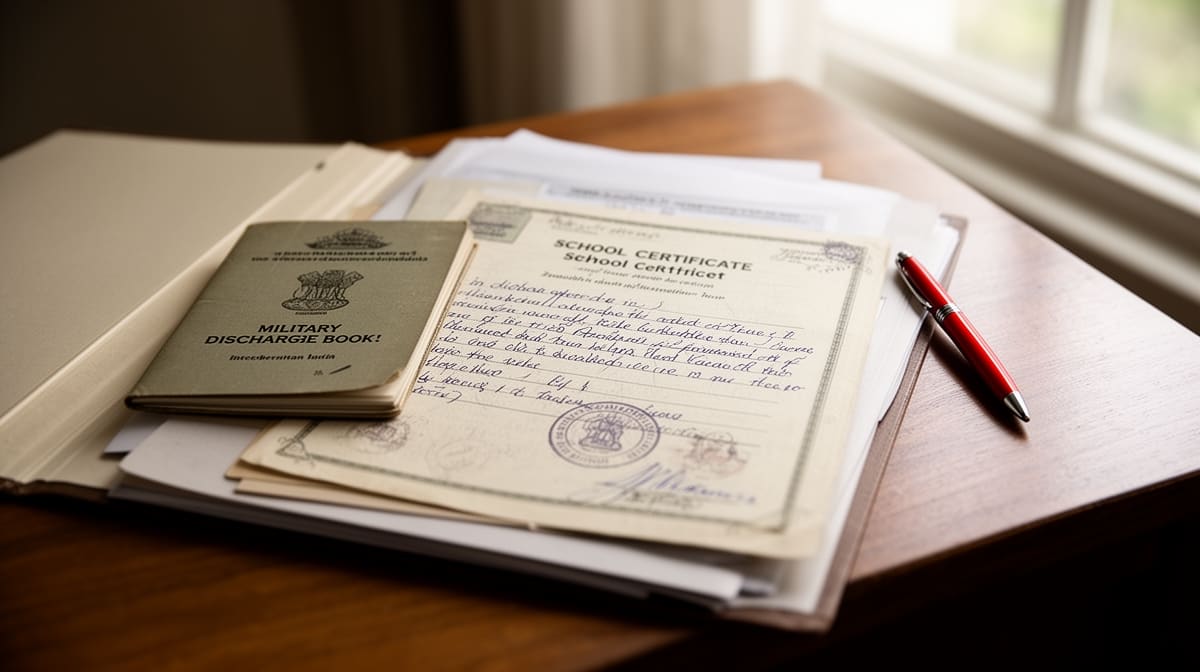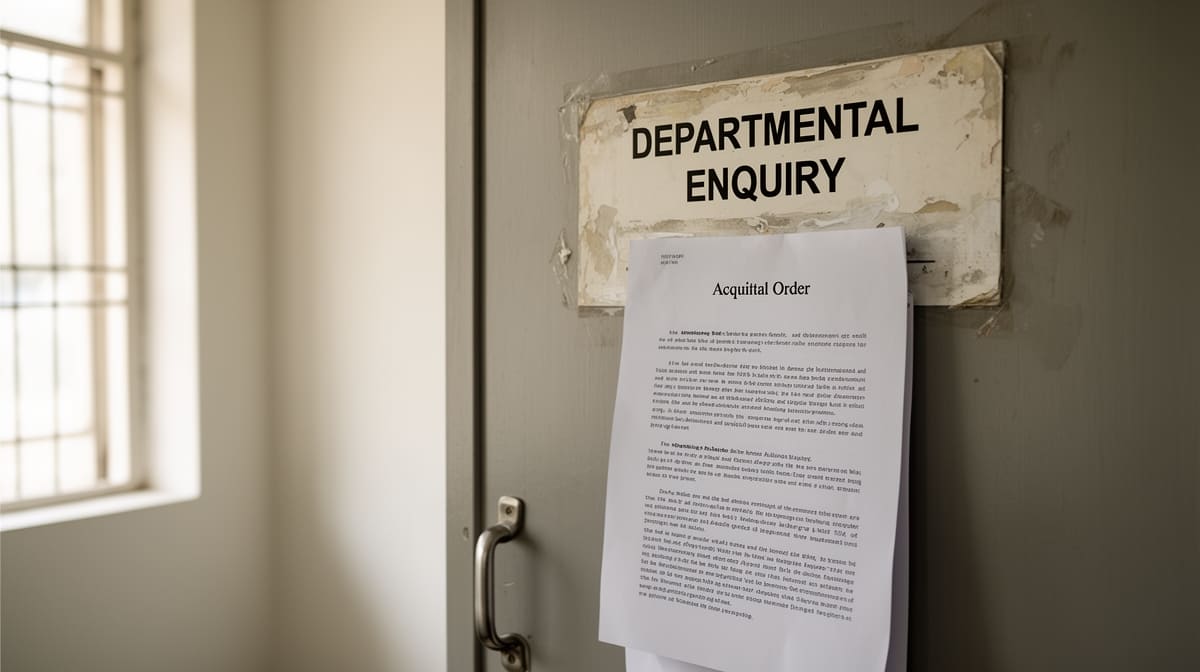
The Bombay High Court has held that an acquittal in a criminal trial, where the same evidence forms the basis of departmental proceedings, cannot be disregarded - especially when the disciplinary action is delayed without justification and new evidence is introduced at a late stage. This judgment reinforces the principle that administrative fairness demands more than technical compliance with procedure.
Background & Facts
The Dispute
The petitioner, Babasaheb Rayappa Waghmare, was employed as a Shore Worker (Category ‘A’) with the Mumbai Port Trust since 13.07.1979. On 14.02.1994, he was allegedly found in possession of four electronic parts weighing approximately two kilograms and valued at Rs.4,000/- near the New Sewree Warehouse during his shift. Security personnel reported the incident, leading to registration of a First Information Report (FIR) under Section 379 IPC. The petitioner was arrested, released on bail on 15.02.1994, and suspended from duty on 16.02.1994 without formal order. He resumed work after 62 days.
Key Facts
- The petitioner had an unblemished service record prior to the incident.
- The alleged articles were recovered during a panchnama conducted between 8:00 p.m. and 8:30 p.m. on 14.02.1994, in the presence of two panch witnesses.
- The prosecution in the criminal case relied on statements of three witnesses - all employees of the Mumbai Port Trust: Shri Prakash Mahadev Sawant (Security Guard), Shri Balu Gangaram Dedhe (Security Guard), and Shri Hotu Basantlal Pahuja (Shed Superintendent).
- The panchnama did not conclusively link the articles to any specific property of the Port Trust.
- No ownership or source of the electronic parts was established by the prosecution.
- On 22.07.1998, the Metropolitan Magistrate, Dadar, acquitted the petitioner in Criminal Case No.218 of 1994, observing serious contradictions in witness testimony, failure to establish ownership, and possibility of false implication.
- On 10.02.1998, nearly four years after the incident, the Mumbai Port Trust issued a Charge Memo initiating departmental proceedings.
- During the departmental enquiry, two new documents - a purported report dated 14.02.1994 and a Time Rate Labour Form - were introduced during cross-examination, neither of which had been disclosed earlier or produced in the criminal trial.
- The petitioner was dismissed from service by order dated 18.12.1998.
Procedural History
- 14.02.1994: Alleged incident and FIR registration (C.R. No.26 of 1994).
- 15.02.1994: Petitioner released on bail.
- 16.02.1994: Petitioner prevented from marking attendance; no formal suspension order issued.
- 08.11.1994: Charge framed in Criminal Case No.218 of 1994.
- 22.07.1998: Acquittal by Metropolitan Magistrate, Dadar.
- 10.02.1998: Charge Memo issued initiating departmental proceedings.
- 08.05.1998 to 14.07.1998: Departmental enquiry conducted by Enquiry Officer Shri D.N. Daithankar.
- 15.09.1998: Enquiry Officer’s report found charges proved.
- 18.12.1998: Deputy Manager dismissed petitioner under Regulation 10 of the Mumbai Port Trust Employees’ (Classification, Control and Appeal) Regulations, 1976.
- 13.04.1999: Departmental appeal dismissed by Traffic Manager.
- 04.08.1999: Review application dismissed by Chairman, Mumbai Port Trust.
- 04.04.2001: Industrial dispute referred to Central Government Industrial Tribunal No. II as Reference No. CGIT-2/29 of 2001.
- 10.02.2003: Tribunal (Part I) upheld departmental proceedings.
- 07.03.2007: Tribunal (Part II) dismissed the reference and upheld dismissal.
- 17.07.2018: Writ Petition No.1778 of 2018 filed before Bombay High Court.
- 07.03.2026: Judgment delivered by Justice Amit Borkar.
Relief Sought
The petitioner sought quashing of the Tribunal’s awards dated 10.02.2003 and 07.03.2007, setting aside the dismissal order dated 18.12.1998, reinstatement or, in view of superannuation, recognition of continuous service, payment of full back wages, and all consequential retiral benefits including pension and gratuity.
The Legal Issue
The central question was whether departmental proceedings can be sustained when the same evidence that led to an acquittal in a criminal trial is relied upon, the disciplinary action is initiated after an unexplained delay of four years, and new documents are introduced at a late stage without affording the employee a fair opportunity to challenge them.
Arguments Presented
For the Petitioner
The petitioner’s counsel relied on Capt. M. Paul Anthony v. Bharat Gold Mines Ltd. and Chandrakant Raoji Gaonkar v. Bombay Port Trust to argue that where criminal and departmental proceedings arise from identical facts and evidence, and the employee is honorably acquitted, the departmental action cannot stand. He emphasized that the criminal court had found serious contradictions in witness testimony, failure to establish ownership of the articles, and possibility of false implication. The delay of four years in initiating proceedings was unexplained and suggested mala fides. The introduction of two new documents during cross-examination - neither disclosed in the charge sheet nor produced in the criminal trial - violated the principles of natural justice. The petitioner had served for nearly 19 years without prior misconduct, making dismissal disproportionate.
For the Respondent
The respondent contended that departmental proceedings operate on the standard of preponderance of probabilities, distinct from the criminal standard of proof beyond reasonable doubt. It relied on Noida Entrepreneurs Association v. Noida and A.S. Manjrekar v. Bombay Port Trust to assert that acquittal in criminal proceedings does not bar disciplinary action. The enquiry was conducted fairly, with opportunity for cross-examination. The petitioner was found in possession of trust property, which alone justified the charge. The delay was due to investigation into possible involvement of multiple employees. The punishment of dismissal was proportionate given the seriousness of theft of employer’s property.
The Court's Analysis
The Court began by affirming two foundational principles: first, that criminal and departmental proceedings operate under different standards of proof; second, that an acquittal does not automatically invalidate departmental action. However, the Court emphasized that these principles do not permit a disciplinary authority to ignore the findings of a criminal court when the same evidence is relied upon.
"When a criminal court, after considering the entire evidence, records such conclusions, the acquittal cannot be treated as a mere technical acquittal. It indicates that the prosecution case itself suffered from weaknesses."
The Court noted that the criminal court had not merely granted benefit of doubt but had explicitly found that the prosecution failed to establish ownership of the articles, their source, or the petitioner’s involvement. These were not minor technicalities but core deficiencies in the case.
The Court further held that the four-year delay in initiating departmental proceedings was not explained. While delay may be excusable during ongoing criminal investigations, no such justification was offered here. The timing - after the criminal case was clearly weakening - raised serious concerns about motive and fairness.
"The introduction of documents during cross-examination, which had never been disclosed earlier and were not part of the criminal trial, deprived the petitioner of a meaningful opportunity to defend himself."
The Court rejected the Tribunal’s reasoning that opportunity to cross-examine cured the prejudice. Fair hearing requires prior disclosure of material. The late production of documents that appeared designed to fill gaps exposed by the criminal acquittal rendered the enquiry fundamentally unfair.
The Court also emphasized proportionality. Dismissal is the harshest penalty. The petitioner had no prior misconduct, served nearly 19 years, and the evidence against him was the same that had failed in a criminal court. The stigma of theft, coupled with the lack of alternative employment post-dismissal, further supported the need for relief.
The Verdict
The petitioner succeeded. The Bombay High Court quashed the Tribunal’s awards dated 10.02.2003 and 07.03.2007, and set aside the dismissal order dated 18.12.1998. Since the petitioner had retired during pendency, reinstatement was not possible. He was deemed to have remained in continuous service until his superannuation. He is entitled to full back wages from the date of dismissal (18.12.1998) to superannuation, with all consequential benefits including increments and pensionary entitlements. The Mumbai Port Trust must compute and pay all retiral dues - including pension and gratuity - within twelve weeks of this judgment. If unpaid, the arrears shall carry interest at six percent per annum from the date of this judgment until realization.
What This Means For Similar Cases
Acquittal in Criminal Case Cannot Be Mechanically Ignored
- Practitioners must argue that if a criminal court finds the prosecution’s case defective on core issues - ownership, source, or credibility of witnesses - the departmental authority must explain how those defects were overcome.
- A mere assertion that the standard of proof is lower is insufficient; the authority must demonstrate independent, credible reasoning.
Delay in Initiating Disciplinary Action Is a Fatal Flaw
- Unexplained delays exceeding two years, particularly when coinciding with the weakening of a criminal case, will be viewed with suspicion.
- Employers must document and justify delays in writing; silence will be construed as prejudice.
Late Introduction of Evidence Violates Natural Justice
-
Any document not disclosed in the charge sheet must be introduced with notice and opportunity to respond before being relied upon.
-
Documents introduced during cross-examination to plug gaps exposed by acquittal are inherently suspect and likely to vitiate proceedings.
-
Always challenge the source and timing of evidence in departmental proceedings.
-
Argue for proportionality: dismissal requires compelling evidence, especially for long-serving employees with clean records.
-
Cite Heem Singh and Samuthiram to distinguish between technical and honourable acquittals, and insist that the latter must be given due weight.