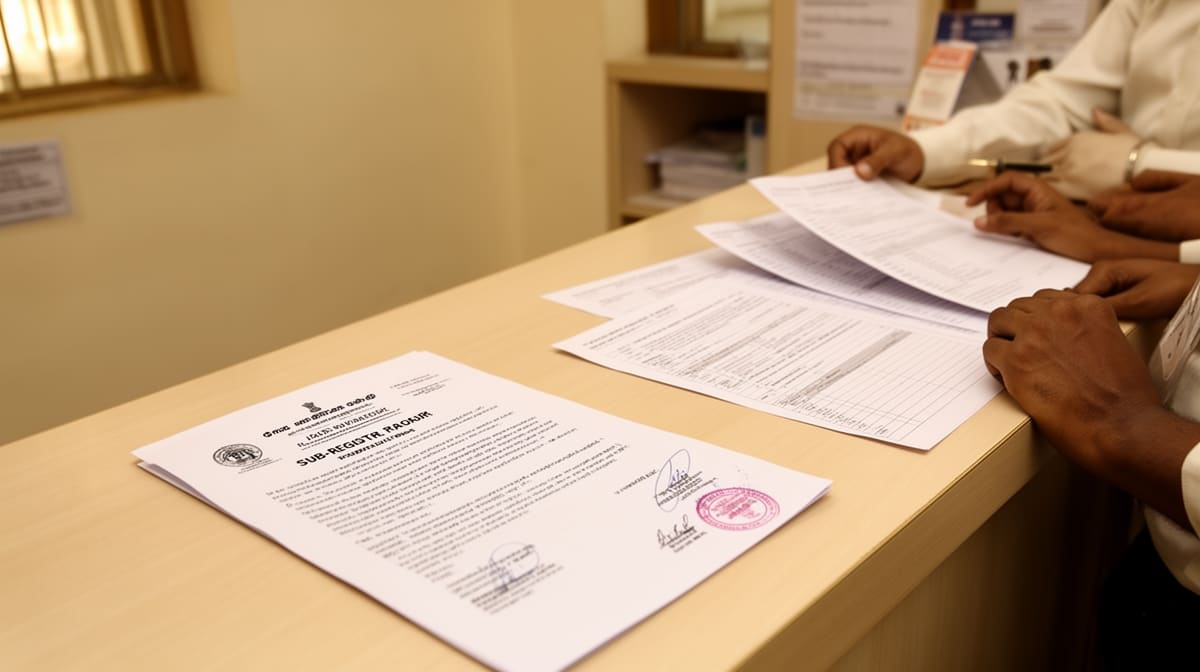
The High Court of Telangana has reinforced the procedural safeguards for property registration by mandating that registering officers must record written reasons before refusing to accept a document. This judgment clarifies the non-discretionary duty under Section 71 of the Registration Act, 1908, ensuring transparency and accountability in administrative action affecting property rights.
Background & Facts
The Dispute
The petitioners, Sreelakshmi Kakalapudi and Akula Anil Kumar, sought registration of sale deeds relating to a residential flat (No. 502, Fifth Floor) in the "Nightingale" complex, located on Plot No. 248, Sector-III, Block-B, Puppalaguda Village, Ranga Reddy District. The documents were presented to the Sub-Registrar, Gandipet, but were neither received nor registered. The petitioners alleged that the refusal was arbitrary and lacked any recorded justification.
Procedural History
- The petitioners submitted the sale deeds on or about January 24, 2026.
- The Sub-Registrar (Respondent No. 3) failed to acknowledge receipt or provide any written reason for non-registration.
- The petitioners filed a writ petition under Article 226 of the Constitution seeking a writ of mandamus to compel registration.
- The petition also challenged the applicability of an earlier order dated May 1, 2024, in O.S. No. 553 of 2023, which the petitioners claimed was not binding on them.
Relief Sought
The petitioners sought directions to the Sub-Registrar to receive, register, and release the sale deeds, and to declare the inaction as illegal, arbitrary, and violative of their right to property under Article 300A.
The Legal Issue
The central question was whether a registering officer under Section 71 of the Registration Act, 1908 may refuse to accept a document without recording written reasons, and whether such silence amounts to a violation of procedural fairness.
Arguments Presented
For the Petitioner
Counsel for the petitioners relied on State of U.P. v. Mohd. Noor and K. S. Puttaswamy v. Union of India to argue that administrative inaction without reasoned orders violates the principles of natural justice and procedural due process. They contended that Section 71 imposes a mandatory duty to record reasons, and failure to do so renders the refusal legally invalid. The petitioners emphasized that the absence of any communication left them without recourse to challenge the refusal.
For the Respondent
The Government Pleader conceded that the Sub-Registrar had not recorded reasons but argued that the refusal was based on pending litigation (O.S. No. 553 of 2023) and potential title defects. However, no formal order or written communication was produced. The respondent did not dispute the applicability of Section 71 but claimed the matter was under internal review.
The Court's Analysis
The Court examined the language and intent of Section 71 of the Registration Act, 1908, which mandates that every Sub-Registrar refusing to register a document must record reasons in Book No. 2 and provide a copy to the applicant upon request. The Court held that this provision is not directory but mandatory, as it serves the twin purposes of transparency and enabling judicial review.
"The requirement to record reasons is not a mere formality; it is a substantive safeguard against arbitrary administrative action. Without reasons, the applicant is deprived of the ability to challenge the refusal meaningfully."
The Court distinguished the case from situations where registration is refused on substantive grounds such as stamp duty deficiency or lack of title, noting that even in such cases, the officer must still comply with Section 71. The Court rejected the argument that pending litigation justified non-compliance, observing that adjudication of title is a separate matter and cannot override statutory procedural obligations.
The Court further clarified that while the registering officer retains the authority to refuse registration on valid grounds, such refusal must be communicated with specificity. The mere act of non-receipt without documentation does not satisfy legal requirements.
The Verdict
The petitioners succeeded. The Court held that Section 71 of the Registration Act, 1908 imposes a mandatory obligation on registering officers to record and communicate reasons for refusal. The Sub-Registrar was directed to receive and process the documents, subject to compliance with the Registration Act and Indian Stamp Act, 1899. The Court explicitly stated it expressed no opinion on the merits of the title claim.
What This Means For Similar Cases
Reasons for Refusal Are Mandatory
- Practitioners must now insist on written refusal orders under Section 71 before filing writ petitions.
- Any refusal without recorded reasons is void ab initio and can be challenged immediately under Article 226.
- Sub-registrars who fail to comply risk contempt proceedings or departmental action.
Procedural Compliance Trumps Substantive Disputes
- Pending civil suits or title disputes cannot justify non-compliance with Section 71.
- Registration officers must process documents and record reasons even if title issues are pending.
- The validity of the document’s content is a matter for civil courts, not for administrative refusal.
Right to Access Registration Is a Property Right
- Denial of registration without reasons infringes Article 300A (right to property).
- This judgment reinforces that procedural fairness is integral to property transactions.
- Legal practitioners should cite this case when opposing arbitrary delays in property registration.