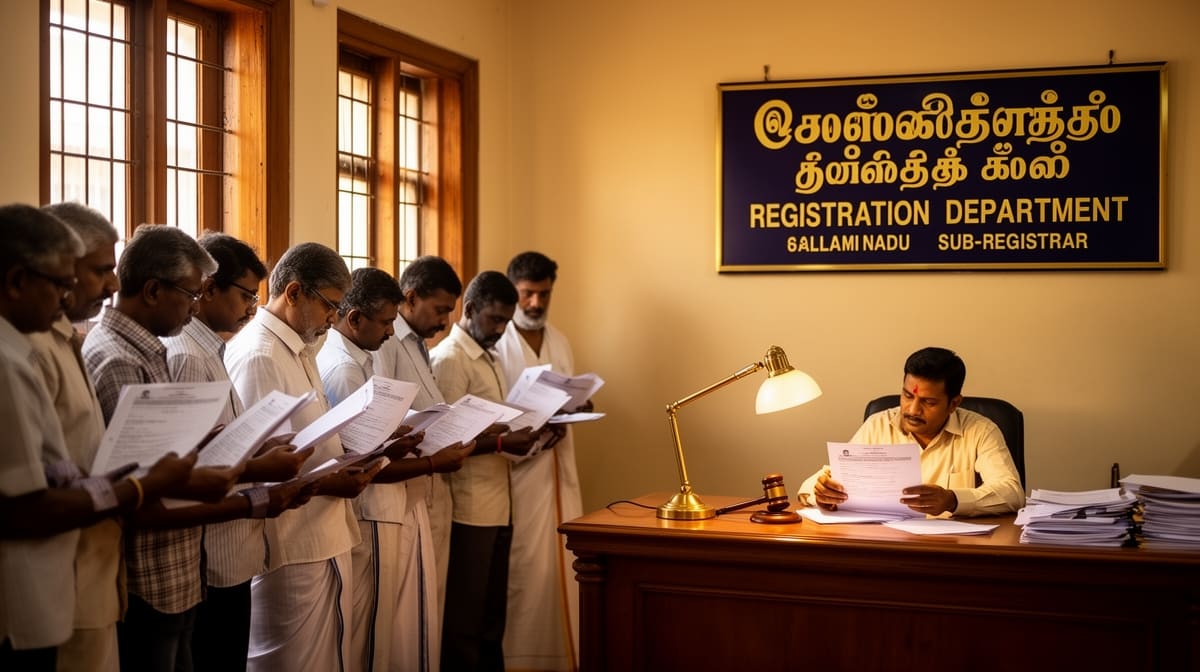
The Madras High Court has clarified that the pendency of civil suits does not automatically bar the registration of property documents under the Registration Act, 1908. This judgment reinforces the principle that registration authorities must follow due process before refusing registration, particularly when protest petitions are involved. The decision provides crucial guidance for property owners and legal practitioners navigating registration disputes.
Background & Facts
The Dispute
The petitioner, Manickammal, executed a settlement deed in favour of her son on 29 October 2025. When she presented the deed for registration at the Chettikulam Sub-Registrar Office, the authorities rejected the request. The refusal was based on two grounds: the pendency of civil suits O.S. Nos. 64 of 2024 and 349 of 2024, and a protest petition filed by an unnamed third party.
Procedural History
The petitioner approached the Madras High Court under Article 226 of the Constitution of India, seeking a writ of certiorarified mandamus. The relief sought included:
- Quashing the impugned refusal order dated 29 October 2025
- Directing the Sub-Registrar to register the settlement deed
The Parties' Positions
The petitioner argued that the mere pendency of civil suits could not justify the refusal of registration. The respondents, represented by the Government Advocate, acknowledged the receipt of a protest petition but did not contest the legal position regarding the civil suits.
The Legal Issue
The central question before the Court was whether the pendency of civil suits or the existence of a protest petition could justify the refusal to register a document under Section 71 of the Registration Act, 1908. Additionally, the Court had to determine the procedural obligations of the registering authority when faced with such objections.
Arguments Presented
For the Petitioner
The petitioner's counsel contended that:
- The pendency of civil suits does not constitute a legal bar to registration under the Registration Act, 1908
- The impugned refusal order was arbitrary and lacked a speaking order as required by law
- The registering authority failed to consider the merits of the protest petition before rejecting the registration
For the Respondent
The Government Advocate, representing the respondents, acknowledged:
- The receipt of Protest Petition No. 30 of 2024 dated 25 April 2024
- The pendency of the civil suits but did not argue that they constituted a bar to registration
The Court's Analysis
The Court examined the provisions of the Registration Act, 1908, particularly Section 71, which governs the refusal of registration. The judgment emphasized the following key principles:
-
Pendency of Civil Suits Not a Bar: The Court held that the mere pendency of civil suits does not justify the refusal of registration. This aligns with the settled position that registration authorities cannot usurp the jurisdiction of civil courts in determining title disputes.
"Mere pendency of O.S.Nos.64 of 2024 and 349 of 2024 is not a bar against registration."
-
Procedural Fairness: The Court noted that the registering authority had received a protest petition but had not disposed of it in accordance with the registration rules. The judgment underscored the importance of following due process, including issuing notices to both the petitioner and the protester before refusing registration.
-
Speaking Order Requirement: The Court reiterated that any refusal to register a document must be accompanied by a speaking order, detailing the reasons for the refusal. The impugned refusal check slip was deemed insufficient as it did not meet this requirement.
-
Opportunity for Re-Presentation: The Court permitted the petitioner to re-present the settlement deed within two weeks. It directed the registering authority to issue notices to both the petitioner and the protester and to either register the document or provide a speaking order of refusal within 30 days.
The Verdict
The Madras High Court allowed the writ petition and set aside the impugned refusal order. The Court directed the Sub-Registrar to:
- Permit the petitioner to re-present the settlement deed within two weeks
- Issue notices to the petitioner and the protester within 30 days of re-presentation
- Either register the document or provide a speaking order of refusal under Section 71 of the Registration Act, 1908
What This Means For Similar Cases
Registration Authorities Must Follow Due Process
This judgment reinforces that registration authorities cannot refuse registration based solely on the pendency of civil suits or the existence of protest petitions. Practitioners should ensure that:
- Registration authorities issue speaking orders when refusing registration
- Protest petitions are disposed of in accordance with the registration rules
- Notices are issued to all concerned parties before any refusal
Title Disputes Do Not Automatically Bar Registration
Property owners and legal practitioners can rely on this judgment to argue that:
- The Registration Act, 1908 does not empower authorities to adjudicate title disputes
- Civil courts retain exclusive jurisdiction over title-related matters
- Registration authorities must focus on the formal validity of documents rather than substantive disputes
Procedural Compliance Is Non-Negotiable
The judgment highlights the importance of procedural compliance in registration matters. Key takeaways include:
- Section 71 of the Registration Act, 1908 mandates a speaking order for refusals
- Authorities must provide an opportunity for re-presentation before final refusal
- Protest petitions must be adjudicated in a time-bound manner to avoid arbitrary delays