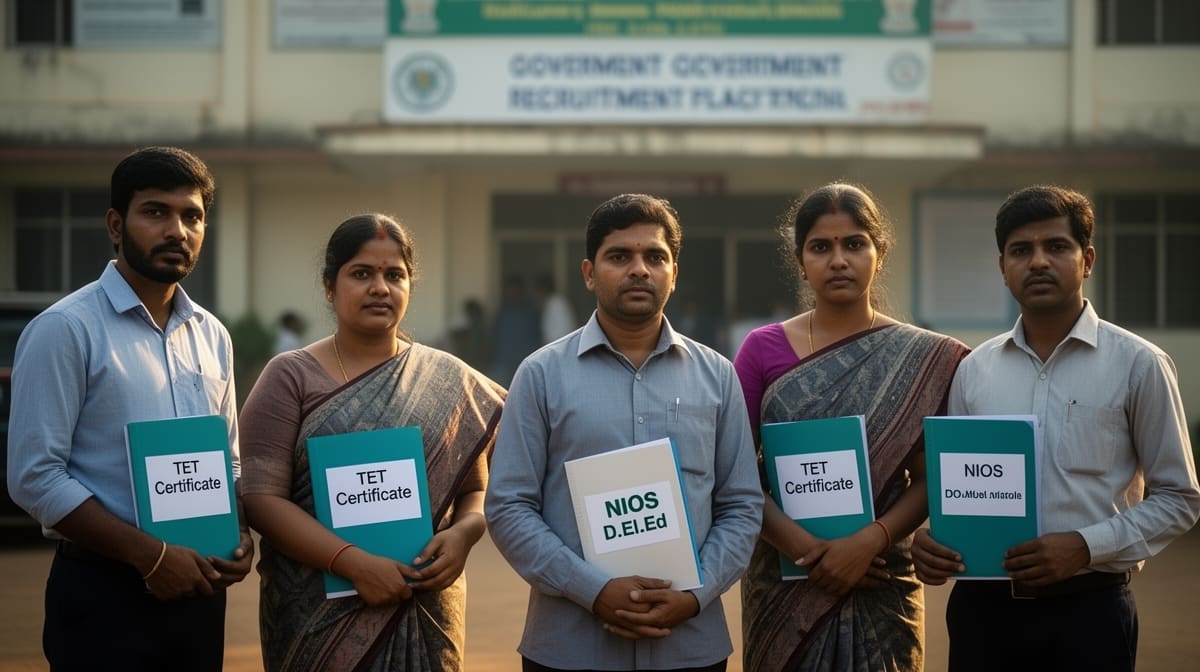
The Rajasthan High Court has affirmed that qualifications prescribed by the Rehabilitation Council of India (RCI) for special education teachers take precedence over conflicting eligibility criteria in state recruitment advertisements. This ruling resolves a long-standing ambiguity in teacher appointments and reinforces the statutory authority of RCI in the domain of special education.
Background & Facts
The Dispute
The petitioners, Vijendra Vyas and Vanita Trivedi, applied for the post of Senior Teacher Grade-II (Special Education) under an advertisement issued by the Rajasthan Public Service Commission (RPSC) on 29.03.2018. The advertisement mandated candidates to possess either B.Ed. (Special Education) or a two-year diploma in Special Education recognized by the Rehabilitation Council of India (RCI). Both petitioners held B.Ed. (General) and a one-year Post Graduate Professional Diploma in Special Education (PGPD-SEDE) from an RCI-recognized institution. Their candidature was rejected on 06.02.2020 on the ground that they did not possess the prescribed two-year diploma.
Key Facts
- Petitioner 1: B.Ed. (General) and one-year PGPD-SEDE in Hindi, recognized by RCI
- Petitioner 2: B.Ed. (General) and one-year PGPD-SEDE in Science, recognized by RCI
- Advertisement dated 29.03.2018 required: B.Ed. (Special Education) OR two-year RCI-recognized diploma in Special Education
- Both petitioners cleared the written examination and appeared for document verification on 06.02.2020
- Rejection order dated 06.02.2020 (Annexure-9) cited non-compliance with two-year diploma requirement
- RCI’s communication No.7-91/RCI-2011 dated 11.01.2012 explicitly lists: "B.Ed. (General) with one year Diploma in Special Education" as an approved qualification
- RCI’s office order dated 20.04.2009 declared B.Ed. (General) + one-year diploma in Special Education equivalent to B.Ed. (Special Education)
- NCTE and RCI entered into a Memorandum of Understanding (MoU) on 08.04.2015, recognizing RCI’s exclusive authority over special education teacher qualifications
Procedural History
- 29.03.2018: RPSC issued advertisement for Senior Teacher Grade-II (Special Education)
- 06.02.2020: Petitioners’ candidature rejected during document verification
- 12.03.2020: Writ Petition No. 4594/2020 filed before the High Court of Judicature for Rajasthan at Jodhpur
- 04.09.2020: Court passed interim order staying further appointments under the advertisement pending final decision
- 24.09.2025: Supreme Court delivered judgment in Manoj Kumar Sharma v. State of Rajasthan (Civil Appeal No. 8140/2024), holding RCI qualifications prevail for special education posts
- 11.05.2026: Oral arguments concluded
- 19.05.2026: Judgment pronounced
The Parties' Positions
For the Petitioners:
- Argued that their qualifications (B.Ed. General + one-year RCI-recognized PGPD-SEDE) are explicitly recognized under RCI’s 11.01.2012 communication and 20.04.2009 order
- Relied on Manoj Kumar Sharma v. State of Rajasthan (SC, 24.09.2025), which held that for special education posts, RCI’s qualifications override any conflicting advertisement terms
- Cited MoU between NCTE and RCI (08.04.2015) affirming RCI’s exclusive regulatory role in special education
- Contended that rejection based on duration (one-year vs two-year) is arbitrary and contrary to statutory recognition
For the Respondents:
- Maintained that the advertisement clearly required a two-year diploma and petitioners failed to meet this express condition
- Argued that recruitment must strictly adhere to advertised terms and no relaxation can be granted
- Asserted that RCI’s guidelines cannot override the specific eligibility criteria published by RPSC
- Claimed that allowing equivalence would undermine the integrity of the recruitment process
Relief Sought
The petitioners sought:
- Quashing of the rejection order dated 06.02.2020
- Declaration that B.Ed. (General) + one-year RCI-recognized PGPD-SEDE is equivalent to B.Ed. (Special Education) or two-year diploma
- Direction to appoint them to the post of Senior Teacher Grade-II (Special Education) with all consequential benefits
- Inclusion of their qualifications in the merit list under the 29.03.2018 advertisement
The Legal Issue
The central question was whether the Rehabilitation Council of India’s (RCI) statutory recognition of B.Ed. (General) with a one-year diploma in Special Education as an equivalent qualification for special education teachers overrides the advertisement’s requirement of a two-year diploma.
Arguments Presented
For the Petitioner
The petitioners relied on the Supreme Court’s binding judgment in Manoj Kumar Sharma v. State of Rajasthan, which held that for appointments in schools for special education, the qualifications prescribed by RCI are mandatory and prevail over any contrary advertisement. They emphasized that RCI, established under the Rehabilitation Council of India Act, 1992, is the statutory regulator for special education qualifications. The petitioners cited RCI’s 11.01.2012 communication and 20.04.2009 order, both of which explicitly list B.Ed. (General) + one-year diploma as an approved qualification. They further relied on the MoU between NCTE and RCI, which delineates RCI’s exclusive jurisdiction over special education teacher qualifications.
For the Respondent
The respondents contended that the advertisement dated 29.03.2018 was clear and unambiguous in requiring a two-year diploma. They argued that recruitment processes must be conducted strictly according to published terms to ensure fairness and transparency. They asserted that RCI’s guidelines, while authoritative, cannot override the specific conditions set by the recruiting authority unless expressly incorporated into the advertisement. They maintained that the petitioners’ qualifications, though recognized by RCI, did not match the exact wording of the advertisement and therefore could not be considered eligible.
The Court's Analysis
The Court undertook a detailed examination of the statutory framework governing special education teacher appointments. It noted that the Rehabilitation Council of India is a statutory body established under the Rehabilitation Council of India Act, 1992, with exclusive authority to prescribe qualifications for special education teachers. The Court emphasized that the Supreme Court in Manoj Kumar Sharma had already settled this issue, holding that "insofar as schools for special education are concerned, the prescription of RCI should be followed."
"The answer to this question is simple and straightforward for the following reasons; a. It is an admitted fact that the advertisement which is issued is intended for the recruitment of Special Education Teachers. Recruitment of teachers intended for special education is governed by the RCI Act, a special statute, the regulator of which is the Rehabilitation Council of India, which has a statutory status."
The Court further observed that the NCTE, while governing general school education, has formally acknowledged RCI’s primacy in special education through the MoU dated 08.04.2015. The MoU explicitly states that for special education institutions, RCI’s norms are binding. The Court held that the respondents’ reliance on the two-year diploma requirement was misplaced because the RCI itself recognizes the one-year PGPD-SEDE as equivalent to the prescribed qualification.
The Court rejected the respondents’ argument that strict adherence to advertisement terms overrides statutory recognition. It held that where a statutory regulator like RCI has clearly defined equivalence, the recruiting authority cannot impose additional or conflicting conditions. The Court noted that the petitioners’ qualifications were not merely similar but were explicitly recognized under RCI’s 11.01.2012 communication as meeting the minimum requirement for appointment.
The Court also distinguished this case from general recruitment matters, emphasizing that special education is a specialized field requiring uniform national standards, which RCI is mandated to provide. The Court concluded that denying appointment on the basis of a one-year versus two-year distinction, when RCI has declared them equivalent, amounts to arbitrariness and violates Article 14 of the Constitution.
The Verdict
The petitioners succeeded. The Court allowed the writ petition and directed the respondents to treat the petitioners’ qualification of B.Ed. (General) along with a one-year Post Graduate Professional Diploma in Special Education (PGPD-SEDE) as equivalent to the prescribed qualification. The respondents are directed to appoint the petitioners to the post of Senior Teacher Grade-II (Special Education) if they fall within the merit list prepared pursuant to the advertisement dated 29.03.2018 and are otherwise eligible, within sixty days from the date of this order. The petitioners shall be entitled to appointment from the date persons similarly situated to them were granted appointment, along with consequential seniority and pay fixation. However, they shall not be entitled to any back wages.
What This Means For Similar Cases
RCI’s Authority Supersedes Advertisement Terms
- Practitioners must now argue that any recruitment for special education posts must comply with RCI’s notified qualifications, even if the advertisement prescribes stricter or different criteria
- Recruitment authorities cannot impose additional conditions (e.g., duration, course name) that contradict RCI’s equivalence declarations
- Failure to follow RCI norms may render selection processes void under Article 14
Equivalence Is Statutory, Not Discretionary
- RCI’s recognition of equivalence (e.g., one-year diploma = two-year diploma) is binding on all state and central agencies
- Courts will not permit literal interpretation of advertisements where statutory equivalence exists
- Candidates holding RCI-approved qualifications must be considered eligible even if their diploma duration differs from the advertisement’s wording
Strategic Implications for Recruitment
- State commissions must align all future advertisements for special education posts with RCI’s latest circulars
- Legal challenges to rejection on technical grounds (e.g., duration, course title) will succeed if RCI recognizes the qualification as equivalent
- Institutions must maintain updated records of RCI notifications and MoUs with NCTE to defend recruitment policies