The Calcutta High Court has clarified that when a public body’s longstanding contractual commitment to supply a now-commercially valuable resource conflicts with evolving public interest in maximizing revenue, equity demands the latter prevail. This judgment redefines the limits of promissory estoppel against the state in resource management cases.
Background & Facts
The Dispute
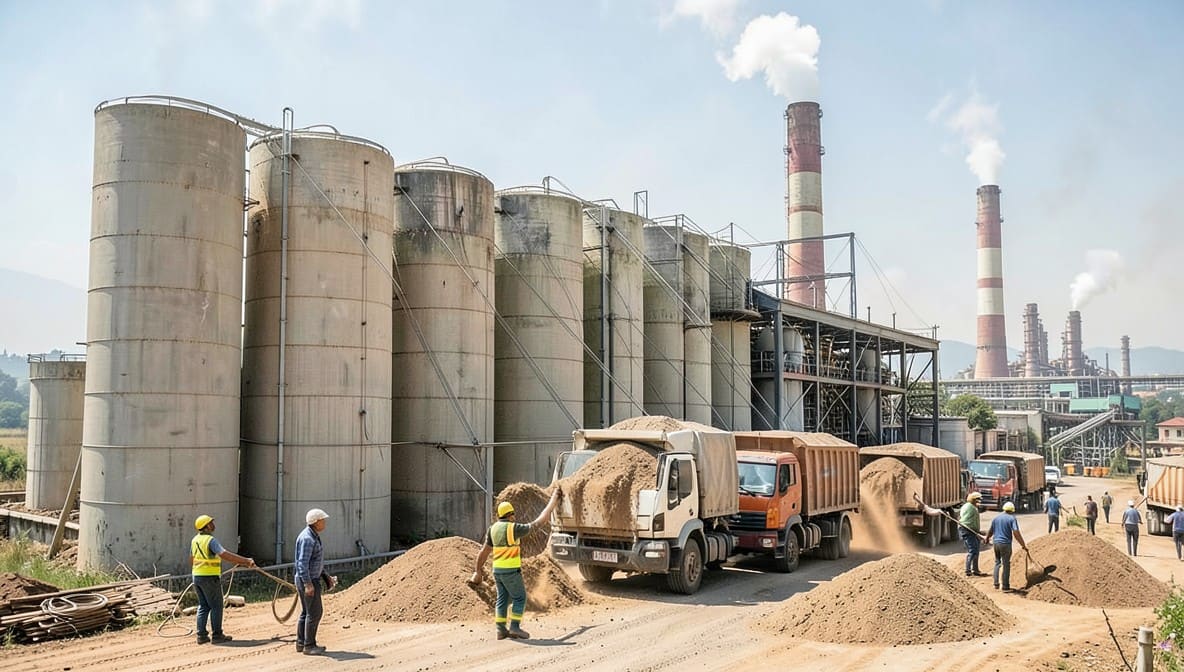
The petitioner, Tushar Kanti Roy, operating as Satyam Sales, entered into a series of agreements with the Damodar Valley Corporation (DVC), a public sector entity, for the supply of dry fly ash generated at its Mejia Thermal Power Station. Initially, fly ash was treated as a hazardous waste requiring disposal. Over time, its commercial value surged due to its use in cement and brick manufacturing, prompting DVC to shift from free disposal to auction-based sales.
Key Facts
- The first agreement was dated 29.05.2007, permitting the petitioner to lift up to 300 metric tons per day of dry fly ash free of cost, with a nominal Rs.3 per metric ton administrative charge.
- An amended agreement dated 01.04.2009 increased the daily supply to 1000 metric tons, with the administrative charge reduced to Rs.1 per metric ton, for a 20-year term.
- In 2017, DVC issued notices inviting all fly ash lifters, including the petitioner, to participate in e-auctions, citing new Ministry of Environment and Forest guidelines.
- The petitioner refused to participate in e-auctions and rejected DVC’s proposal to increase the administrative charge to Rs.20 per metric ton.
- A revised agreement dated 01.01.2019 was entered into, fixing the charge at Rs.6 per metric ton for the first 1000 metric tons daily, with any excess to be paid at the prevailing e-auction rate.
- The petitioner did not agree to further increases beyond this, despite DVC’s repeated requests.
- On 19.07.2022, DVC ceased fly ash supply and demanded a fresh agreement contingent on e-auction participation.
- The petitioner had invoked arbitration under the 2009 agreement in 2018 but no proceedings were initiated.
- In July 2019, a Public Interest Litigation (WP 12311(W) of 2019) was filed by Bijay Kedia challenging the 2009 agreement, leading to a Division Bench observation on 19.10.2020 that public interest required terms of long-term agreements to be revised to reflect market value.
- DVC’s financial disclosures showed fly ash generation of 47.72 million metric tons in FY 2021-22, with evacuation costs of Rs.93 crore and revenue of Rs.18 crore.
- For FY 2022-23, fly ash sales via e-auction generated Rs.11.10 crore; for FY 2023-24, Rs.13.23 crore.
Procedural History
- 29.05.2007: First agreement executed between DVC and petitioner.
- 01.04.2009: Revised agreement signed for 20-year term.
- 20.01.2017: DVC invites all lifters to e-auction.
- 13.09.2017: DVC proposes Rs.20/metric ton charge; petitioner refuses.
- 06.02.2018 & 10.05.2018: Petitioner invokes arbitration clause.
- 01.01.2019: Amended agreement signed with Rs.6/metric ton charge.
- 19.10.2020: Division Bench observes in WP 12311(W) of 2019 that public interest demands revision of old agreements.
- 23.11.2020: Meeting held; DVC requests petitioner to match e-auction rates; petitioner declines.
- 22.09.2022: Ministry of Power issues advisory affirming fly ash as valuable commodity.
- 19.07.2022: DVC issues letter terminating supply unless fresh agreement signed.
- 28.07.2022: Petitioner objects to termination.
- 12.07.2022: Fly ash supply halted without notice.
- 19.12.2022: Writ Petition (WPA 19750 of 2022) filed before Calcutta High Court.
- 11.06.2025, 02.01.2026, 16.01.2026: Hearings held.
- 30.04.2026: Judgment delivered.
Relief Sought
The petitioner sought a writ of mandamus directing DVC to continue fly ash supply under the terms of the 01.01.2019 agreement, restrain DVC from terminating supply, and declare the 19.07.2022 letter unlawful.
The Legal Issue
The central questions were: (1) Can a public body invoke public interest to override a binding contractual obligation to supply a resource now recognized as commercially valuable? (2) Does the doctrine of promissory estoppel bind the state even when equity demands its non-enforcement for larger public interest? (3) Can a writ court grant specific performance of a contract under Article 226?
Arguments Presented
For the Petitioner
The petitioner relied on Union of India v. Vertex Broadcasting Company Private Limited (2015) 16 SCC 198 and Mary v. State of Kerala (2014) 14 SCC 272 to argue that a concluded contract cannot be unilaterally altered by the state. He contended that the 2019 agreement was a valid, subsisting contract and that DVC’s refusal to supply fly ash violated Article 19(1)(g) (right to trade) and Article 14 (equality). He cited Jharkhand State Mineral Development Corporation v. Tirupati Niryat (MANU/JH/0822/2022) to assert that rising market prices cannot justify breach of contract. He further argued that DVC’s own financial data showed it was incurring higher evacuation costs than revenue from e-auctions, making its refusal economically irrational.
For the Respondent
DVC relied on Motilal Padampat Sugar Mills v. State of Uttar Pradesh (1979) 2 SCC 409, Sharma Transport v. Government of Andhra Pradesh (2002) 2 SCC 188, and Kasturi Lal Lakshmi Reddy v. State of Jammu and Kashmir (1980) 4 SCC 1 to argue that public interest in maximizing revenue from natural resources overrides private contractual claims. It contended that fly ash, once a waste, is now a valuable commodity and must be sold at market price to prevent loss to the exchequer. It cited Ram and Shyam Company v. State of Haryana (1985) 3 SCC 267 to assert that the state cannot be estopped from acting in public interest. It also argued that the 2019 agreement was a temporary accommodation, not a permanent entitlement, and that the petitioner had an alternative remedy through arbitration.
The Court's Analysis
The Court began by affirming the maintainability of the writ petition despite the arbitration clause, relying on Harbanslal Sahnia v. Indian Oil Corporation (2003) 2 SCC 107 and Whirlpool Corporation v. Registrar of Trade Marks (1998) 8 SCC 1, noting that constitutional rights under Articles 14 and 19(1)(g) override procedural alternatives.
The Court then turned to the doctrine of promissory estoppel. It acknowledged that the state is bound by its promises under Motilal Padampat Sugar Mills, but emphasized that this doctrine is equitable and must yield when public interest so demands. The Court quoted paragraph 24 of Motilal Padampat:
"The doctrine of promissory estoppel is an equitable doctrine, it must yield when the equity so requires. If it can be shown by the Government that having regard to the facts as they have transpired, it would be inequitable to hold the Government to the promise made by it, the Court would not raise an equity in favour of the promisee and enforce the promise against the Government."
The Court found that the circumstances had fundamentally changed since 2007: fly ash was no longer a waste but a high-demand commodity with substantial auction revenue. The petitioner’s continued access to fly ash at Rs.6 per metric ton, while others paid market rates, created an inequitable distortion. The Court noted that DVC had not acted arbitrarily but had invited renegotiation and offered the petitioner a path to continue supply by matching auction prices.
The Court rejected the petitioner’s reliance on financial data showing higher evacuation costs, noting that the data included both dry fly ash and bottom ash, and no reliable segregation was provided. The Court held that the petitioner failed to prove that DVC was suffering losses by ceasing supply.
On the issue of specific performance, the Court relied on Municipal Council Gondia v. S. R. S. Enterprises and Surjeet Singh Sahni v. State of Uttar Pradesh to hold that writ courts cannot grant specific performance of contracts under Article 226, especially where factual disputes exist and an arbitration clause is in place. The Court concluded:
"It shall be open to the parties to enforce their claims and/or counter claims and seek resolution of the disputes through the arbitral process in accordance with law."
The Verdict
The writ petition was dismissed. The Court held that the doctrine of promissory estoppel cannot compel the state to continue supplying fly ash at below-market rates when public interest demands maximization of revenue. The 19.07.2022 letter terminating supply under the 2019 agreement was upheld. The petitioner is not entitled to specific performance or damages through writ jurisdiction. The parties are directed to resolve their dispute through arbitration under the 2009 agreement.
What This Means For Similar Cases
Public Interest Can Override Contractual Promises
- Practitioners must now argue that any state contract involving natural resources must be evaluated against evolving public interest, especially when the resource gains commercial value.
- Mere existence of a contract does not create an indefeasible right if the underlying purpose of the contract (e.g., waste disposal) has been superseded.
Promissory Estoppel Has Rigorous Limits Against the State
- The burden is on the state to demonstrate that public interest would suffer if the promise is enforced - not merely claim it.
- Courts will require concrete evidence of changed circumstances, not vague policy shifts.
- The state must offer reasonable alternatives (e.g., renegotiation) to avoid inequity.
Writ Courts Will Not Grant Specific Performance
- Parties seeking enforcement of commercial contracts with public bodies must pursue civil remedies or arbitration.
- Writ petitions under Article 226 are not substitutes for civil suits, even when constitutional rights are invoked.
- Arbitration clauses remain effective barriers to writ jurisdiction unless fundamental rights are directly violated.