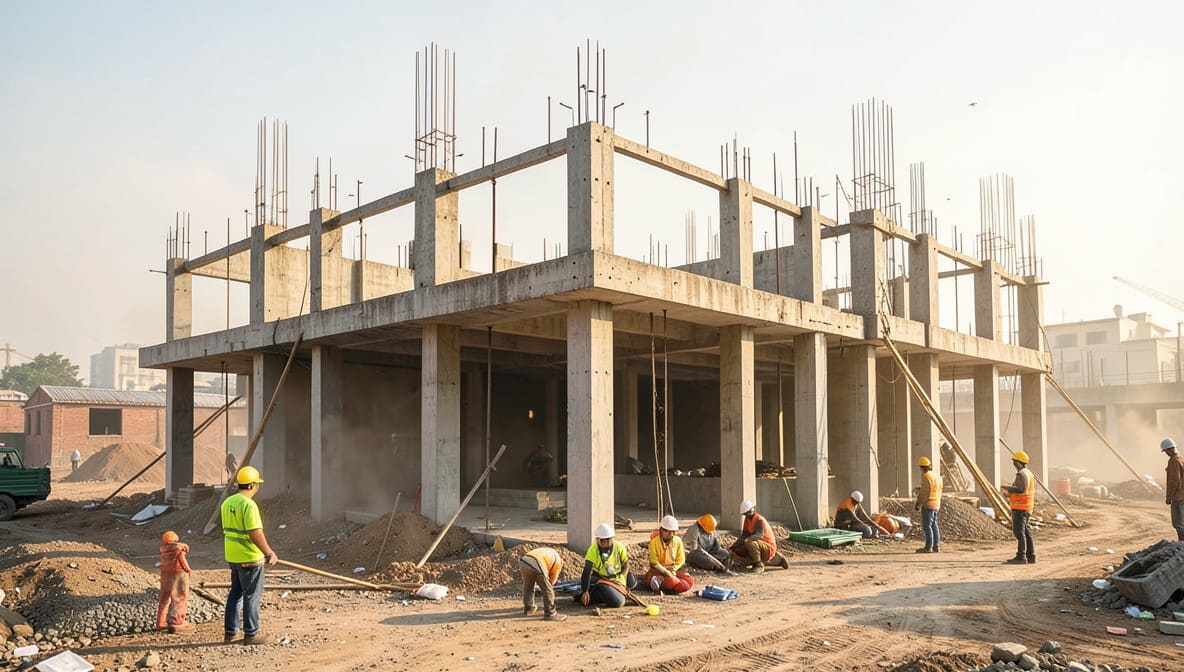
The Karnataka High Court has clarified that a contractor cannot claim price escalation for construction materials absent a clear, unequivocal promise from the public authority, even where informal assurances were made. The judgment reinforces the primacy of written contractual terms and the burden on claimants to prove mutual agreement on modifications.
Background & Facts
The Dispute
The dispute arose from a construction contract between the University of Agricultural Sciences (UAS), Dharwad, and M/s Shankar Construction Company for the construction of a Main Administrative Building at an estimated cost of Rs. 1,57,00,000. The plaintiff submitted the lowest tender on 10.04.1992 and was awarded the contract on 06.08.1992 for a total value of Rs. 1,94,89,161, with a stipulated completion period of 24 months excluding the rainy season.
Key Facts
- The tender notice explicitly stated: "Conditional tenders will not be accepted."
- On 09.04.1992, the plaintiff submitted a letter requesting price escalation for cement, steel, and other materials, attaching an appendix to the tender.
- On 17.07.1992, UAS responded via letter (Ex.D4), rejecting all escalation requests except for cement, stating: "...the requests/conditions mentioned in your letter dated 09.04.1992, 19.05.1992 and 15.07.1992 cannot be considered as there is no provision in the conditions of tender..."
- The plaintiff executed the agreement on 06.08.1992, accepting the tender conditions, including Clause 44.
- Clause 44 of the contract permitted price adjustment only for contracts exceeding two years in duration and excluded the first 12 months of work.
- On 25.07.1994, a meeting was held where the plaintiff expressed inability to continue work without escalation payments. UAS did not agree to modify the contract.
- On 22.09.1994, UAS rescinded the contract citing breach, including failure to complete work on time and cessation of construction activities.
- The plaintiff had completed approximately 70% of the work by 11.06.1994, according to its own witness PW-2.
- UAS encashed the bank guarantee of Rs. 24.18 lakhs as per contract terms.
- UAS paid Rs. 1,41,476 towards cement price escalation via RA Bill No.12 dated 21.08.1993, and subsequent bills (RA Nos.13-18).
- The plaintiff claimed Rs. 2,25,000 for cement escalation but provided no supporting documentation.
- The plaintiff filed W.P. No.30585/1994 challenging the rescission, which was dismissed on 25.01.1995 with a finding that no unequivocal promise of escalation was made.
Procedural History
- 06.08.1992: Contract awarded and executed.
- 17.07.1992: UAS rejects escalation requests except for cement.
- 22.09.1994: Contract rescinded by UAS.
- 25.01.1995: W.P. No.30585/1994 dismissed by High Court, holding no promissory estoppel established.
- 19.09.1997: O.S. No.211/1998 filed by plaintiff seeking declaration of rescission as illegal and recovery of Rs. 42,22,105 with interest.
- 27.01.2001: Suit against Defendant No.2 (Sri Kempayya) dismissed for non-service of summons.
- 30.10.2017: Trial Court partially decreed the suit, awarding Rs. 85,000 for cement escalation with interest.
- 27.03.2026: Appeals heard and decided by Division Bench of Karnataka High Court.
The Parties' Positions
Plaintiff (Appellant in RFA No.100038/2018): Contended that UAS orally and through correspondence agreed to escalate prices for cement, steel, and materials; that the contract was rescinded unlawfully; and that it was entitled to recovery of escalation amounts, encashed bank guarantee, profit on balance work, and cost of materials left on site.
Defendant (Appellant in RFA No.100097/2018): Contended that the plaintiff submitted a conditional tender in violation of tender terms; that no agreement on escalation beyond cement existed; that the plaintiff breached the contract by halting work; and that the rescission and encashment of bank guarantee were lawful.
Relief Sought
The plaintiff sought: (i) declaration that the contract rescission was illegal; (ii) recovery of Rs. 42,22,105 comprising escalation amounts, cement difference, encashed bank guarantee, profit on balance work, and cost of materials on site; (iii) interest at 18.5% from date of suit; and (iv) costs.
The Legal Issue
The central question was whether a public authority’s equivocal response to a contractor’s request for price escalation, in the face of a clear contractual clause limiting such adjustments, constitutes a binding promise enforceable under contract or promissory estoppel.
Arguments Presented
For the Appellant (Plaintiff)
The plaintiff relied on the meeting of 25.07.1994 and letters dated 09.04.1992 and 02.02.1994 to argue that UAS had made a clear assurance to consider escalation, inducing the plaintiff to proceed with work. Counsel cited M/s J.G. Engineers Pvt. Ltd. v. Union of India to argue that unilateral adjudication of breach was invalid, and A.T. Brij Paul Singh v. State of Gujarat to claim entitlement to anticipated profit. It was contended that the Trial Court correctly appreciated the evidence and that the plaintiff was entitled to recovery for cement escalation and materials left on site.
For the Respondent (Defendant)
UAS argued that the tender conditions explicitly barred conditional bids, and the plaintiff’s requests were categorically rejected in writing on 17.07.1992. Counsel emphasized that Clause 44 of the contract limited price adjustment to contracts exceeding two years and excluded the first 12 months, which applied here. It was submitted that the plaintiff’s failure to complete work on time, coupled with cessation of activities, constituted clear breach. The encashment of the bank guarantee was contractual, and no evidence supported the claimed amounts for materials or profit.
The Court's Analysis
The Court began by examining the binding effect of its own earlier order in W.P. No.30585/1994, which had conclusively held that UAS had not made an unequivocal promise to pay escalation charges beyond cement. The Court observed:
"...it cannot be said that there has been an unequivocal promise on the part of the respondents to accept the same. All that is stated is that the matter would be placed before the Board of Regents and thereafter decision will be taken. The decision being taken either then or later was all that promise was made. Therefore, the question of the petitioner having been given any promise in that regard may not be well founded."
This finding, rendered on 25.01.1995, attained finality and precluded the plaintiff from relitigating the existence of a binding promise. The Court held that promissory estoppel, a doctrine rooted in equity, could not override the express terms of a written contract.
The Court further analyzed Clause 44 of the contract, which explicitly restricted price adjustment to contracts exceeding two years and excluded the first 12 months. Since the contract was terminated after 25 months, but the plaintiff sought escalation from the outset, the claim was barred by the contract’s own terms. The plaintiff’s submission of the tender with the appendix, despite knowing the clause, placed the burden squarely on them to prove mutual modification - a burden they wholly failed to discharge.
Regarding the claim for Rs. 85,000 for cement escalation, the Court found the Trial Court’s reasoning flawed. UAS had paid Rs. 1,41,476 via RA Bill No.12 dated 21.08.1993, and subsequent bills followed. The plaintiff provided no documentation to substantiate its claim of Rs. 2,25,000. The mere absence of a final settlement did not create liability where no evidence of dues existed.
On the issue of encashment of the bank guarantee, the Court held it was contractually permissible upon breach, and the plaintiff had not contested the amount claimed by UAS. Similarly, the claim for profit on balance work and cost of materials on site failed due to lack of evidence and failure to respond to UAS’s letter (Ex.P1) requesting site clearance.
The Court distinguished A.T. Brij Paul Singh and Puran Lal Sah, noting that where the contractor breaches the contract, no claim for anticipated profit or quantum meruit lies.
The Verdict
The appeals were decided as follows: (i) RFA No.100097/2018 filed by UAS is allowed; (ii) RFA No.100038/2018 filed by the plaintiff is dismissed; (iii) the judgment and decree dated 30.10.2017 of the Trial Court is set aside; (iv) the suit is dismissed in its entirety; (v) parties to bear their own costs. No monetary relief was awarded to the plaintiff.
What This Means For Similar Cases
Contractual Terms Override Oral Assurances
- Practitioners must treat written contract clauses as paramount; oral or informal assurances, even if made in good faith, cannot override express contractual limitations.
- In public procurement, any deviation from tender conditions must be documented in writing and approved by competent authority.
- Contractors cannot rely on "understandings" or "intentions" expressed in correspondence if the tender explicitly prohibits conditional bids.
Burden of Proof Lies with Claimant for Escalation
- Any claim for price escalation must be supported by contemporaneous documentation proving mutual agreement to modify the contract.
- Mere submission of an appendix or request letter, without acceptance, does not create liability.
- In the absence of proof, courts will not infer agreement, especially where the contract contains a clear limitation clause.
Rescission Valid Where Breach Is Clear
- A public authority may rescind a contract if the contractor fails to perform, halts work, or breaches material terms.
- Encashment of bank guarantee is lawful upon proven breach, provided the contract permits it.
- Claims for profit or quantum meruit are barred where the contractor is the party in breach.
No Relief Without Evidence
- Claims for amounts such as cost of materials on site or profit require specific, quantified evidence - mere assertions are insufficient.
- Failure to respond to official notices (e.g., for site clearance) waives the right to claim subsequent losses.
- Courts will not compensate for speculative or unproven losses, even if the contractor suffered financial hardship.