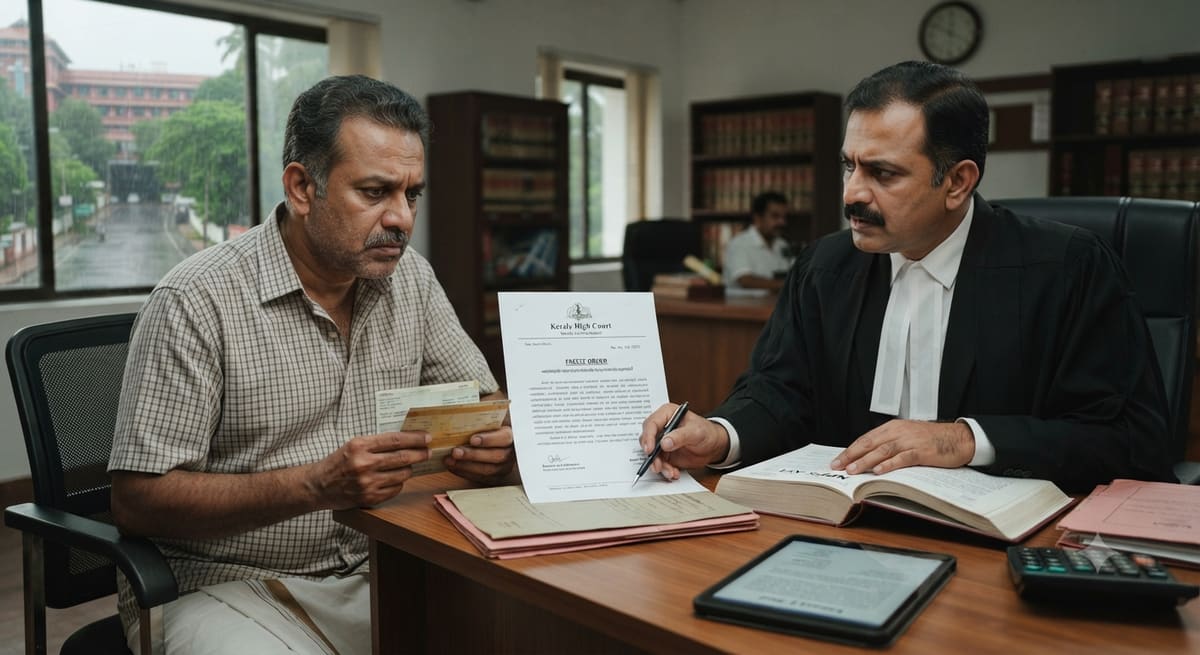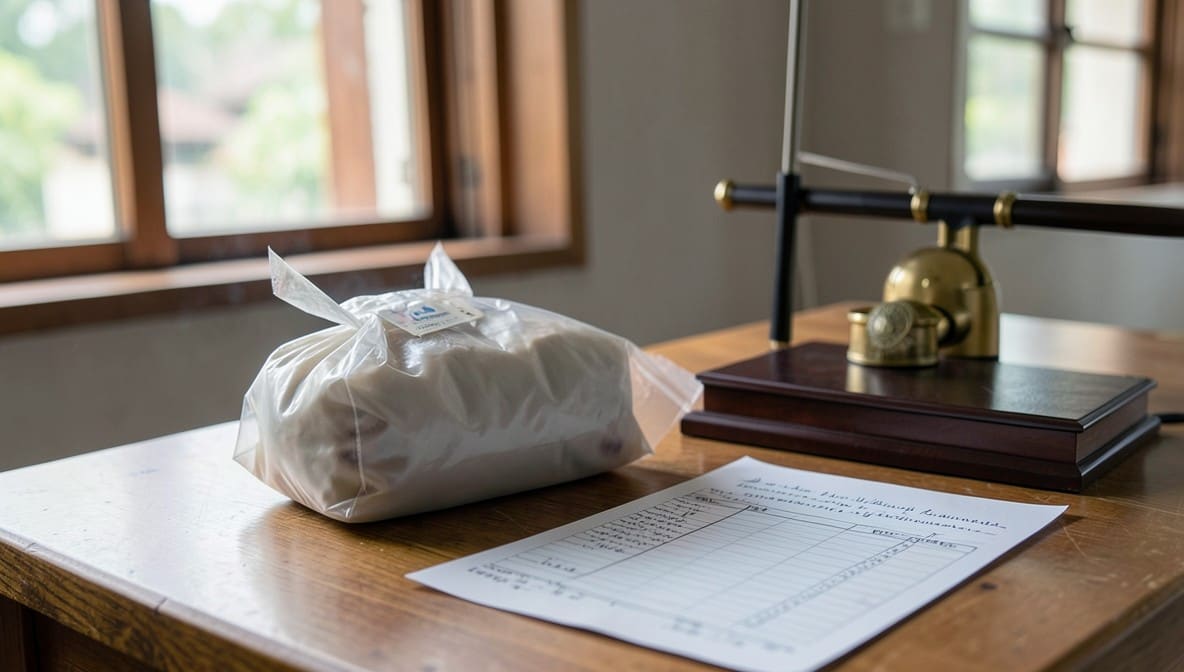
The Madras High Court has clarified that law enforcement agencies cannot indefinitely retain cash seized during narcotics investigations without following the statutory confiscation procedure under the Narcotic Drugs and Psychotropic Substances Act. This ruling reinforces that mere suspicion of illicit origin is insufficient to justify prolonged detention of property, and procedural mandates must be strictly observed.
Background & Facts
The Dispute
The petitioner, Ramzan Beevi, sought the return of Rs.32,84,000 in cash seized from her residence during the investigation into her husband’s alleged possession of 2 kgs of methamphetamine under Section 8(c) r/w 22(c), 28 and 29 of the NDPS Act. She claimed the cash was a gift from her brothers, received after the sale of ancestral property in March 2023, and intended for her daughter’s upcoming marriage.
Procedural History
- 13 May 2023: Cash seized from petitioner’s home under Section 102 Cr.P.C. (now Section 106 of BNSS)
- 14 May 2023: Petitioner’s husband arrested for possession of commercial quantity of narcotics
- 28 August 2025: Special Judge dismissed petitioner’s application under Section 497 of BNSS for return of cash, citing improbable explanation and presumed proceeds of crime
- 2026: Criminal Revision filed before Madras High Court challenging the dismissal
Relief Sought
The petitioner sought return of the seized cash, arguing it was lawfully acquired and not connected to the alleged offence. She requested the court to direct its release, possibly subject to conditions.
The Legal Issue
The central question was whether the Narcotic Control Bureau could retain seized cash indefinitely without invoking Section 68-F of the NDPS Act, and whether the mere size of the amount and the nature of the offence suffice to treat it as proceeds of crime without formal confiscation proceedings.
Arguments Presented
For the Petitioner
The petitioner’s counsel argued that the cash was not proceeds of crime but a legitimate gift, supported by evidence of property sale. He contended that Section 68-F provides the exclusive mechanism for confiscation of property suspected to be proceeds of crime, and its non-application rendered the retention unlawful. He cited State of Maharashtra v. Mohd. Yusuf to emphasize that seizure without a confiscation order violates due process.
For the Respondent
The Special Public Prosecutor contended that the quantum of cash - over Rs.32 lakh - was disproportionate to the petitioner’s known income and inconsistent with her explanation. He argued that under Section 51 of the NDPS Act, the Cr.P.C. framework permits retention pending trial, and the cash’s link to narcotics trafficking was evident. He further noted the cash had been invested in a fixed deposit to preserve its value.
The Court's Analysis
The Court examined the statutory framework under the NDPS Act and found that while Section 106 of BNSS permits seizure, it does not authorize indefinite retention. The Court emphasized that Section 68-F is the only provision that allows for formal confiscation of property suspected to be proceeds of crime, requiring a specific order by the competent authority after notice and opportunity to be heard.
"The procedure adopted by the respondent in seizing the money and keeping it in Fixed Deposit is not in accordance with law."
The Court noted that although an order under Section 68-F had been passed for immovable property, no such order was issued for the cash - despite nearly three years having passed. This selective application undermined procedural fairness. The Court rejected the argument that the cash’s size alone justified its retention, stating that presumption of illegality cannot substitute statutory procedure.
The Court further held that the petitioner’s explanation, while improbable, could not be summarily dismissed without a proper adjudication under Section 68-F. The burden of proving illicit origin lies with the State, and that burden can only be discharged through a formal confiscation proceeding.
The Verdict
The petitioner did not win immediate return of the cash, but the Court set aside the lower court’s dismissal and directed the Narcotic Control Bureau to either invoke Section 68-F of the NDPS Act within three weeks or return the cash to the petitioner under strict conditions. The core holding is that procedural compliance under Section 68-F is mandatory before confiscation.
What This Means For Similar Cases
Confiscation Requires Formal Order, Not Just Seizure
- Practitioners must challenge prolonged retention of seized cash where no Section 68-F order has been passed
- Seizure under Section 106 BNSS is temporary; confiscation requires a separate, adjudicative order
- Failure to invoke Section 68-F within a reasonable time renders retention unlawful
Burden of Proof Remains With the State
- Mere size of cash or association with a narcotics offence does not shift the burden to the claimant
- The State must establish a nexus between the cash and the offence through evidence, not speculation
- Courts will not accept vague assertions of "proceeds of crime" without documented investigation
Procedural Inconsistencies Invalidate Retention
- If authorities invoke Section 68-F for property but not for cash, courts will view this as arbitrary
- Fixed deposits or other custodial measures do not cure procedural defects
- Petitioners may now seek writs for return of cash if the State fails to act within a reasonable timeframe