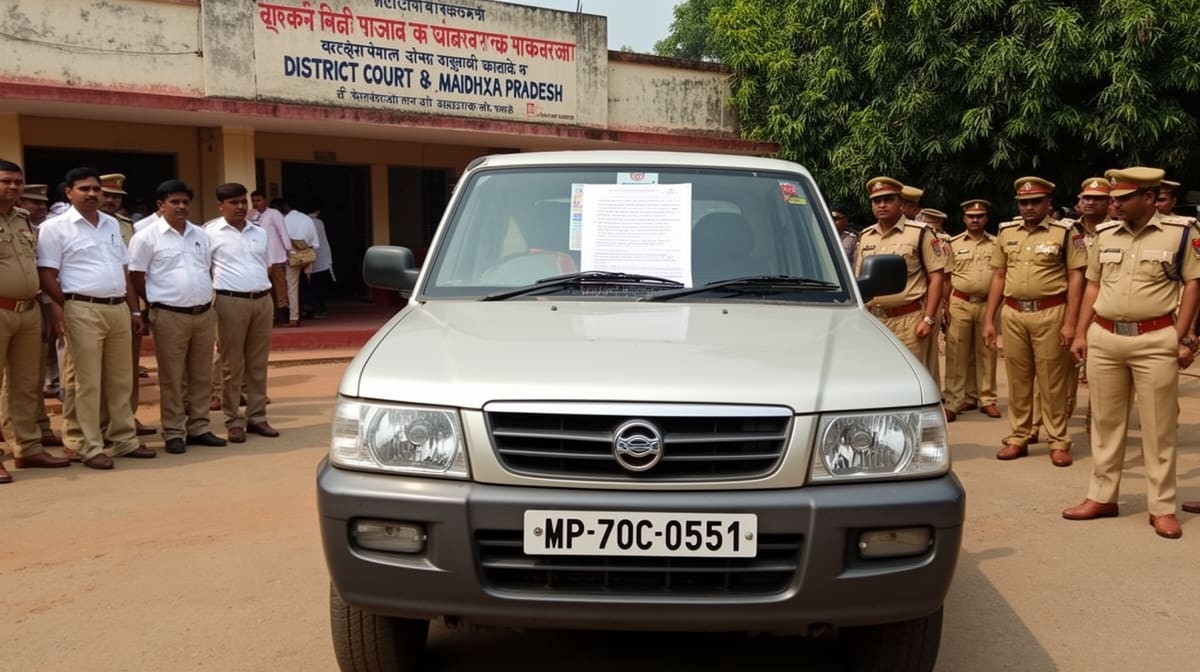
The Madhya Pradesh High Court has unequivocally held that administrative confiscation of a vehicle under the M.P. Excise Act cannot proceed while a criminal trial under Section 34(2) is pending. This ruling reinforces the principle that penal consequences must follow judicial determination of guilt, not administrative expediency.
Background & Facts
The Dispute
The petitioner, Lakhlan Lal Mallah, was accused under Section 34(2) of the Madhya Pradesh Excise Act, 1915, for alleged illicit transportation of liquor. A charge-sheet was filed by the police in RCT No. 429/25 before the Chief Judicial Magistrate, Narsinghpur. While the criminal trial remained pending, the District Magistrate (Collector), Narsinghpur initiated confiscation proceedings under Section 47-A of the same Act and passed an order on 16-04-2025 seizing the petitioner’s motor-cycle bearing registration No. MP-49-MT-9579. The petitioner challenged this confiscation before the trial court by filing a supurdginama application, which was rejected on 23-06-2025.
Key Facts
- The criminal case under Section 34(2) of the M.P. Excise Act was instituted and remained pending before the Chief Judicial Magistrate, Narsinghpur.
- The confiscation order dated 16-04-2025 was passed by the District Magistrate while the criminal trial was ongoing.
- The petitioner had previously filed M.Cr.C. No. 19910/25 before this Court seeking direction to decide the supurdginama application.
- The vehicle in question was seized without any prior conviction or adjudication of guilt in the criminal proceeding.
Procedural History
- 16-04-2025: District Magistrate, Narsinghpur passed confiscation order under Section 47-A of the M.P. Excise Act.
- 23-06-2025: Chief Judicial Magistrate rejected the petitioner’s supurdginama application seeking release of the vehicle.
- Prior to 21-04-2025: The Full Court of the Madhya Pradesh High Court delivered judgment in WP No. 11356/24, declaring Section 47-A of the M.P. Excise Act ultra vires of the Constitution.
- 21-04-2025: Full Court judgment reported in 2025 SCC Online MP 1904 was published, laying down prospective applicability of the ultra vires declaration.
- 28-06-2025: Petitioner filed the present petition under Section 482 Cr.P.C. and Section 528 BNSS seeking quashing of the confiscation order and the rejection of the supurdginama application.
- 31-03-2026: Hearing concluded and judgment delivered by Justice B.P. Sharma.
Relief Sought
The petitioner sought quashing of the confiscation order dated 16-04-2025 and the order dated 23-06-2025 rejecting the supurdginama application. He further sought the release of the vehicle subject to conditions and direction to the trial court to proceed with the criminal trial without prejudice.
The Legal Issue
The central question was whether the District Magistrate may lawfully confiscate a vehicle under Section 47-A of the M.P. Excise Act while a criminal trial under Section 34(2) is still pending, prior to any conviction by the trial court.
Arguments Presented
For the Petitioner
Learned counsel for the petitioner relied on the Full Court judgment in WP No. 11356/24 (Ramlal Jhariya v. State of Madhya Pradesh), reported in 2025 SCC Online MP 1904, which held that Section 47-A of the M.P. Excise Act is ultra vires the Constitution. He argued that even if the provision were not struck down, confiscation during pendency of trial violates the principle of presumption of innocence and exceeds the statutory authority of the Collector. He further contended that Clause (c) of Paragraph 97 of the Full Court judgment preserved the right of the petitioner to challenge the confiscation order, as the limitation period had not expired.
For the Respondent
The Public Prosecutor for the State did not contest the applicability of the Full Court judgment. No independent legal argument was advanced to justify the confiscation during pendency of trial. The State conceded that the order was passed in the shadow of the Full Court’s declaration but sought to uphold it on procedural grounds, which the Court rejected.
The Court's Analysis
The Court examined the Full Court judgment in Ramlal Jhariya and found its reasoning directly applicable. The judgment had declared Section 47-A ultra vires and laid down a prospective framework to prevent chaos in pending cases. Paragraph 97(c) explicitly preserved the right of persons to challenge confiscation orders if statutory limitation had not expired as of the date of the Full Court judgment (21-04-2025). The present confiscation order was passed on 16-04-2025, prior to the Full Court judgment, and the challenge was filed within limitation.
"97. ... c. where either (a) the confiscation order or (b) order in appeal has already been passed prior to date of this order, the benefit of this order will be applicable only if statutory limitation for challenging the same has not expired on date of this order and if (c) order in Revision has been passed less than three months prior to date of this order, then also, benefit of this order will apply while making challenge before the High Court in Writ petition/ Section 482 CrPC or Sec. 528 BNSS."
The Court emphasized that the very purpose of the Full Court’s directive was to prevent administrative action from prejudicing the rights of the accused during trial. Confiscation before conviction undermines the presumption of innocence and constitutes a deprivation of property without due process. The Court held that the Collector’s power to confiscate is contingent upon a final conviction, not merely the filing of a charge-sheet. The order dated 16-04-2025 was therefore illegal and unsustainable.
The Court further noted that the rejection of the supurdginama application by the trial court was a direct consequence of the unlawful confiscation order. Since the confiscation itself was invalid, the trial court’s refusal to release the vehicle could not stand.
The Verdict
The petition was allowed. The confiscation order dated 16-04-2025 and the order dated 23-06-2025 rejecting the supurdginama application were set aside. The trial court was directed to release the vehicle bearing registration No. MP-49-MT-9579 on supurdginama, subject to the following conditions: (i) a personal bond of Rs. 50,000 with one solvent surety of like amount; (ii) photographs of the vehicle showing registration and chassis numbers, taken before a court-deputed officer; (iii) photographs of the petitioner and surety, with residential proof; (iv) no transfer or modification of the vehicle; (v) no use in anti-social activities; and (vi) the petitioner shall keep the vehicle available for confiscation if a conviction is later recorded. The trial court was directed to comply within two weeks.
What This Means For Similar Cases
Confiscation Requires Conviction, Not Allegation
- Practitioners must now argue that any confiscation under Section 47-A of the M.P. Excise Act during pendency of trial is void ab initio.
- Applications under Section 482 CrPC or Section 528 BNSS should be filed immediately upon issuance of such orders, even if the charge-sheet is recent.
Full Court Judgment Is Binding and Retroactive in Effect for Pending Challenges
- Even if a confiscation order was passed before 21-04-2025, it can be challenged if the limitation period had not expired on that date.
- This applies to all pending appeals, revisions, or writ petitions as of 21-04-2025.
Trial Courts Must Act as Safeguards Against Administrative Overreach
- Trial courts are now obligated to entertain and grant supurdginama applications where confiscation occurred without conviction.
- Failure to release the vehicle under these conditions may attract contempt proceedings.
No Automatic Confiscation for First-Time Offenders
- The judgment implicitly rejects the notion that possession of illicit liquor justifies immediate seizure of property.
- The burden remains on the State to prove guilt in court before property rights are extinguished.
The Doctrine of Presumption of Innocence Is Non-Negotiable
- The Court reaffirmed that constitutional rights cannot be suspended by administrative orders.
- Any confiscation prior to conviction violates Article 21 and Article 14 of the Constitution.