The Madhya Pradesh High Court has clarified that state authorities cannot confiscate vehicles during the pendency of criminal proceedings under cattle preservation laws, affirming that such power rests exclusively with the criminal court. This ruling reinforces procedural safeguards against executive overreach in enforcement actions.
Background & Facts
The Dispute
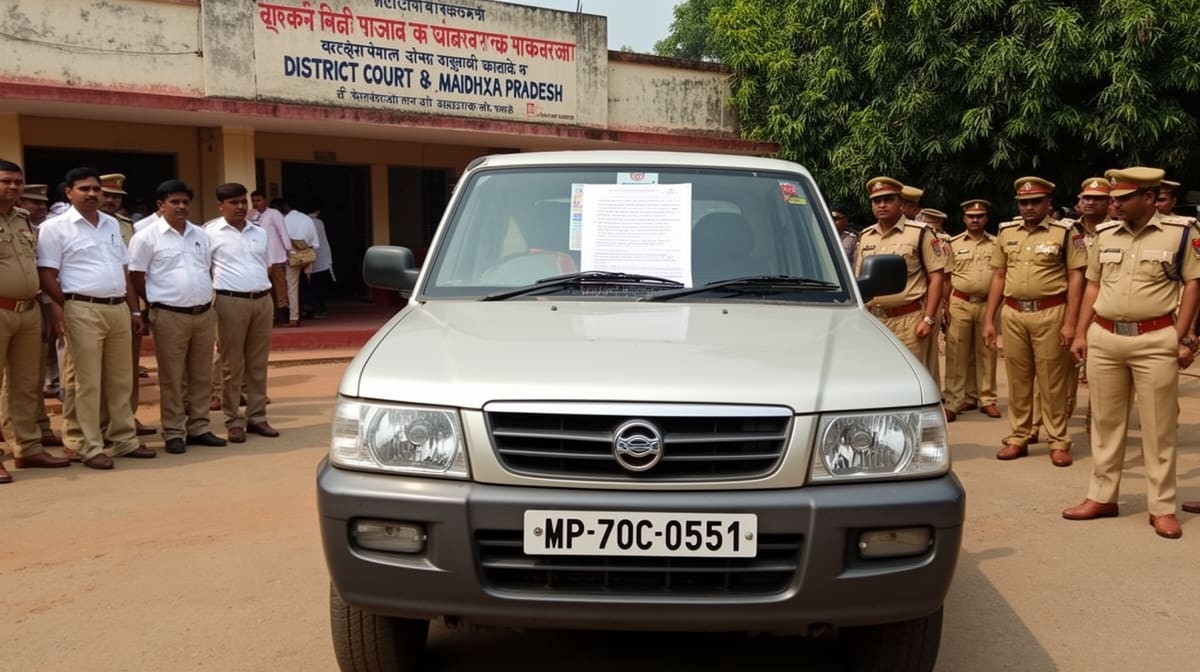
The petitioner, Manish Gamad, challenged the confiscation of his pickup vehicle bearing registration No. MP-45-ZC-6584, which was seized by authorities under the Madhya Pradesh Cow Slaughter Prohibition Act, 2004; the Madhya Pradesh Agricultural Cattle Preservation Act, 1959; and Section 11(1)(D) of the Prevention of Cruelty to Animals Act, 1960. The confiscation was ordered without any judicial determination of guilt or pending adjudication of the underlying criminal case.
Key Facts
- The vehicle was seized on grounds of alleged transportation of cattle in violation of the aforementioned statutes.
- The seizure was carried out by the District Collector, Mansaur, under administrative authority.
- No criminal conviction had been obtained at the time of confiscation.
- The criminal case arising from the alleged offence remained pending before the trial court.
- The vehicle remained in custody of the state since the date of seizure, with no interim release granted.
Procedural History
- 13.11.2024: First confiscation order passed by the Learned Judicial Magistrate First Class (JMFC), Garoth, Mansaur.
- 26.11.2024: Additional District and Sessions Judge, Garoth, upheld the confiscation order on appeal.
- 30.12.2024: District Collector, Mansaur, confirmed the confiscation order under administrative powers.
- 01.04.2025: Petitioner filed the present writ petition under Section 528 of the Bharatiya Nagarik Suraksha Sanhita, 2023 before the Madhya Pradesh High Court, Indore.
Relief Sought
The petitioner sought:
- Quashing of all three impugned orders dated 13.11.2024, 26.11.2024, and 30.12.2024.
- Immediate release of the vehicle bearing registration MP-45-ZC-6584.
- Any other relief deemed just by the Court.
The Legal Issue
The central question was whether administrative authorities, including the District Collector, may confiscate a vehicle under cattle preservation statutes while the associated criminal case remains pending before a trial court, or whether such power is exclusively vested in the criminal court under Section 528 of the BNSS, 2023.
Arguments Presented
For the Petitioner
Counsel for the petitioner relied on the Full Bench decision in Ramlal Jhariya v. State of Madhya Pradesh & Others (W.P. No. 11356 of 2024, decided on 21.04.2025), which held that confiscation of vehicles under cattle protection laws cannot be ordered by executive authorities during the pendency of criminal proceedings. The petitioner argued that Section 528 of the BNSS, 2023 vests exclusive power of confiscation in the criminal court after conviction or as part of sentencing, and that pre-trial confiscation by administrative bodies violates the principle of separation of powers and due process.
For the Respondent
The Government Advocate for the State did not dispute the legal proposition laid down in Ramlal Jhariya. The State conceded that the impugned orders were issued in contravention of the binding precedent and did not contest the petitioner’s prayer for quashing.
The Court's Analysis
The Court examined the statutory framework under the Madhya Pradesh Cow Slaughter Prohibition Act, 2004, the Agricultural Cattle Preservation Act, 1959, and the Prevention of Cruelty to Animals Act, 1960. It noted that while these statutes empower authorities to seize vehicles, they do not confer independent power of confiscation without judicial sanction.
"The power to confiscate property, especially a vehicle used in the commission of an offence, is a penal consequence that must follow adjudication, not precede it. To allow executive authorities to confiscate property before the trial concludes is to invert the presumption of innocence and undermine the role of the criminal court."
The Court emphasized that Ramlal Jhariya was a Full Bench decision binding on all benches of the High Court and had squarely addressed the issue of pre-trial confiscation. The State’s concession further removed any factual or legal dispute. The Court held that confiscation is not an investigative or preventive tool but a punitive measure requiring judicial determination.
The Court also noted that Section 528 of the BNSS, 2023 explicitly provides that only the court trying the offence may order confiscation, and no other authority may exercise such power. Administrative confiscation during pendency, therefore, is ultra vires.
The Verdict
The petition was allowed. The Court quashed the confiscation orders dated 13.11.2024, 26.11.2024, and 30.12.2024. The State was directed to release the petitioner’s vehicle, registration No. MP-45-ZC-6584, upon the petitioner furnishing adequate surety to the satisfaction of the trial court. The Court imposed no costs.
What This Means For Similar Cases
Confiscation Requires Judicial Order
- Practitioners must challenge any pre-trial confiscation of vehicles or property under cattle or animal protection laws as ultra vires.
- Administrative orders issued under Sections 4, 6, or 9 of the MP Cow Slaughter Act are void if passed before conviction.
Section 528 BNSS Is Exclusive
- Only the court trying the offence may order confiscation under Section 528 of the BNSS, 2023.
- Seizure may occur during investigation, but confiscation requires a judicial order.
Precedent Binding Across MP
- The Ramlal Jhariya ruling applies uniformly across all districts of Madhya Pradesh.
- Any pending confiscation orders issued between 21.04.2025 and 01.04.2026 are now legally unsustainable and subject to quashing.