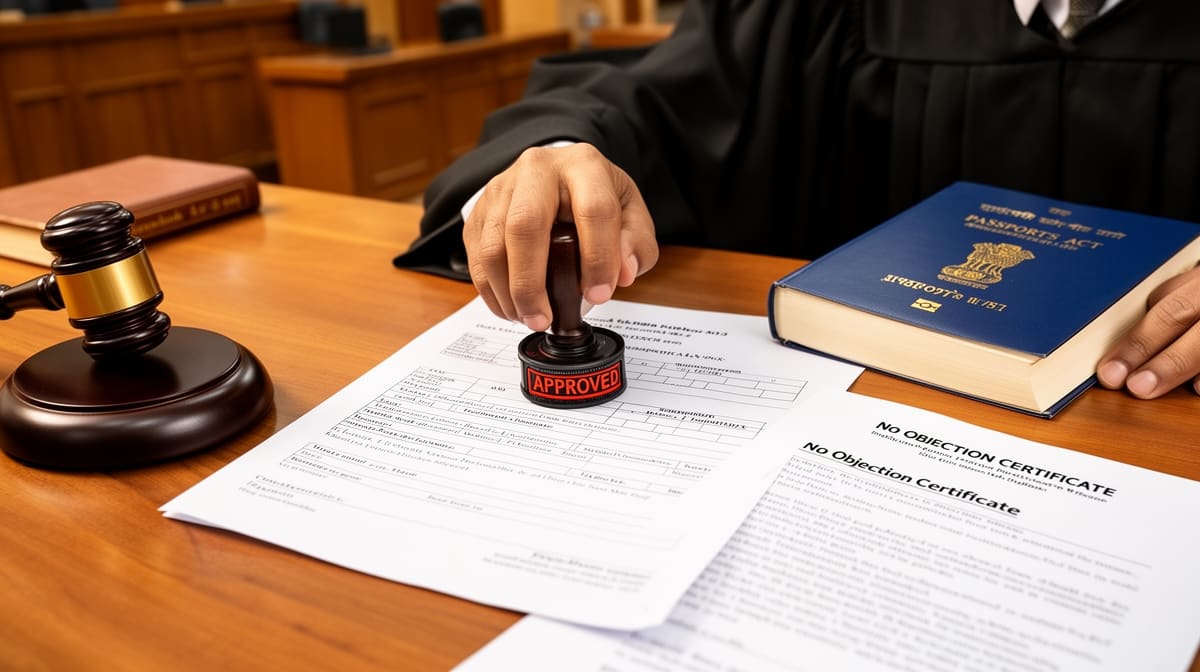
The Telangana High Court has clarified that the pendency of a criminal case against a passport applicant cannot, by itself, justify refusal to renew a passport. The judgment reinforces that administrative action must comply with statutory mandates and principles of natural justice, and that procedural safeguards must be followed before denying a fundamental right to international travel.
Background & Facts
The Dispute
The petitioner, Mrs. Sridevi Nemani, applied for renewal of her passport bearing No. N3097739 under File No. HY1076305912226 dated 28.01.2026. The Regional Passport Officer, Respondent No. 2, rejected the application on the ground that police verification revealed a pending criminal case against her in S.C. No. 170 of 2024 before the Additional Chief Judicial Magistrate, Medchal Malkaigiri District, Kukatpally. No specific allegations, charges, or stage of proceedings were disclosed to the petitioner.
Key Facts
- The petitioner’s current passport (No. N3097739) was issued on a prior occasion and was due for renewal.
- The application for renewal was submitted on 28.01.2026.
- Police verification report dated prior to 28.01.2026 flagged the pendency of S.C. No. 170 of 2024 as an adverse finding.
- The passport authority refused renewal without providing the petitioner an opportunity to be heard or disclosing the nature of the criminal case.
- No evidence was placed on record indicating that the petitioner had been charged, convicted, or that the case involved moral turpitude or flight risk.
- The petitioner had not been served with any summons, notice, or order restricting her travel.
Procedural History
- 28.01.2026: Petitioner submitted application for passport renewal (File No. HY1076305912226).
- Early February 2026: Passport authority issued refusal letter citing pending criminal case as ground for denial.
- 15.03.2026: Writ Petition No. 10850 of 2026 filed before the Telangana High Court under Article 226.
- 15.03.2026: Simultaneously filed LA No. 1 of 2026 under Section 151 CPC seeking interim direction for passport renewal.
- 10.04.2026: Hearing before the Hon’ble Justice Nagesh Bheemapaka.
The Parties' Positions
For the Petitioner:
- Argued that mere pendency of a criminal case, without any conviction or specific restriction, cannot justify denial of a passport under the Passport Act, 1967.
- Relied on the principle that the right to travel abroad is a facet of personal liberty under Article 21 of the Constitution.
- Contended that the refusal violated principles of natural justice as no opportunity to explain or rebut the adverse report was given.
- Cited the Division Bench judgment in W.A. No. 194 of 2026 dated 17.02.2026, which held that passport authorities must follow the Ministry of External Affairs’ Office Memorandum dated 10.10.2019.
For the Respondents (Union of India and Passport Authority):
- Submitted that Rule 6(2)(c) of the Passport Rules, 1980, read with the Office Memorandum dated 10.10.2019, permits refusal if criminal proceedings are pending.
- Argued that the passport authority is bound to act on police verification reports and cannot ignore pending criminal cases.
- Asserted that the petitioner must first obtain a No Objection Certificate (NOC) from the trial court before the passport authority can proceed.
- Stated that the refusal was procedural and not final, and that the petitioner retains the right to apply again upon furnishing an NOC.
Relief Sought
The petitioner sought:
- A declaration that the refusal to renew her passport was arbitrary, unconstitutional, and violative of natural justice.
- A writ of mandamus directing the passport authority to renew her passport without reference to the pending criminal case.
- Alternatively, an interim direction to renew the passport pending disposal of the criminal case.
The Legal Issue
The central question was whether the mere pendency of a criminal case against a passport applicant, without any court order restricting travel or any finding of flight risk, constitutes a lawful ground for refusal of passport renewal under the Passport Act, 1967 and the Office Memorandum dated 10.10.2019.
Arguments Presented
For the Petitioner
The petitioner’s counsel relied on the Division Bench judgment in W.A. No. 194 of 2026 and the Ministry of External Affairs’ Office Memorandum dated 10.10.2019, which clarify that the passport authority cannot unilaterally deny renewal on the basis of police reports alone. He argued that the Act and Rules do not empower the passport authority to act as a judge of pending criminal cases. The right to travel is protected under Article 21, and any restriction must be procedurally fair and substantively justified. Mere pendency, without a court order or specific risk assessment, is insufficient. The petitioner had not been charged, and no evidence of flight risk was presented.
For the Respondent
The Standing Counsel for the Central Government contended that the Office Memorandum dated 10.10.2019 mandates that passport authorities must refer cases involving pending criminal proceedings to the concerned trial court for an NOC. The memorandum was issued to standardize procedure and prevent arbitrary denials. The passport authority acted in accordance with this directive. The refusal was not final but procedural, and the petitioner was not barred from applying again upon obtaining an NOC. The Counsel emphasized that the trial court, not the passport authority, is the appropriate forum to assess whether the petitioner’s travel would interfere with the administration of justice.
The Court's Analysis
The Court began by affirming the settled legal position that the pendency of a criminal case alone cannot be a ground to deny a passport. The Court observed that the Passport Act, 1967, and the Passport Rules, 1980, do not contain any provision that automatically bars passport issuance or renewal on the basis of pending proceedings. The authority to restrict travel lies with the court, not the executive.
The Court then examined the Office Memorandum dated 10.10.2019 issued by the Ministry of External Affairs, which provides a procedural framework for handling such cases. The Memorandum states that if a criminal case is pending, the passport authority shall not act unilaterally but shall require the applicant to obtain a No Objection Certificate from the concerned trial court. The Court held that this procedure is not an additional burden but a necessary safeguard to ensure that administrative action does not encroach upon judicial authority.
"In the light of the principle laid down by the Apex Court concerning the interpretation of GSR 570(E) dated 25.08.1993 and Office Memorandum dated 10.10.2019, we are of the considered view that the appellant should make an application for seeking NOC from the concerned trial courts where criminal cases are pending against him. It is upon issuance of NOC that the appellant should file an application for renewal of the passport."
The Court noted that in the present case, the petitioner had not approached the trial court for an NOC. Therefore, the refusal by the passport authority was procedurally correct, though not substantively punitive. The Court emphasized that the trial court must act expeditiously: upon the petitioner’s application, the Additional Chief Judicial Magistrate must decide within one week.
The Court further clarified that any NOC granted by the trial court shall not be construed as permission to travel abroad. Separate permission for international travel during pendency of criminal proceedings must be sought directly from the trial court, which may impose conditions such as surrender of passport, reporting obligations, or bail conditions.
The Court rejected the notion that the passport authority is empowered to adjudicate the merits of criminal cases. Its role is purely administrative and must conform to the procedural norms laid down by the Ministry and upheld by the judiciary.
The Verdict
The writ petition was disposed of with directions. The petitioner must approach the Additional Chief Judicial Magistrate, Medchal Malkaigiri District, Kukatpally, and file an application for a No Objection Certificate for passport renewal within seven days of this order. The trial court shall decide the application expeditiously, preferably within one week of filing. Upon submission of the NOC, the passport authority shall reconsider the renewal application. Any permission for international travel during pendency of the criminal case must be sought separately from the trial court, which shall impose conditions as necessary under law. There shall be no order as to costs.
What This Means For Similar Cases
NOC Is Mandatory, Not Discretionary
- Practitioners must advise clients facing passport denial due to pending criminal cases to immediately file for an NOC with the trial court, not wait for the passport authority to act.
- Failure to obtain an NOC will render any subsequent challenge to passport refusal procedurally defective.
Trial Courts Must Act Swiftly
- Courts must treat NOC applications under this protocol as urgent matters and dispose of them within one week, as directed by the Telangana HC.
- Delay by the trial court in issuing an NOC may be challenged via writ petition for inaction.
Travel Permission Is Separate from Passport Renewal
- A passport renewal NOC does not equate to permission to travel abroad.
- Clients intending to travel internationally during pendency of criminal proceedings must file a separate application before the trial court, specifying duration, destination, and purpose.
- Courts may impose conditions such as bail bonds, passport surrender, or reporting requirements.
Administrative Denial Is Not Final
- Passport authorities may refuse renewal on procedural grounds (lack of NOC) but cannot permanently deny the right.
- The refusal is a procedural pause, not a substantive bar.
- Clients retain the right to reapply upon compliance with the NOC requirement.
No Automatic Link Between Criminal Case and Passport
- Mere registration of an FIR or pendency of a case, without a court order or evidence of flight risk, cannot justify denial.
- Authorities must not rely on police reports alone; they must follow the Ministry’s procedural guidelines.
Burden of Proof on the State
- If the State wishes to oppose an NOC, it must file a specific affidavit before the trial court demonstrating why the petitioner’s travel would obstruct justice.
- Generalized allegations of "pending case" are insufficient.
Legal Strategy Takeaway
- In all passport-related writ petitions, the first step is to verify whether an NOC application was filed.
- If not, the petition should be amended to seek direction to the trial court to grant an NOC.
- If an NOC was denied, challenge the denial before the trial court, not the passport authority.
Key Statutory Reference
- Passport Act, 1967: No provision bars renewal on mere pendency.
- Passport Rules, 1980: Rule 6(2)(c) permits refusal only if the applicant is subject to a court order restricting travel.
- Office Memorandum dated 10.10.2019: Mandatory procedural guide for passport authorities.
Note: This judgment does not overrule any statutory provision but interprets administrative guidelines to align with constitutional rights and procedural fairness.
Practical Tip for Practitioners
Always file an NOC application in triplicate: one copy to the trial court, one to the passport authority, and one retained by the client. Obtain a stamped receipt. This creates a clear record of compliance and prevents future disputes.
Case Law Reference
- W.A. No. 194 of 2026 (Telangana HC Division Bench, 17.02.2026) - Binding precedent on procedure.
- State of West Bengal v. Anwar Ali - Right to travel is part of Article 21.
- K.S. Puttaswamy v. Union of India - Proportionality and procedural fairness in state action.
The judgment ensures that administrative discretion is exercised within the bounds of law and does not become a tool for arbitrary denial of fundamental rights.
Final Note
This ruling brings clarity to a common administrative conflict. It protects citizens from being penalized by bureaucracy for matters pending before courts, while preserving the judiciary’s role in determining whether travel should be restricted.
Conclusion
The Telangana High Court has struck a balanced, rights-based approach: no automatic denial, no executive overreach, and no judicial delay. The path forward is clear - apply for NOC, and let the court decide.
Key Takeaway for Law Students
This case illustrates the interplay between administrative law, constitutional rights, and procedural due process. It demonstrates how statutory interpretation must be guided by constitutional values, and how courts act as arbiters between executive discretion and individual liberty.
Citation for Future Reference
Mrs. Sridevi Nemani v. Union of India, W.P. No. 10850 of 2026, Telangana High Court, 10.04.2026.
Recommended Reading
- Ministry of External Affairs, Office Memorandum dated 10.10.2019.
- Passport Act, 1967, Sections 5, 6, 10.
- Maneka Gandhi v. Union of India, (1978) 1 SCC 248.
Practice Note
Always check the status of the criminal case before filing a passport application. If the case is in the investigation stage, the NOC application should request a certificate stating that no objection is raised to passport renewal. If the case is in trial, request a certificate that the petitioner’s presence is not required for travel during the specified period.
Final Advice
Do not assume that a pending case means a denied passport. Follow the procedure. Obtain the NOC. Challenge inaction. The law is on the side of the citizen.
Summary for Clients
You can renew your passport even if a case is pending - but you must first ask the court for permission. The court will decide. The passport office will follow.
Legal Principle Established
Mere pendency of a criminal case is not a ground for denial of passport renewal; the applicant must obtain a No Objection Certificate from the trial court, which must decide within one week.