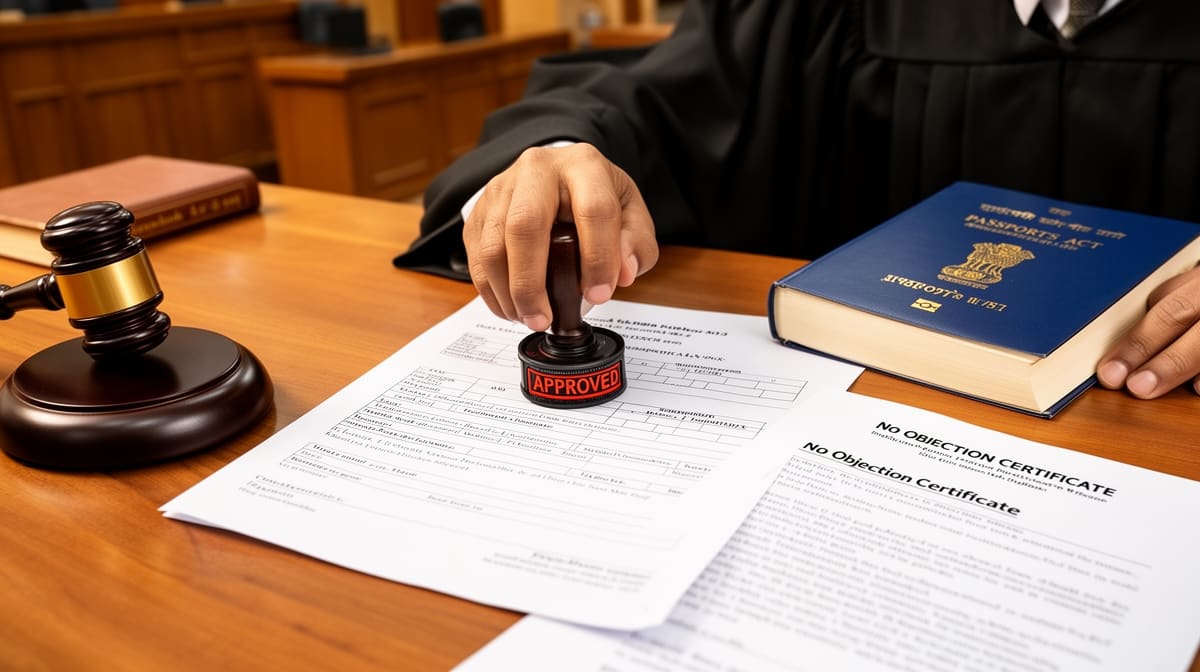
The Telangana High Court has clarified that the mere pendency of a criminal case cannot justify automatic denial of a passport application. The judgment establishes a procedural safeguard requiring applicants to first seek a No Objection Certificate from the trial court handling the criminal matter, reinforcing the principle that rights under Article 21 cannot be curtailed without due process.
Background & Facts
The Dispute
The petitioner, Thota Ramesh, applied online for a fresh passport on 05-06-2025, paying the requisite fee of Rs. 1,500. The Regional Passport Office rejected the application citing an adverse police verification report indicating a pending criminal case under S.C. No. 248 of 2022 before the Senior Civil Judge, Suryapet. The petitioner contended that the pendency of the case alone was insufficient grounds for denial, especially since he had no prior criminal record and had never misused his passport.
Procedural History
- 05-06-2025: Petitioner submitted online passport application (Ref. No. 25-1053059906)
- Shortly thereafter: Regional Passport Office denied application citing pending criminal proceedings
- 2026: Petitioner filed Writ Petition No. 4597 of 2026 under Article 226 of the Constitution
- Simultaneously: Filed Application No. 1 of 2026 under Section 151 CPC seeking interim relief
Relief Sought
The petitioner sought a writ of mandamus directing the Passport Authority to issue the passport, arguing that the refusal violated principles of natural justice and was arbitrary under Article 14 of the Constitution.
The Legal Issue
The central question was whether the passports authority may lawfully refuse issuance of a fresh passport solely on the ground of pending criminal proceedings, without requiring the applicant to first obtain a No Objection Certificate (NOC) from the trial court.
Arguments Presented
For the Petitioner
Counsel for the petitioner relied on W.P. No. 2422 of 2024 decided by the same court, which held that pending criminal proceedings do not automatically disqualify an applicant from obtaining a passport. He emphasized that the petitioner sought a fresh passport, not renewal, and that the denial was disproportionate and violated the presumption of innocence. He argued that the Passport Rules do not mandate automatic refusal and that the police report alone cannot override constitutional rights.
For the Respondent
The Standing Counsel for the Union of India contended that Rule 6 of the Passport Rules, 1980, read with the Ministry of External Affairs’ 2019 Memorandum, permits refusal if criminal proceedings are pending. He asserted that the NOC from the trial court is a mandatory procedural precondition, especially where the police verification reveals adverse findings. He cited Thirumani Nagaraj v. Union of India to support the view that courts must balance individual rights against potential obstruction of justice.
The Court's Analysis
The Court examined the statutory framework governing passport issuance, particularly the 2019 Ministry of External Affairs Memorandum and the precedent in Thirumani Nagaraj v. Union of India. It held that while the Passport Authority has discretion to refuse issuance, such refusal must be grounded in a reasoned judicial determination, not merely an administrative decision based on police reports.
"The Notification G.S.R. 570(E) carves out a statutory exemption, permitting the issuance or renewal of a passport to such applicants, provided they produce either (i) a No Objection Certificate (NOC) or (ii) an order of permission from the competent court allowing renewal during the pendency of the criminal case."
The Court emphasized that the presumption of innocence underpins the entire criminal justice system and that denying a passport without judicial scrutiny undermines this foundational principle. It clarified that the trial court, not the Passport Authority, is the appropriate forum to assess whether the applicant poses a risk of absconding or obstructing justice. The Court further noted that the petitioner had not approached the trial court at all, thereby bypassing the statutorily mandated procedural channel.
The Court rejected the petitioner’s plea for direct intervention under Article 226, holding that writ jurisdiction cannot be invoked to circumvent established administrative and judicial procedures. It stressed that the trial court must first apply the triple test - considering the nature of the offence, stage of proceedings, antecedents of the accused, and likelihood of misuse - before granting or denying an NOC.
The Verdict
The petitioner’s writ petition was dismissed. The Court held that a No Objection Certificate from the trial court is a mandatory precondition for passport issuance when criminal proceedings are pending. The petitioner was directed to approach the Senior Civil Judge, Suryapet, to file an application for an NOC, which must be decided within one week.
What This Means For Similar Cases
NOC Is Mandatory, Not Discretionary
- Practitioners must advise clients facing pending criminal cases to file for an NOC before applying for a passport
- Passport authorities cannot independently assess the merits of criminal cases; they are bound to act only upon receipt of a court-issued NOC or order
- Failure to obtain an NOC renders any passport application legally incomplete, regardless of the applicant’s conduct or history
Trial Courts Must Act Expeditiously
- Trial courts are now under a clear obligation to decide NOC applications within one week
- Delay by trial courts in issuing NOCs may itself become grounds for writ intervention
- Courts must record reasons for denial, ensuring compliance with the presumption of innocence and proportionality
Travel Permission Is Separate from Passport Issuance
- An NOC for passport issuance does not equate to permission to travel abroad
- Separate applications must be filed before the trial court for international travel during pendency of proceedings
- Courts may impose conditions such as surrender of passport, periodic reporting, or security deposit