The Karnataka High Court has clarified that delay in filing an application for appointment of a Court Commissioner under Order XXVI Rule 9 of the CPC is not a ground for rejection when the factual dispute hinges on physical verification of property boundaries. The judgment reinforces the principle that judicial efficiency demands accurate fact-finding, even if sought late in proceedings.
Background & Facts
The Dispute
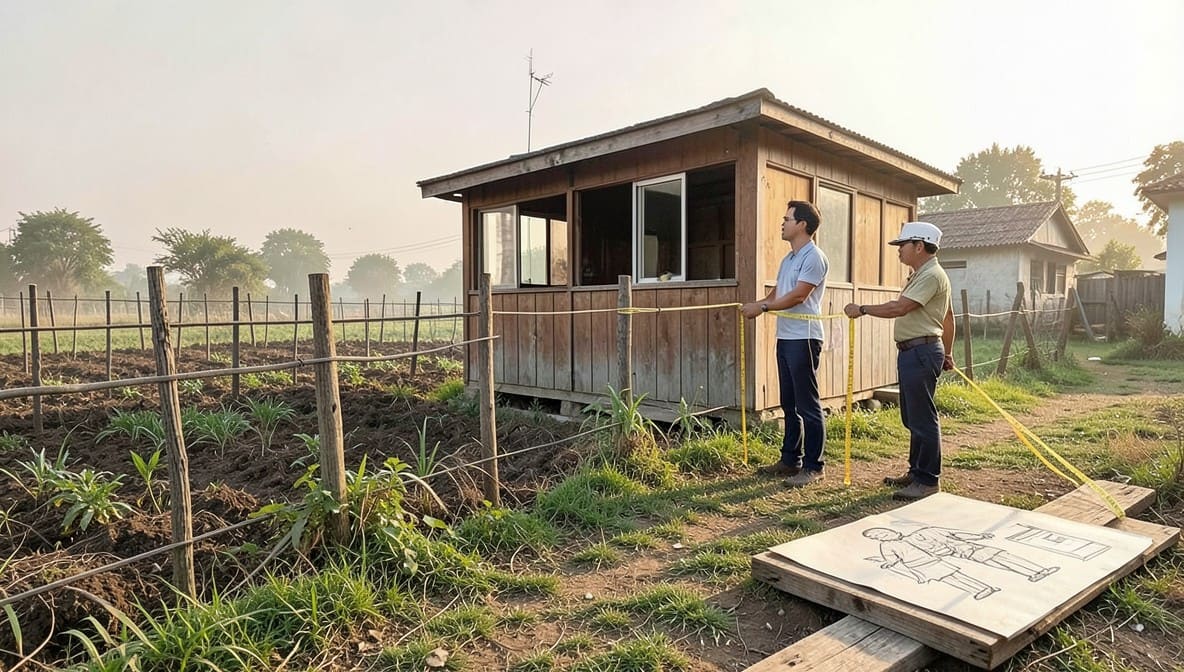
The petitioner, Sri. Bhavanna S/o Dodda Mallappa, filed Original Suit No. 46/2014 before the Civil Judge and JMFC, Bagepalli, seeking a declaration of ownership, permanent injunction, and mandatory injunction against the respondent, Sri. G.M. Ramakrishnappa. The petitioner alleged that the respondent had encroached upon his suit schedule property by extending a bunk shop east to west by 11 feet and north to south by 1½ feet, thereby violating the boundary line.
Key Facts
- The petitioner claimed ownership of the suit property based on title documents and possession
- The respondent admitted to being allotted a plot measuring 11x18 feet but asserted that 11x13 feet of it was acquired by the State for road widening, leaving him with only 11x5 feet
- The respondent produced a sketch marked as Exhibit P10 to substantiate his claim of reduced landholding
- The petitioner’s plaint specifically alleged encroachment of 11 feet east-west and 1½ feet north-south
- The petitioner’s witness PW1 reiterated the encroachment claim during examination-in-chief
- The respondent filed a detailed written statement denying encroachment and relying on the sketch and acquisition records
Procedural History
- 2014: Original Suit No. 46/2014 filed by the petitioner
- Ongoing: Trial proceedings conducted, including recording of oral evidence from both parties
- 08.12.2020: Petitioner filed Application under Order XXVI Rule 9 read with Section 151 CPC seeking appointment of a Court Commissioner to inspect the property and submit a report on the alleged encroachment
- 08.12.2020: Trial Court rejected the application solely on the ground that it was filed at the fag end of proceedings, without assigning any reasoning on the merits
- 20.01.2021: Petitioner filed the present Writ Petition No. 20/2021 under Article 227 of the Constitution challenging the rejection order
- 09.06.2026: Hearing before the Karnataka High Court
The Parties' Positions
Petitioner’s Position: The encroachment is a factual dispute requiring physical verification. Oral evidence and sketch Ex.P10 are insufficient to determine the exact boundary. The application is necessary for accurate adjudication and does not prejudice the respondent.
Respondent’s Position: The sketch Ex.P10 and acquisition records conclusively establish the respondent’s landholding. The application is a dilatory tactic, filed after closure of evidence, and amounts to abuse of process.
Relief Sought
The petitioner sought quashing of the order dated 08.12.2020 rejecting the application under Order XXVI Rule 9 CPC, and direct the trial court to appoint a Court Commissioner to inspect the suit property and submit a report on the alleged encroachment.
The Legal Issue
Whether the trial court can reject an application under Order XXVI Rule 9 CPC solely on the ground of delay, without examining whether the factual assertion requires physical inspection beyond oral evidence and documentary sketches?
Arguments Presented
For the Petitioner
The petitioner’s counsel relied on N. Swamygowda v. Ramegowda and Others (ILR 2010 Karnataka 897) and Sri. Shadaksharappa v. Kumari Vijayalaxmi and Others (ILR 2023 Kar 3983), arguing that when one party asserts a factual claim requiring physical verification and the other denies it, the court must appoint a Commissioner to resolve the dispute. He emphasized that Order XXVI Rule 9 is a procedural tool to assist the court in ascertaining facts, and delay alone cannot override the need for accurate evidence. He contended that the sketch Ex.P10 was not a substitute for a professional survey and that the trial court’s refusal to appoint a Commissioner rendered the adjudication speculative.
For the Respondent
The respondent’s counsel argued that the sketch Ex.P10, duly marked in evidence, clearly showed the respondent’s landholding after acquisition. He submitted that the petitioner had ample opportunity to file the application earlier and that the belated filing was an abuse of process. He contended that the trial court was justified in rejecting the application to prevent unnecessary prolongation of proceedings and that the court had sufficient material to decide the issue without a Commissioner.
The Court's Analysis
The Court observed that the core dispute centered on the physical extent of encroachment - a question of fact that could not be resolved by relying solely on oral testimony or a hand-drawn sketch. The Court noted that while the respondent relied on Exhibit P10 to show his post-acquisition landholding, the sketch lacked precise survey markers, scale, or official certification. The petitioner’s assertion of encroachment was specific, consistent across the plaint and evidence, and directly contradicted by the respondent.
"The appointment of a Court Commissioner would aid the trial Court in deciding the lis between the parties, when one party makes assertion of facts and another party denies the same."
The Court held that the trial court’s rejection of the application was based solely on the timing of filing, without any analysis of whether the existing evidence was sufficient to determine the factual dispute. This was legally untenable. The Court emphasized that Order XXVI Rule 9 is not a discretionary tool to be denied on procedural grounds alone, but a mechanism to ensure justice by enabling the court to obtain reliable, objective evidence.
The Court distinguished the respondent’s reliance on N. Swamygowda as being misapplied. The earlier case did not hold that delay was fatal; rather, it affirmed the court’s duty to appoint a Commissioner when factual disputes require physical verification. The Court further noted that the respondent retained full rights to challenge the Commissioner’s report, cross-examine him, and present rebuttal evidence - thus no prejudice would arise.
The Court concluded that the trial court’s failure to consider the substantive need for inspection, and its reliance on procedural delay as the sole ground for rejection, amounted to a failure to discharge its duty under Section 151 CPC to secure the ends of justice.
The Verdict
The writ petition was allowed. The order dated 08.12.2020 rejecting the application under Order XXVI Rule 9 CPC was set aside. The trial court was directed to appoint the Taluka Surveyor of the Town Municipality, Bagepalli, as Court Commissioner. If unavailable, the Taluka Surveyor of Bagepalli shall be appointed. The Commissioner shall conduct a physical survey of the suit property and submit a report on the alleged encroachment of 11 feet east-west and 1½ feet north-south. The survey shall be completed within 60 days from the date of appointment.
What This Means For Similar Cases
Physical Inspection Overrides Procedural Delay
- Practitioners may now file applications under Order XXVI Rule 9 CPC even after evidence is closed, provided the dispute involves physical boundaries, encroachments, or structural alterations
- Courts must evaluate the necessity of inspection, not merely the timing of the application
- Delay is relevant only if it causes irreparable prejudice - not as a standalone ground for rejection
Sketches and Oral Evidence Are Insufficient for Boundary Disputes
- Hand-drawn sketches without surveyor certification cannot substitute for official physical inspection
- Courts must not rely on unverified sketches to determine property lines in contested cases
- Where parties present conflicting claims on spatial extent, a Court Commissioner’s report is the only reliable method of resolution
Judicial Duty Under Section 151 CPC Is Non-Negotiable
- Section 151 CPC empowers courts to act in the interest of justice, even beyond procedural rules
- Refusing a Commissioner’s appointment without substantive reasoning violates this duty
- Appellate courts will intervene under Article 227 where trial courts act arbitrarily by ignoring factual necessity