The Karnataka High Court has clarified that the doctrine of res judicata may be determined as a preliminary issue in a civil suit when the pleadings themselves contain full disclosure of prior adjudication, thereby preventing indefinite delay in long-pending property disputes. This ruling reinforces procedural efficiency without compromising substantive rights.
Background & Facts
The Dispute
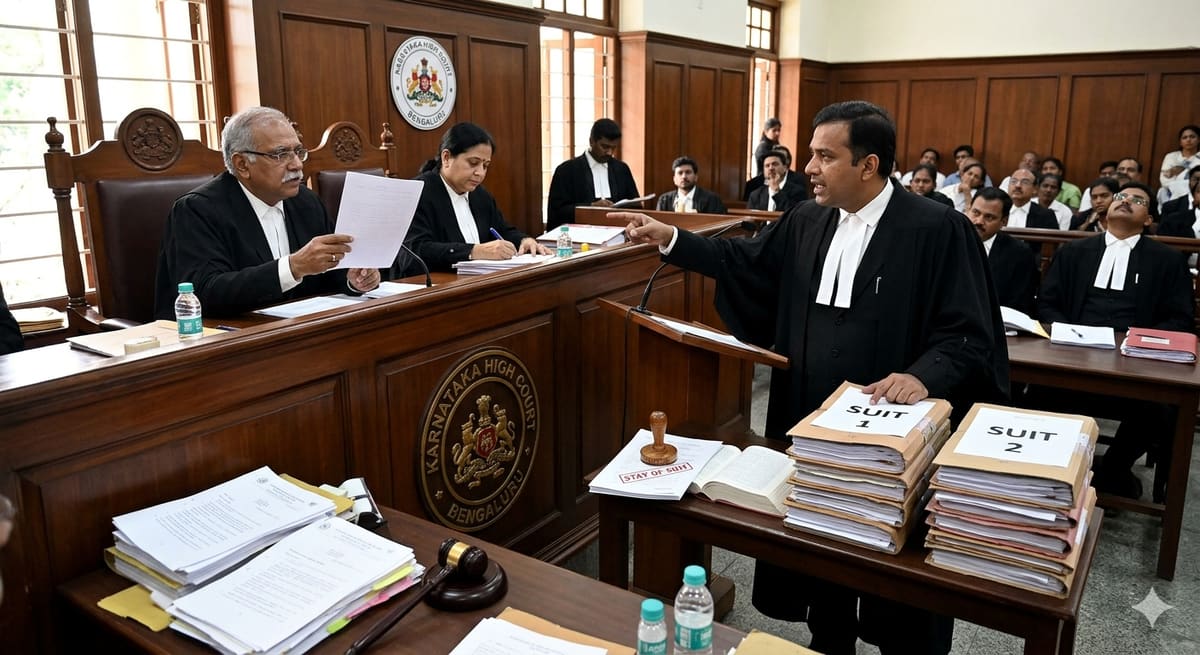
The present writ petition challenges an order dated 21.09.2019 passed by the 3rd Additional Civil Judge and JMFC, Gadag, in O.S. No. 271/2014. The suit was instituted by the plaintiffs seeking partition and separate possession of immovable properties allegedly held jointly by the plaintiffs and defendants. The defendants, including the petitioners herein, raised two preliminary objections: (1) the suit is barred by res judicata due to a prior partition suit, and (2) the suit was improperly valued and the court fee paid was insufficient. The Trial Court treated both objections as preliminary issues and decided them against the defendants, holding that res judicata did not apply and that the court fee was adequate.
Key Facts
- The original propositus, Hanamappa, died leaving behind heirs who filed O.S. No. 151/1984 in the Court of Civil Judge (Senior Division), Gadag, for partition of ancestral properties.
- O.S. No. 151/1984 was decreed, and final decree proceedings were initiated in F.D.P. No. 2/1998.
- In F.D.P. No. 2/1998, a Court Commissioner was appointed and the properties were divided by metes and bounds.
- The plaint in the present suit (O.S. No. 271/2014) explicitly admits the existence of O.S. No. 151/1984 and F.D.P. No. 2/1998, and states that the suit properties were allotted jointly to the shares of the present parties.
- The plaintiffs claim a joint 1/4th share, while the defendants claim shares as follows: Defendant No.1 - 1/4th; Defendants No.2 - 5 - joint 1/4th; Defendants No.6 - 8 - joint 1/4th.
- The defendants relied on the earlier proceedings to assert res judicata, and produced the judgment and decree from O.S. No. 151/1984 as part of their pleadings.
- The suit was instituted on 15.04.2014.
- The impugned order was passed on 21.09.2019.
- The writ petition was filed on 28.11.2019.
- The writ petition has remained pending before the High Court since 2019.
Procedural History
- 15.04.2014: O.S. No. 271/2014 filed before the 3rd Additional Civil Judge and JMFC, Gadag.
- 21.09.2019: Trial Court framed and decided issues on res judicata and court fee as preliminary issues, ruling against defendants.
- 28.11.2019: Writ Petition No. 115781/2019 filed before the Karnataka High Court, Dharwad Bench, challenging the impugned order.
- 17.06.2026: Hearing concluded and judgment delivered by Justice Sachin Shankar Magadum.
The Parties' Positions
Petitioners (Defendants): Argued that res judicata and court fee valuation are mixed questions of law and fact requiring full trial with oral and documentary evidence. Contended that the Trial Court violated principles of natural justice by deciding these issues without affording opportunity to lead evidence.
Respondents (Plaintiffs): Maintained that the suit has been pending since 2014 and that the writ petition, filed in 2019, has caused further delay. Emphasized that the pleadings themselves contain full disclosure of prior proceedings, making further evidence unnecessary.
Relief Sought
The petitioners sought quashing of the order dated 21.09.2019 on the grounds that the Trial Court erred in treating res judicata and court fee as preliminary issues. They requested that the matter be remanded for full trial with opportunity to lead evidence.
The Legal Issue
Can the issues of res judicata and court fee valuation be decided as preliminary issues in a civil suit when the pleadings contain full and unambiguous disclosure of prior adjudication and valuation, without requiring oral evidence?
Arguments Presented
For the Petitioner
The petitioners contended that res judicata is a mixed question of law and fact requiring examination of pleadings, issues, and evidence from the earlier suit. They relied on settled principles that such issues cannot be decided summarily without affording parties an opportunity to lead oral testimony, cross-examine witnesses, and present rebuttal evidence. They argued that the Trial Court’s decision violated natural justice and the procedural safeguards under Order XIV Rule 2 of the CPC, which permits preliminary issues only when they are purely questions of law.
For the Respondent
The respondents argued that the plaint explicitly admitted the existence of O.S. No. 151/1984, its decree, and the final decree proceedings in F.D.P. No. 2/1998. They submitted that the defendants themselves relied on these documents to assert res judicata, making the issue purely documentary. They further contended that the court fee was correctly calculated under Section 35(2) of the Karnataka Court Fees and Suits Valuation Act, and that allowing further delay through evidentiary hearings would defeat the purpose of civil justice.
The Court's Analysis
The Court acknowledged that, as a general rule, res judicata involves a comparison of pleadings, issues, and reliefs between two suits, and often requires examination of evidence from the prior proceeding. Ordinarily, such issues are not suitable for determination as preliminary matters under Order XIV Rule 2 of the CPC. However, the Court emphasized that the facts of this case were exceptional.
"The petitioners themselves have produced the judgment and decree rendered in O.S. No. 151/1984 and have heavily relied upon the same to substantiate their plea of res judicata. The existence of the earlier partition suit, the decree passed therein and the initiation of final decree proceedings are all admitted facts emerging from the plaint itself."
The Court noted that the plaintiffs did not conceal the prior litigation; on the contrary, they disclosed it fully and explained why the present suit was maintainable despite the earlier decree. This transparency negated any claim of suppression or procedural unfairness. The Court held that since the entire controversy turned on documentary material already before the Trial Court - the plaint, the decree in O.S. No. 151/1984, and the final decree report - no amount of oral evidence could alter the legal conclusion.
The Court further observed that the suit had been pending for over a decade, and the writ petition had stalled proceedings for seven years. Allowing further delay would frustrate the object of civil adjudication, which is timely resolution of disputes. The Court stressed that procedural fairness must not become a tool for perpetuating litigation.
The Verdict
The writ petition was dismissed. The High Court upheld the Trial Court’s order dated 21.09.2019, affirming that res judicata and court fee valuation could be decided as preliminary issues in this case due to the complete disclosure in the pleadings. The Court directed the Trial Judge to proceed with the suit on a priority basis and dispose of it within twelve months from the date of receipt of this order. All pending interlocutory applications were disposed of.
What This Means For Similar Cases
Res Judicata Can Be Decided Preliminarily When Pleadings Are Transparent
- Practitioners must now assess whether prior proceedings are fully disclosed in the plaint before challenging preliminary determination of res judicata.
- If the plaintiff admits the existence of a prior suit and its outcome, the defendant cannot claim prejudice for lack of oral evidence on res judicata.
- Courts may treat res judicata as a preliminary issue where the material is documentary and undisputed.
Delay in Interlocutory Challenges Will Not Be Tolerated in Long-Pending Suits
- Writ petitions challenging interlocutory orders in long-pending civil suits (especially partition suits) will face heightened scrutiny for delay.
- Courts are likely to refuse interference under Article 227 where the challenge has been pending for years and the main suit remains stalled.
- Parties must prioritize expeditious trial over procedural technicalities when substantive rights have been delayed for over a decade.
Court Fee Valuation Is Not a Blanket Ground for Evidentiary Hearings
- Where the valuation is based on clear market value or statutory provisions, and no dispute exists as to the nature of the property or claim, courts may accept the plaintiff’s valuation without requiring evidence.
- Objections to court fee must be raised with specific grounds - mere general assertions will not justify a full trial on valuation.