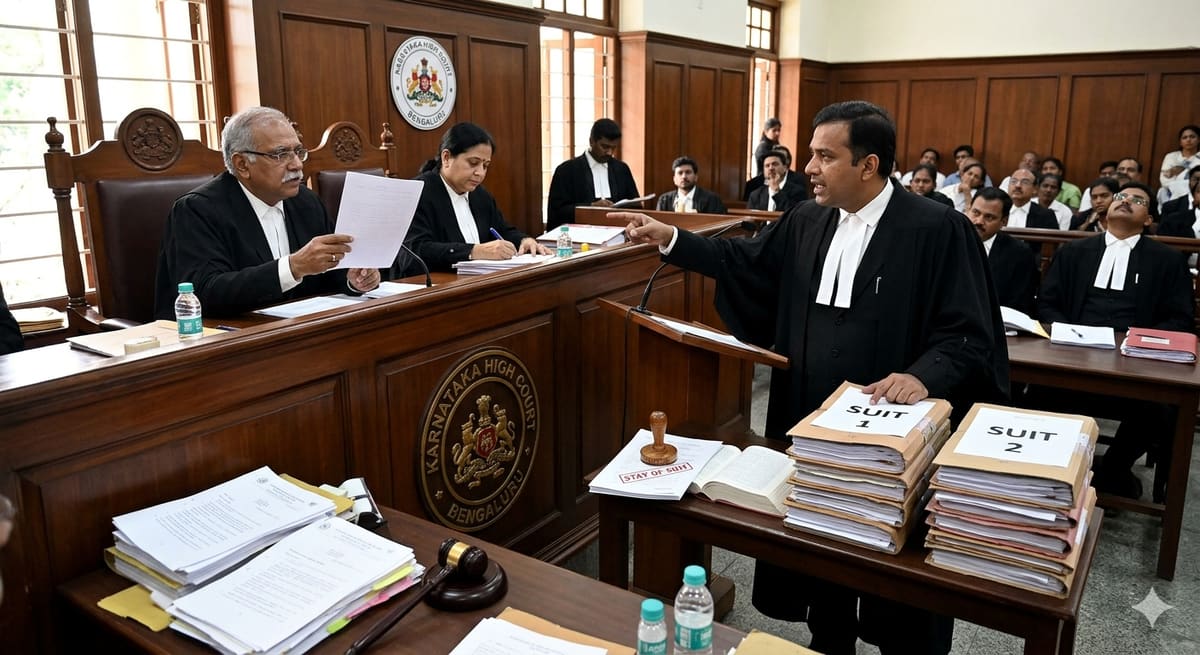
The Karnataka High Court, Kalaburagi Bench, has underscored the importance of Order I Rule 10 of the Code of Civil Procedure (CPC) in impleadment applications, particularly when multiple suits involve the same property and parties. The Court set aside a trial court order rejecting an impleadment application, holding that the petitioner was both a proper and necessary party to the suit, and directed consolidation of related suits for efficient adjudication.
Background & Facts
The Dispute
The petitioner, Ambadas Sagave, filed this writ petition challenging an order dated 07.01.2026 passed by the Senior Civil Judge and JMFC at Bhalki. The impugned order rejected his application (IA No. V) under Order I Rule 10 read with Section 151 CPC, seeking impleadment as additional defendant No. 4 in Original Suit No. 134/2021. The dispute revolves around the same suit schedule property, which is the subject of multiple partition suits among family members.
Key Facts
- The petitioner instituted OS No. 48/2019 against respondent No. 1 (Sharanbasappa) and other defendants, seeking partition and separate possession of his alleged share in the suit schedule property.
- During the pendency of OS No. 48/2019, respondent No. 4 (Devidas) instituted OS No. 59/2019 against his two sons (Rahul and Rohit) for partition, which was compromised and decreed on 21.11.2019.
- Respondent No. 1 (Sharanbasappa) subsequently instituted OS No. 134/2021 against Devidas (respondent No. 4), Rahul, and Rohit for declaration, permanent injunction, and other reliefs concerning the same property.
- The petitioner filed IA No. V in OS No. 134/2021, seeking impleadment as additional defendant No. 4, contending he was a proper and necessary party to the suit.
- The trial court rejected the impleadment application on 07.01.2026, prompting the present writ petition.
Procedural History
- 15.03.2019: Petitioner files OS No. 48/2019 for partition against Sharanbasappa and others.
- 21.11.2019: Compromise decree passed in OS No. 59/2019 (Devidas vs. Rahul and Rohit).
- 2021: Sharanbasappa files OS No. 134/2021 against Devidas, Rahul, and Rohit.
- 2021-2025: OS No. 48/2019 and OS No. 134/2021 remain pending before the Senior Civil Judge, Bhalki.
- 2026: Petitioner files IA No. V in OS No. 134/2021 for impleadment.
- 07.01.2026: Trial court rejects IA No. V.
- 22.06.2026: Present writ petition filed before Karnataka High Court, Kalaburagi Bench.
Relief Sought
The petitioner sought:
- Quashing of the impugned order dated 07.01.2026 passed in IA No. V.
- Impleadment as additional defendant No. 4 in OS No. 134/2021.
- Direction to the trial court to club, consolidate, and dispose of OS No. 48/2019 and OS No. 134/2021 together.
The Legal Issue
The central question before the Court was whether the petitioner, who had already instituted a suit for partition against some of the same parties concerning the same property, was a proper and necessary party to OS No. 134/2021 under Order I Rule 10 CPC, and whether the trial court erred in rejecting his impleadment application.
Arguments Presented
For the Petitioner
- Contended that he was a proper and necessary party to OS No. 134/2021, as the suit involved the same property and parties as his pending suit (OS No. 48/2019).
- Argued that rejection of his impleadment application would lead to multiplicity of proceedings and inconsistent decrees, violating judicial efficiency.
- Relied on Order I Rule 10 CPC, which empowers courts to add parties necessary for complete adjudication of the dispute.
For the Respondent
- Opposed the impleadment application, arguing that the petitioner’s presence was not necessary for the adjudication of OS No. 134/2021.
- Contended that the petitioner’s suit (OS No. 48/2019) was distinct and pending separately, and his impleadment would complicate the proceedings.
- Submitted that the trial court had discretion under Order I Rule 10 CPC to reject impleadment applications if not warranted.
The Court's Analysis
The Court examined the scope of Order I Rule 10 CPC, which provides for the addition of parties to a suit where their presence is necessary for complete and effectual adjudication of the dispute. The Court emphasized that impleadment is not a matter of mere technicality but serves the larger objective of avoiding multiplicity of proceedings and inconsistent decrees.
"Under these circumstances, having regard to the fact that both the suits are between the same parties and in respect of the very same suit schedule property, the petitioner would clearly be both proper and necessary party to the present suit and his application deserves to be allowed by issuing certain directions for clubbing the present suit along with OS No. 48/2019, since both are pending before the very same court."
The Court observed that:
- The petitioner had already instituted OS No. 48/2019 against respondent No. 1 and respondent No. 4 for partition of the same property.
- Respondent No. 1 had instituted OS No. 134/2021 against respondent No. 4 and his sons concerning the same property.
- Both suits were pending before the same trial court, making consolidation practicable and necessary to avoid conflicting judgments.
The Court distinguished the present case from scenarios where impleadment might be refused on grounds of delay, prejudice, or irrelevance. Here, the petitioner’s presence was essential to adjudicate the rights of all parties concerning the same property. The Court also noted that the trial court’s rejection of the impleadment application was unsustainable in law, as it failed to appreciate the overlapping interests and the risk of inconsistent decrees.
The Verdict
The Court allowed the writ petition and set aside the impugned order dated 07.01.2026. The key directions issued were:
- The petitioner is impleaded as additional defendant No. 4 in OS No. 134/2021.
- The trial court is directed to club, consolidate, try, and dispose of OS No. 48/2019 and OS No. 134/2021 together in accordance with law.
- The petitioner is granted liberty to file a written statement and contest OS No. 134/2021 on merits.
- No opinion is expressed on the merits or demerits of the rival contentions, which are left open for adjudication by the trial court.
What This Means For Similar Cases
Impleadment Under Order I Rule 10 CPC Is Not Discretionary When Same Property and Parties Are Involved
- Courts must liberally interpret Order I Rule 10 CPC when multiple suits involve the same property and parties. Impleadment should not be rejected merely on technical grounds if it serves the ends of justice and avoids multiplicity of proceedings.
- Practitioners should argue that consolidation of suits is necessary where overlapping claims exist, as inconsistent decrees can lead to judicial inefficiency and prejudice to parties.
Consolidation of Suits Is Mandatory to Avoid Inconsistent Decrees
- Where two or more suits involve the same property, parties, and issues, trial courts are duty-bound to consolidate them for joint adjudication.
- This judgment reinforces that Order I Rule 10 CPC is not merely procedural but serves the substantive goal of justice by preventing conflicting judgments.
- Lower courts must actively consider consolidation when impleadment applications are filed, especially in partition or property disputes involving the same stakeholders.
Trial Courts Must Provide Reasons for Rejecting Impleadment Applications
- The judgment underscores that arbitrary rejection of impleadment applications without adequate reasoning will not withstand appellate scrutiny.
- Trial courts must record specific reasons for rejecting impleadment, particularly when the applicant is a proper and necessary party to the dispute.
- Practitioners should challenge rejection orders that fail to address the overlapping interests or the risk of inconsistent decrees in their grounds of appeal.