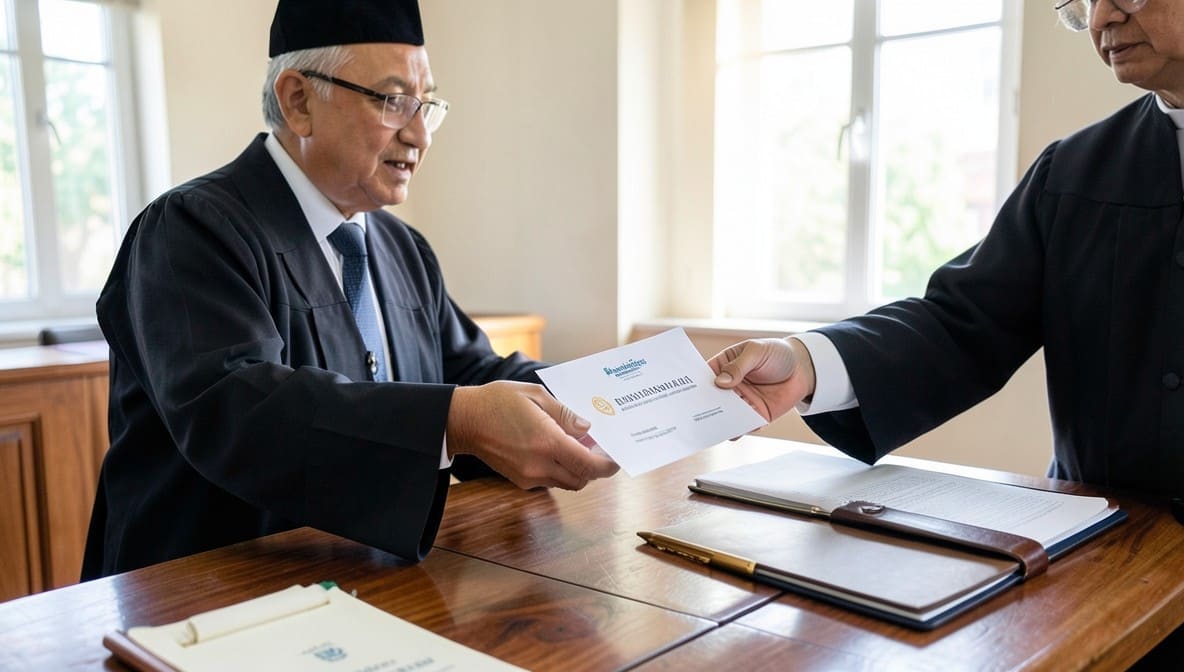
The Andhra Pradesh High Court has clarified a long-standing ambiguity in civil procedure: a purchaser of property subject to a partition suit cannot be impleaded as a defendant during the main trial. This ruling reinforces procedural boundaries under the Code of Civil Procedure and prevents premature adjudication of title disputes.
Background & Facts
The Dispute
The dispute arose from a partition suit filed by Murukonda Sarojini and Nayudu Anjamma against their brother, Murukonda Srinivasa Rao, over ancestral property. The respondent, Danda Venkateswarlu, claimed to have purchased one of the partitioned properties from the deceased father of the plaintiffs and defendant under an agreement of sale dated 05.11.2017. He paid ₹14,00,000 of the ₹15,00,000 consideration before the vendor’s death on 28.12.2017. Unable to secure a registered sale deed, he filed a separate suit for specific performance in 2015.
Procedural History
- 2019: Partition suit (O.S. No. 3 of 2019) filed by plaintiffs against defendant.
- 2024: Respondent (purchaser) filed I.A. No. 53 of 2025 under Order 1 Rule 10 CPC and Section 151 CPC seeking impleadment as defendant.
- 20.02.2025: Senior Civil Judge, Parchur, allowed the impleadment, holding the purchaser was a "necessary and proper party" to avoid multiplicity of proceedings.
- 2025: Petitioners filed Civil Revision Petition No. 909 of 2025 under Article 227 of the Constitution challenging the order.
- 09.03.2026: High Court delivered judgment.
Relief Sought
The petitioners sought setting aside of the impleadment order, arguing that the purchaser’s rights could be adjudicated only in the specific performance suit or during final decree proceedings, not in the partition suit itself.
The Legal Issue
The central question was whether a purchaser of property subject to a partition suit qualifies as a necessary or proper party under Order 1 Rule 10 CPC during the trial stage, prior to the final decree.
Arguments Presented
For the Petitioner
Counsel argued that the agreement of sale was forged and that the purchaser’s presence in the partition suit would prejudice the plaintiffs’ right to equitable division. He relied on S. R. Subramanian v. S. R. Subramanian and K. S. Srinivasan v. K. S. Srinivasan to assert that partition suits are strictly between co-owners, and third-party claims must be litigated separately. He emphasized that impleadment at this stage would convert a partition suit into a title dispute, violating the principle of limited adjudication.
For the Respondent
Counsel contended that since the purchaser had paid substantial consideration and held a valid agreement, his rights were directly affected by the partition outcome. He cited R. S. R. R. Ramaswamy v. R. S. R. R. Ramanathan to argue that impleadment ensures effective adjudication and prevents multiplicity of litigation. He maintained that the trial court’s discretion under Section 151 CPC was correctly exercised.
The Court's Analysis
The Court examined the nature of partition suits and the scope of Order 1 Rule 10 CPC, distinguishing between parties whose presence is indispensable to the suit’s adjudication and those whose interests are collateral. It held that partition suits determine the shares of co-owners; they do not adjudicate third-party claims to the property.
"In a suit for partition, purchaser of one of the items of the partition suit is neither a necessary nor a proper party, since he cannot have any say in the said suit and his presence or absence in the suit would not affect the effective adjudication of the partition suit, more particularly when the petitioner filed suit for specific performance against petitioners as well as respondent no.2."
The Court acknowledged that purchasers may be impleaded during final decree proceedings to ensure their purchased portion is allotted to the vendor’s share, as held by the Supreme Court in S. R. Subramanian. However, this right arises only after the shares are determined and before the final decree is drawn. Impleadment at the trial stage risks conflating ownership disputes with inheritance rights.
The trial court erred by treating the purchaser’s claim as integral to the partition. The existence of a pending specific performance suit demonstrated that the purchaser had an adequate remedy elsewhere. The Court further noted that allowing impleadment at this stage would undermine the procedural integrity of partition suits and invite collateral attacks on title.
The Verdict
The petitioners won. The High Court set aside the order of the Senior Civil Judge impleading the purchaser as a defendant. It held that a purchaser in a partition suit is not a necessary or proper party during the trial stage and dismissed the impleadment application. The purchaser retains the right to seek impleadment during final decree proceedings.
What This Means For Similar Cases
Impleadment in Partition Suits Is Restricted to Final Decree Stage
- Practitioners must resist attempts to implead third-party purchasers during the trial phase of partition suits.
- Any claim by a purchaser must be pursued through a separate suit for specific performance or deferred until final decree proceedings.
- Courts must not conflate title disputes with partition proceedings under the guise of avoiding multiplicity.
Specific Performance Remedy Remains Unaffected
- A purchaser’s right to enforce the sale agreement is preserved and must be litigated independently.
- Filing a specific performance suit is not an alternative to impleadment - it is the exclusive remedy for enforcing contractual rights.
- Courts should not use Section 151 CPC to circumvent the procedural limitations of Order 1 Rule 10.
Burden of Proof on Impleading Party to Show Necessity
- The party seeking impleadment must demonstrate that their absence would render the suit ineffective or incomplete.
- Mere financial interest or potential impact on outcome is insufficient; legal necessity must be established.
- Courts must apply a strict test: "Can the suit be effectively adjudicated without this party?"