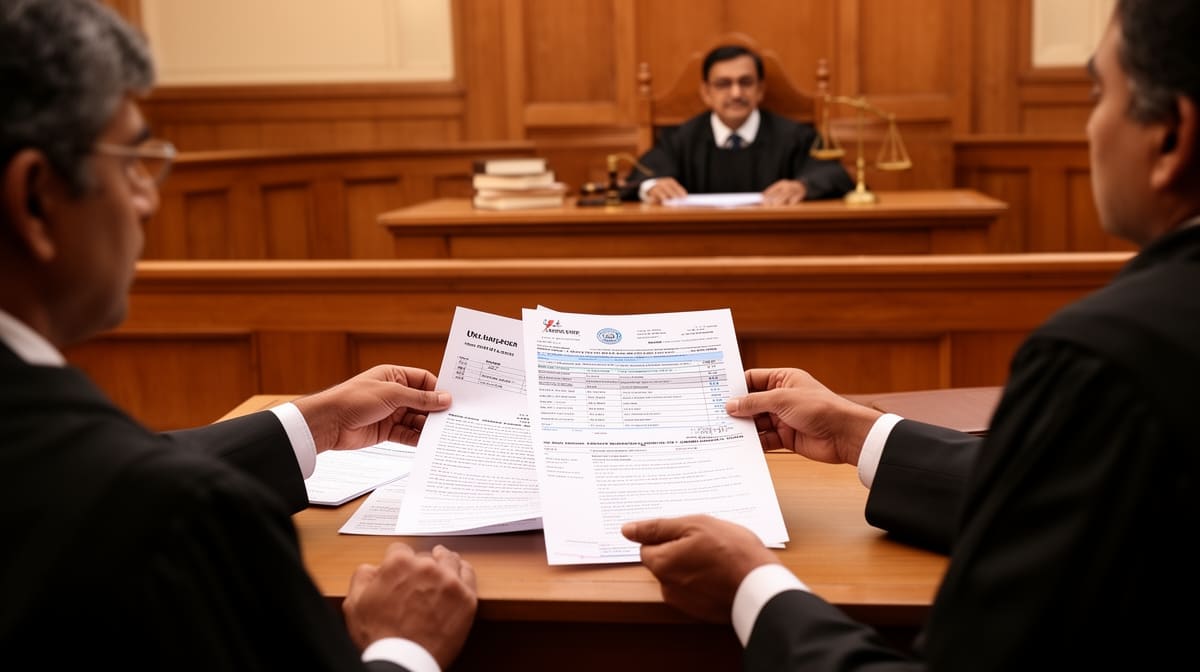
The Punjab and Haryana High Court has reaffirmed that the admission of additional evidence under CPC Order 41 Rule 27 is not barred by technicality when such evidence is essential to ensure a just outcome. In a motor accident claim where compensation was unduly low due to incomplete income proof, the Court permitted the production of income tax returns that were not filed before the Motor Accident Claims Tribunal, emphasizing substantive justice over procedural rigidity.
Background & Facts
The Dispute
The appellants, the widow and minor son of late Balwinder Singh, filed a claim petition before the Motor Accident Claims Tribunal, Amritsar, seeking compensation for the death of the deceased in a motor vehicle accident on 17.05.2008. The Tribunal awarded compensation based on an assessed monthly income of Rs. 3,000, treating the deceased as a casual worker, despite the claimants’ assertion that he was a goldsmith by profession.
Key Facts
- The deceased, Balwinder Singh, died on 17.05.2008 in a motor vehicle accident
- Claimants alleged he was a goldsmith engaged in a small business
- No documentary proof of income was produced before the MACT
- MACT assessed deceased’s age at 60 years and monthly income at Rs. 3,000
- Appellants now seek to produce Income Tax Returns for Assessment Years 2006-2007 and 2007-2008
- Annexure A1 (AY 2006-2007): Net business income of Rs. 95,500 per annum
- Annexure A2 (AY 2007-2008): Net business income of Rs. 1,04,550 per annum
- Both returns explicitly state the deceased’s occupation as a Goldsmith
- The documents were available at the time of the MACT proceedings but were not produced
Procedural History
- 17.05.2008: Death of Balwinder Singh in motor accident
- 23.05.2009: MACT, Amritsar, passed award awarding compensation based on Rs. 3,000/month income and age 60
- 2010: Appeal filed before the High Court as FAO-2765-2010(O&M)
- CM-13022-CII-2010: Application filed under Order 41 Rule 27 CPC seeking permission to produce ITRs as additional evidence
- 23.03.2026: Hearing before the High Court
The Parties' Positions
The appellants contended that the MACT’s assessment of income was grossly inadequate and that the ITRs, which clearly establish the deceased’s business income and occupation, were not available due to administrative delays in retrieval, not due to lack of diligence.
The respondent-insurance company opposed the application, arguing that the documents were always within the appellants’ control, that no explanation was offered for non-production before the MACT, and that permitting additional evidence at this stage would prejudice the insurer’s right to cross-examine and rebut.
Relief Sought
The appellants sought enhancement of compensation based on actual income as reflected in the ITRs, revision of the deceased’s age to 54 years, and remand of the matter to the MACT for fresh adjudication with the new evidence.
The Legal Issue
Can additional evidence in the form of Income Tax Returns be admitted under Order 41 Rule 27 of the Code of Civil Procedure when such evidence was not produced before the Tribunal but is essential for a just decision of the case?
Arguments Presented
For the Appellant
Learned counsel submitted that the ITRs are conclusive proof of the deceased’s income and occupation, which directly impacts the calculation of loss of dependency. The documents were not deliberately withheld; rather, they were not immediately accessible due to procedural delays in obtaining certified copies. The MACT’s reliance on an arbitrary income figure of Rs. 3,000 per month, without any supporting documentation, resulted in a manifestly inadequate award. The admission of ITRs is necessary to prevent a miscarriage of justice.
For the Respondent
The insurance company’s counsel argued that Order 41 Rule 27 CPC permits additional evidence only under strict conditions: (a) the evidence could not have been produced despite due diligence, and (b) it is essential for a just decision. Here, the documents were in the appellants’ possession throughout, and no explanation was offered for their non-production before the MACT. Allowing such evidence at the appellate stage would undermine the finality of tribunal proceedings and deprive the insurer of a fair opportunity to challenge the authenticity or relevance of the documents.
The Court's Analysis
The Court acknowledged the general principle that additional evidence under Order 41 Rule 27 CPC is an exception and not the rule. However, it emphasized that the overriding objective of civil procedure is to secure a just, fair, and equitable adjudication.
"No doubt, the said income tax returns, which are now being relied upon and are being sought to be produced by way of additional evidence, were not produced before the MACT. However, it has to be borne in mind that the MACT assessed the deceased’s income at Rs.3,000/- p.m., whereas, in case, the income tax returns are brought on record, it would make a substantial difference in the compensation payable to the appellants/claimants."
The Court held that the ITRs were not merely cumulative or corroborative but went to the very foundation of the compensation calculation. The Tribunal’s assessment of income was speculative and unsupported, while the ITRs provided objective, statutory evidence of actual earnings. The Court further noted that the insurer would not be prejudiced, as the MACT would be directed to provide two full opportunities for the appellants to lead this evidence, with full opportunity for cross-examination and rebuttal.
The Court rejected the argument that mere availability of documents precludes admission. The critical test is whether the evidence is essential for a just decision. Here, the difference between Rs. 3,000 and Rs. 8,700 per month (as per ITRs) would alter the compensation by over 180%, making the admission of this evidence not just permissible but necessary.
The Verdict
The High Court allowed the application under Order 41 Rule 27 CPC and set aside the MACT award dated 23.05.2009. The matter was remanded to the Motor Accident Claims Tribunal, Amritsar, for fresh adjudication. The appellants were granted two effective opportunities to produce the Income Tax Returns for AY 2006-2007 and 2007-2008 as additional evidence. The respondent-insurance company was granted full opportunity to cross-examine witnesses and rebut the evidence. The parties were directed to appear before the District Judge, Amritsar, on 08.04.2026 at 10:00 am for further proceedings.
What This Means For Similar Cases
Additional Evidence Is Not Barred by Mere Non-Production
- Practitioners may now rely on this judgment to seek admission of critical documentary evidence (e.g., ITRs, bank statements, employment records) even if not produced before the tribunal, provided they demonstrate the evidence is essential for a just outcome
- The burden is not on the party to prove they were unable to obtain the document, but to show its materiality and the risk of injustice without it
- Mere availability of documents does not automatically disqualify them under Order 41 Rule 27 CPC
Income Tax Returns Are Conclusive for Dependency Calculations
- In motor accident claims involving self-employed or business persons, ITRs are now established as superior evidence to speculative income assessments
- Tribunals must not rely on arbitrary figures (e.g., Rs. 3,000/month) when statutory income records exist
- The Court’s recognition of the deceased’s occupation as a goldsmith via ITRs reinforces that occupation must be determined from objective records, not assumptions
Remand Is the Proper Remedy When Evidence Is Material
- Setting aside and remanding is preferable to enhancement by the appellate court when factual disputes remain unresolved
- The Court’s directive to provide two opportunities for evidence production ensures procedural fairness without compromising the tribunal’s primary fact-finding role
- This approach balances finality with the constitutional imperative of substantive justice under Article 21