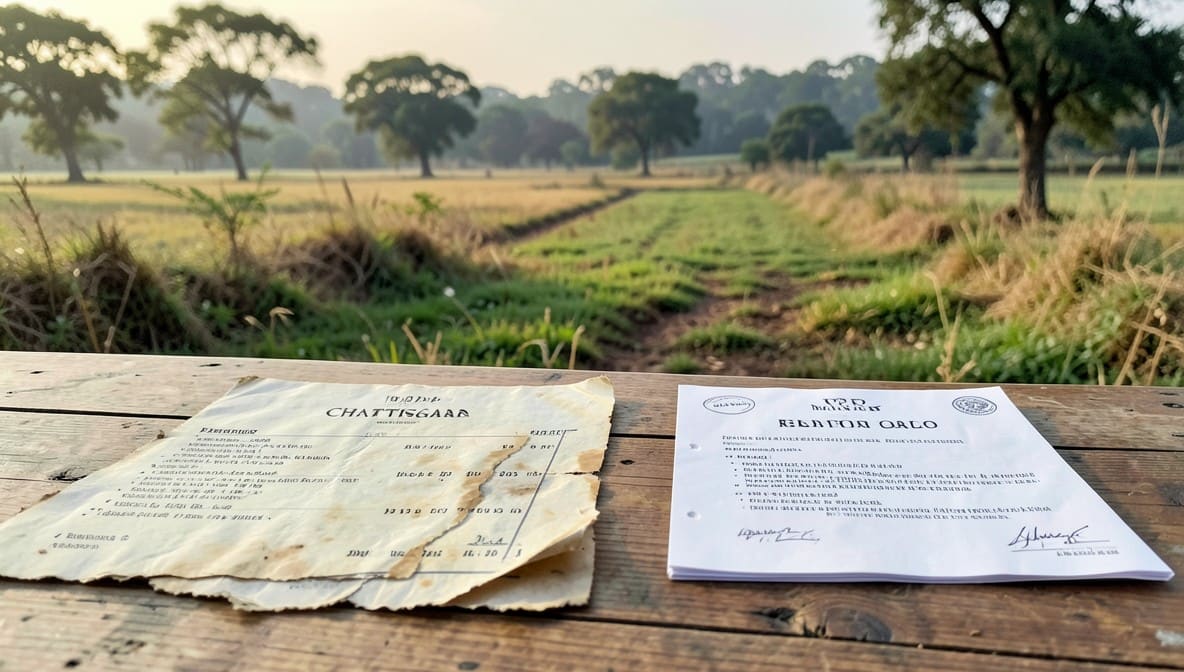
The Chhattisgarh High Court has reaffirmed that settled possession, coupled with a glaring discrepancy in stamp duty payment, can establish a prima facie case for temporary injunction - even where a registered sale deed exists. The judgment underscores that courts must look beyond documentary form to substance, particularly when fraud, undervaluation, and encroachment cast doubt on transactional bona fides.
Background & Facts
The Dispute
The dispute centers on Nazul land bearing Sheet No. 05, Plot No. 34/6, admeasuring 6932 sq. ft., located in Mouza Jarhabhata, Bilaspur, within the Municipal Corporation limits. The property was originally purchased by plaintiff No. 1, Nirmal Kumar Samuel, in 1977. After his death, his legal heirs - plaintiffs No. 2 (Smt. Jyotsna Lall) and No. 3 (Nitesh Kumar Samuel) - along with defendant No. 2 (Nalin Kumar Samuel, his son), contested ownership following a sale deed executed by Nirmal Kumar Samuel in favor of defendant No. 1 (Atul Kumar Shukla) on 18.06.2021.
The plaintiffs allege that the property was orally partitioned among the three siblings in 1998, with each receiving distinct portions. Plaintiff No. 2 received a residential portion of approximately 3215 sq. ft., plaintiff No. 3 received a commercial portion of 1650 sq. ft. with two shops, and defendant No. 2 received a commercial portion of 1600 sq. ft. adjacent to the main road. Despite the partition, revenue records remained in the name of plaintiff No. 1.
Key Facts
- Plaintiff No. 1 purchased the property in 1977.
- Oral partition occurred in 1998; each sibling took possession of their respective shares.
- Plaintiff No. 2 constructed a residential house on her share in 2000 and has resided there continuously.
- Plaintiff No. 3 constructed shops and a residence on his share and has been in continuous possession.
- Defendant No. 2 constructed a shop on his share and remained in possession.
- A gift deed dated 23.01.2018 was executed by plaintiff No. 1 in favor of defendant No. 2 but was never registered due to illness and the COVID-19 pandemic.
- A sale deed dated 18.06.2021 was registered in favor of defendant No. 1, purporting to transfer 644.237 sq. meters (approx. 6932 sq. ft.) of the entire property for Rs. 65,00,000.
- The Government of Chhattisgarh’s guideline rate for property near Rajiv Gandhi Chowk is Rs. 64,000 per sq. meter, making the market value of the entire property approximately Rs. 4.00 crores.
- Stamp duty paid on the sale deed was Rs. 4,06,250 - calculated on a value far below the guideline rate.
- Defendant No. 2 claims the sale deed was intended only for his share of approximately 1500 sq. ft., and the entire property description was falsely included to evade higher stamp duty.
- Sale consideration of Rs. 65,00,000 was deposited into a joint bank account held by plaintiff No. 1 and defendant No. 2, and withdrawn entirely by defendant No. 2.
- Defendant No. 1 never took physical possession of the property; plaintiffs remain in exclusive possession.
- On 29th/30th November 2022, a JCB machine attempted to demolish a shop belonging to plaintiff No. 3.
- Plaintiffs filed a police complaint on 22.08.2022 and lodged a formal complaint on 26.01.2023.
- Encroachment by plaintiffs on Government land (Khasra No. 113) has been noted, reducing a 30-foot public road to 8 feet, raising questions about the parties’ bona fides.
Procedural History
- 1977: Plaintiff No. 1 purchases the Nazul land.
- 1998: Oral partition among siblings; possession transferred.
- 2000: Plaintiff No. 2 constructs residential house on her share.
- 23.01.2018: Gift deed executed by plaintiff No. 1 in favor of defendant No. 2 (unregistered).
- 18.06.2021: Sale deed executed and registered in favor of defendant No. 1, describing entire property.
- 29.08.2022: Complaint filed by Lt. Col. J.J. Lall (Retd.) alleging stamp duty fraud.
- 16.09.2022: District Registrar initiates inquiry under Section 47-A(3) of the Indian Stamp Act, 1899.
- 23.09.2022: Revenue Case No. 189/B-105/2021-22 registered; proceedings pending.
- 22.08.2022: Plaintiffs obtain certified copy of sale deed and lodge police complaint.
- 26.01.2023: Formal police complaint filed by plaintiff No. 2.
- 30.01.2023: Trial Court issues interim order directing status quo (Annexure-A/7).
- 05.07.2025: Trial Court rejects application under Order 39 Rules 1 & 2 CPC.
- 11.09.2025: High Court directs Collector of Stamps to file affidavit on stamp duty.
- 25.09.2025: Affidavit filed confirming deficit stamp duty and pending proceedings.
- 09.03.2026: High Court directs parties to submit bank statements on sale consideration.
- 24.03.2026: Appellants file Government guideline rates showing market value discrepancy.
- 07.04.2026: High Court delivers judgment.
The Parties' Positions
Appellants (Plaintiffs): Claim settled possession since 1998, allege fraudulent misrepresentation in sale deed, assert that only defendant No. 2’s share was sold, and contend that the entire property description was falsely included to evade stamp duty. They argue that defendant No. 1 never took possession and that the transaction is voidable due to fraud and lack of consideration to plaintiff No. 1.
Respondent No. 1 (Defendant): Claims lawful purchase of entire property via registered sale deed, asserts payment of full consideration, and contends that the sale deed is conclusive under Section 92 of the Indian Evidence Act. Denies any fraud or collusion.
Respondent No. 2 (Defendant): Confirms oral partition, admits sale of only his 1500 sq. ft. share, admits that the sale deed falsely described the entire property, and confirms that consideration was received in a joint account and withdrawn by him alone.
Relief Sought
The appellants sought:
- Declaration that the sale deed dated 18.06.2021 is void and not binding.
- Permanent injunction restraining defendants from interfering with possession.
- Cancellation of the sale deed.
- Temporary injunction pending final adjudication.
The Legal Issue
The central question was whether the plaintiffs established a prima facie case, balance of convenience, and risk of irreparable injury to warrant temporary injunction under Order 39 Rules 1 & 2 CPC, despite the existence of a registered sale deed, where possession remained with them and stamp duty payment indicated a gross undervaluation inconsistent with the claimed extent of sale.
Arguments Presented
For the Appellant/Petitioner
Learned counsel argued that the plaintiffs have been in settled, continuous, and peaceful possession since 1998, with substantial investments in construction. The sale deed, while registered, misrepresents the extent of property sold - 644.237 sq. meters instead of 1500 sq. ft. - and the stamp duty paid (Rs. 4,06,250) corresponds only to a fraction of the market value, indicating fraud. Reliance was placed on Rame Gowda v. M. Varadappa Naidy, Dalpat Kumar v. Prahlad Singh, and Krishna Ram Mahale v. Shobha Venkat Rao to assert that possession cannot be disturbed without due process. The joint bank account and withdrawal by defendant No. 2 further negated the claim that plaintiff No. 1 received consideration.
For the Respondent/State
Respondent No. 1 contended that the registered sale deed carries a presumption of validity under Section 92 of the Indian Evidence Act and that oral evidence cannot contradict it. He argued that plaintiff No. 1 personally appeared before the Sub-Registrar and executed the deed voluntarily. The trial court correctly held that no prima facie case was made since the plaintiffs did not specifically deny plaintiff No. 1’s execution of the deed. Respondent No. 1 also argued that the plaintiffs’ pleadings were inconsistent - claiming oral partition in the plaint but alleging a written partition in the appeal.
The Court's Analysis
The Court undertook a meticulous review of the evidence, emphasizing that the existence of a registered sale deed does not automatically defeat a claim for injunction when fraud, possession, and valuation anomalies are present. The Court noted that the plaintiffs have been in settled possession for over two decades, and the Supreme Court in Rame Gowda has held that such possession cannot be disturbed except by due process of law.
"The burden is on the plaintiff by evidence aliunde by affidavit or otherwise that there is 'a prima facie case' in his favour which needs adjudication at the trial. Prima facie case is not to be confused with prima facie title which has to be established, on evidence at the trial. Only prima facie case is a substantial question raised, bona fide, which needs investigation and a decision on merits."
The Court found that the stamp duty paid - Rs. 4,06,250 - was calculated on a value of approximately Rs. 65,00,000, which corresponds to 1500 sq. ft. at Rs. 433 per sq. ft., not the entire 6932 sq. ft. At the Government’s guideline rate of Rs. 64,000 per sq. meter (approx. Rs. 5960 per sq. ft.), the correct stamp duty for the entire property would have exceeded Rs. 2.5 crores. This massive discrepancy, coupled with the fact that the entire property was never transferred to defendant No. 1, established a prima facie case of fraud.
The Court further noted that defendant No. 2, the seller of the share, admitted the sale was only for his portion and that the consideration was received and withdrawn by him, not plaintiff No. 1. The plaintiffs’ continued possession, the attempted demolition, and the pending stamp duty proceedings under Section 47-A(3) of the Indian Stamp Act further supported the need for interim protection.
The Court held that the balance of convenience clearly favored the plaintiffs. If the injunction were denied, they would suffer irreparable injury through dispossession and destruction of their investments. Defendant No. 1, on the other hand, had no physical possession and could be compensated in damages if the sale deed were later invalidated.
The Court also acknowledged the encroachment issue but held that it did not negate the plaintiffs’ possessory rights over their own portions and could not be used to justify unlawful dispossession.
The Verdict
The appeal was allowed. The impugned order dated 05.07.2025 rejecting the application under Order 39 Rules 1 & 2 CPC was set aside. The application for temporary injunction was granted. The parties are directed to maintain status quo over the suit property as it exists today, until final disposal of the suit. The trial court is directed to proceed with the trial strictly in accordance with law, without being influenced by the observations in this judgment.
What This Means For Similar Cases
Possession Trumps Registration in Injunction Applications
- Practitioners must now argue that settled, long-standing possession - even without formal title - is a decisive factor in injunction applications under Order 39 CPC.
- A registered sale deed alone cannot override possession if fraud, undervaluation, or non-delivery of possession is established.
- Courts will examine conduct, not just documents, when assessing the balance of convenience.
Stamp Duty as a Proxy for Transactional Truth
- A significant mismatch between stamp duty paid and market value guideline rates is now a recognized indicator of fraudulent misrepresentation in property transactions.
- Courts may infer the actual extent of sale from stamp duty paid, especially when the deed describes a larger area.
- Legal advisors must advise clients to pay correct stamp duty; underpayment may invalidate the transaction’s credibility even if registered.
Fraudulent Misdescription of Property Invalidates Bona Fide Claim
- If a sale deed misrepresents the extent of property sold, the buyer cannot claim to be a bona fide purchaser for value without notice.
- The burden shifts to the buyer to prove the accuracy of the description and the legitimacy of the consideration.
- In cases involving joint family property or oral partitions, courts will scrutinize whether the seller had authority to sell the entire property.