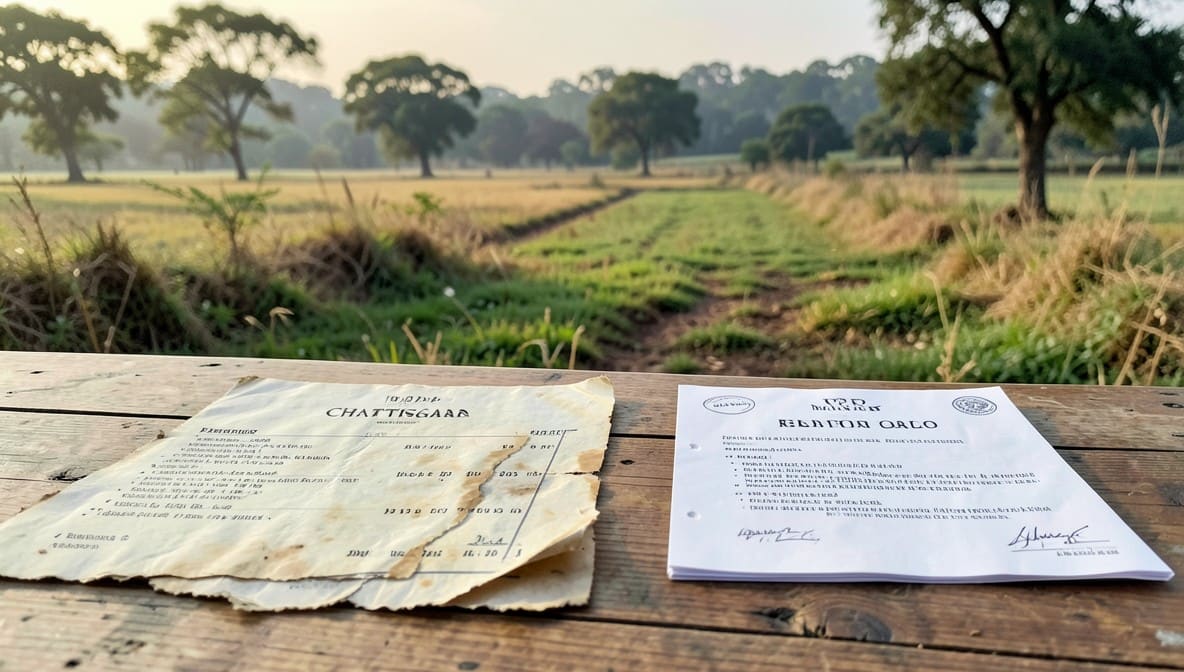
The Chhattisgarh High Court has reaffirmed that a registered sale deed, while significant, does not by itself confer conclusive title when a prior judicial decree in favor of another party has attained finality. The judgment underscores the necessity of proving fraud with strict evidence to challenge such decrees, and clarifies that failure to establish possession or revenue mutation cannot compensate for the absence of a valid legal challenge to an existing court order.
Background & Facts
The Dispute
The dispute centers on ownership of land bearing khasra nos. 383/2, 383/3, and 402 in village Mana, Raipur, Chhattisgarh, totaling 0.364 hectares. The appellant, Jitendra Goel, claims title through a registered sale deed dated 16.12.2005 executed by defendant No. 2, R.K. Dubey. However, defendant No. 1, Sewak Ram Pandey, claims title based on a decree dated 30.10.2010 passed in Civil Suit No. 21-A/2009, which directed specific performance and resulted in a registered sale deed executed on 24.02.2012.
Key Facts
- The appellant purchased the land from defendant No. 2 on 16.12.2005; the sale deed was registered on 20.12.2005.
- The appellant took possession and remained in peaceful possession until the land was notified for acquisition under the National Highway project.
- Khasra nos. 402 and 383/2 (0.1767 hectares) were identified for acquisition; compensation proceedings were initiated in the name of defendant No. 1.
- On 03.05.2017, the appellant served a legal notice to defendant No. 1 and the Land Acquisition Officer, challenging the recording of defendant No. 1’s name in revenue records.
- Defendant No. 1 responded on 23.05.2017, asserting title derived from Civil Suit No. 21-A/2009 and the subsequent execution of a sale deed on 24.02.2012.
- Defendant No. 2, the original seller, had filed a written statement in Civil Suit No. 21-A/2009 denying the existence of any agreement to sell dated 03.07.2008, alleging forgery.
- Despite this denial, defendant No. 2 did not appear in the suit after initial pleadings and was proceeded against ex parte.
- The District Judge, Raipur, passed a decree for specific performance on 30.10.2010 and executed the sale deed in favor of defendant No. 1 on 24.02.2012.
- The appellant filed Civil Suit Class A/31/2017 on 15.03.2017 seeking: (i) declaration of his title, (ii) declaration that the 2010 judgment and 2010 decree were null and void due to fraud, and (iii) permanent injunction restraining defendant No. 1 from receiving compensation.
- The appellant did not file an appeal against the 2010 decree.
- No mutation of the appellant’s name in the revenue records was produced.
- The appellant did not provide evidence of continuous, open, and exclusive possession beyond mere assertion.
Procedural History
- 03.07.2008: Alleged agreement to sell executed between defendant No. 1 and defendant No. 2.
- 16.12.2005: Sale deed executed in favor of appellant, registered on 20.12.2005.
- 27.10.2010: Judgment passed in Civil Suit No. 21-A/2009 in favor of defendant No. 1.
- 30.10.2010: Decree passed in Civil Suit No. 21-A/2009.
- 24.02.2012: Sale deed executed in favor of defendant No. 1 pursuant to the decree.
- 03.05.2017: Legal notice issued by appellant challenging defendant No. 1’s claim.
- 15.03.2017: Civil Suit Class A/31/2017 filed by appellant.
- 25.04.2024: Judgment and decree passed by Seventh Additional District Judge, Raipur, dismissing the appellant’s suit.
- 25.04.2024: Appellant filed First Appeal (FA No. 111 of 2024) before the Chhattisgarh High Court.
- 23.03.2026: Judgment delivered by the Division Bench of the Chhattisgarh High Court.
The Parties' Positions
- Appellant (Plaintiff): Claims title through a registered sale deed dated 16.12.2005; alleges that defendant No. 1 obtained the 2010 decree through fraud and collusion with defendant No. 2, who concealed the prior sale.
- Respondent No. 1 (Defendant): Claims title through a final court decree and execution of a registered sale deed; asserts that the appellant’s suit is an impermissible collateral attack on a binding judicial order.
- Respondent No. 2 (Defendant): Admitted execution of the 2005 sale deed in favor of the appellant but did not contest the 2010 decree; remained ex parte.
- Respondent No. 3 (State): Took no position on title but confirmed that compensation proceedings were initiated in the name of defendant No. 1 based on revenue records and court decree.
Relief Sought
The appellant sought: (i) declaration of his title over the suit property; (ii) declaration that the judgment and decree dated 27.10.2010 and 30.10.2010 in Civil Suit No. 21-A/2009 were null and void due to fraud; and (iii) permanent injunction restraining defendant No. 1 from receiving compensation from the National Highway acquisition.
The Legal Issue
The central question was whether a plaintiff who holds a registered sale deed but lacks revenue mutation or proof of continuous possession can override a final court decree obtained by another party, and whether allegations of fraud in obtaining that decree suffice to invalidate it without strict proof.
Arguments Presented
For the Appellant
The appellant’s counsel argued that the registered sale deed dated 16.12.2005 conclusively transferred title, and that failure to mutate revenue records or prove possession does not negate ownership. He contended that the 2010 decree was obtained by fraud, as defendant No. 2 concealed the prior sale to the appellant and falsely represented the existence of a valid agreement to sell. He relied on Ram Prakash Agarwal v. Gopi Krishan to assert that fraud vitiates all judicial proceedings, and that filing a separate suit to declare a decree null and void is a permissible remedy when fraud is alleged. He further argued that the trial court erred in requiring an appeal against the 2010 decree as the only remedy, when a suit for declaration on grounds of fraud is equally available.
For the Respondent
Respondent No. 1’s counsel countered that the 2010 decree was passed by a competent court after due process and had attained finality. He emphasized that the appellant, aware of the decree, chose not to appeal and instead filed a collateral suit, which is not maintainable under law. He argued that allegations of fraud were vague, unsubstantiated, and lacked any documentary or witness evidence of deliberate deception. He distinguished Ram Prakash Agarwal on the ground that fraud must be specifically pleaded and strictly proved, which the appellant failed to do. He further contended that the absence of mutation and possession rendered the appellant’s title incomplete and unenforceable against a decree-holder.
The Court's Analysis
The Court examined the interplay between private conveyances, judicial decrees, and the doctrine of finality. It acknowledged that a registered sale deed creates a strong prima facie title, but held that such title is not absolute when a prior judicial decree exists. The Court emphasized that a decree passed by a competent court is binding until set aside through due process.
"While the execution of a sale deed is a significant step towards establishing title, it does not ipso facto confer conclusive ownership where a prior judicial decree, duly executed, stands unchallenged."
The Court analyzed the appellant’s claim of fraud and found that mere non-disclosure of a prior sale by defendant No. 2, even if intentional, does not constitute fraud under law unless it is shown that the court was deliberately misled or that there was a conspiracy to defraud. The Court noted:
"Mere non-disclosure, in the absence of proof of intentional deceit or collusion, cannot render a judicial decree null and void. Fraud must be specifically pleaded and strictly proved by cogent evidence."
The Court further held that the appellant’s failure to challenge the 2010 decree through appeal, despite having knowledge of its existence, precluded him from circumventing the statutory remedy. The Court rejected the argument that a separate suit for declaration is always available, stating:
"A party cannot bypass the appellate route merely because he prefers a different forum. The remedy of appeal is the exclusive statutory mechanism to challenge a decree, absent fraud of such magnitude as to render the decree a nullity."
The Court also clarified that revenue mutation is not the source of title but merely a record of possession and liability, and its absence does not invalidate a title established by a registered sale deed. However, in the presence of a competing decree, the absence of mutation and continuous possession weakened the appellant’s claim.
The Verdict
The appeal was dismissed. The Chhattisgarh High Court upheld the judgment and decree dated 25.04.2024 passed by the Seventh Additional District Judge, Raipur, dismissing the appellant’s suit. The Court held that the appellant failed to prove fraud with the requisite strictness, and that the 2010 decree remained binding. Defendant No. 1 is entitled to receive compensation from the National Highway acquisition proceedings. No monetary relief was awarded to either party, and no costs were imposed.
What This Means For Similar Cases
Final Decrees Cannot Be Collaterally Attacked Without Strict Proof of Fraud
- Practitioners must now establish fraud with documentary evidence, witness testimony, or clear indicia of conspiracy to challenge a final decree.
- Vague allegations of non-disclosure or concealment are insufficient; the burden is on the plaintiff to prove deliberate deception.
- A suit for declaration of a decree as null and void is not a substitute for an appeal unless fraud is proven beyond doubt.
Revenue Records Are Not Conclusive of Title, But Their Absence Weakens Claims Against Decrees
- A registered sale deed remains a strong title document, but its efficacy is diminished when a competing decree exists.
- Lawyers must advise clients to pursue mutation and maintain possession records to strengthen claims, especially in land acquisition contexts.
- In acquisition disputes, title based on decree will prevail over title based on sale deed alone if the decree is final.
Appeal Is the Exclusive Remedy to Challenge a Decree
- Any challenge to a decree must be filed as an appeal within the statutory period.
- Filing a separate suit to declare a decree void is a procedural misstep unless fraud is clearly and specifically pleaded and proved.
- Courts will not entertain collateral attacks on decrees as a matter of policy to preserve judicial finality.