The Andhra Pradesh High Court has reaffirmed that procedural technicalities cannot override the substantive principles governing interim injunctions. In a significant ruling, the Court set aside an appellate order that overturned a temporary injunction on grounds of mislabelled relief and unmarked documents, emphasizing that justice must not be sacrificed at the altar of form over substance.
Background & Facts
The Dispute
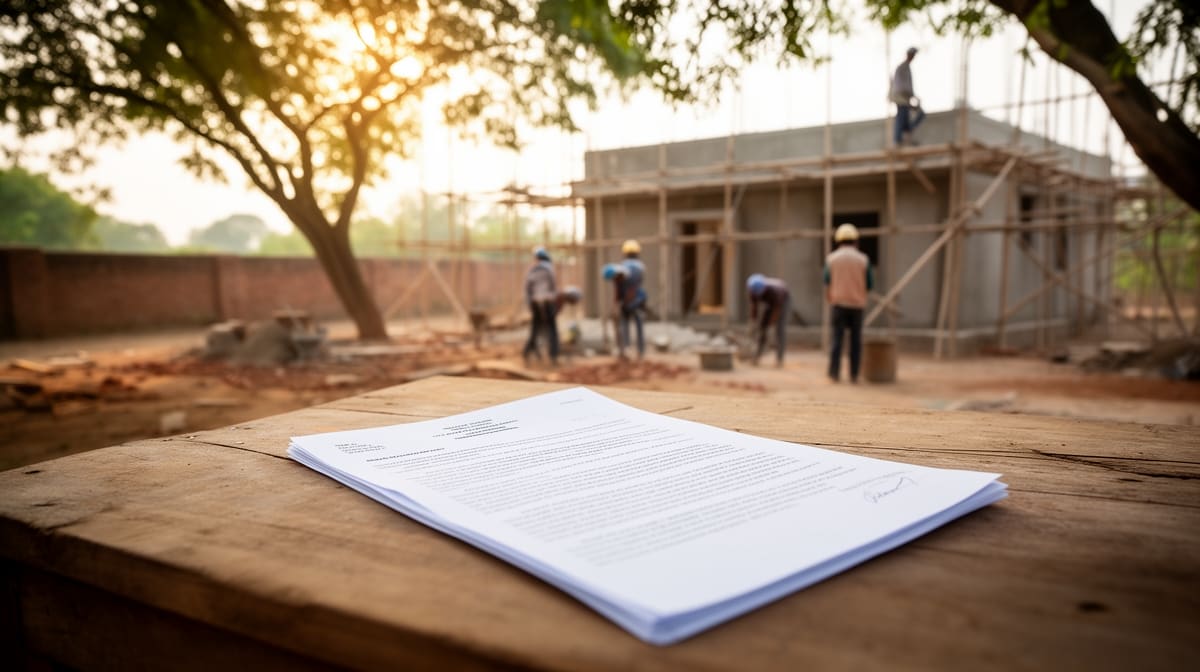
The petitioner, Maturu Rama Krishna Uma Shankar, filed Original Suit No. 62 of 2022 before the Principal Junior Civil Judge, Repalle, seeking a permanent and mandatory injunction against the respondents, Penugonda Naga Raja Kumari and Penugonda Srinivasa Rao. The petitioner alleged that the respondents were constructing a building on land that formed part of his property, specifically encroaching upon the northern side of his house by extending slab centring into the set-back area designated under his Building Permit Order. The petitioner claimed ownership of 252.50 square yards of land through a settlement deed executed by his mother and relied on photographs and the Building Permit Order to substantiate his claim.
Key Facts
- The petitioner acquired the plaint schedule property through a settlement deed dated prior to the dispute
- The Building Permit Order issued in the petitioner’s name mandated a set-back of at least 1.5 feet on all four sides of the building
- The respondents commenced construction on their adjacent plot, extending slab centring that allegedly touched the petitioner’s building
- Photographs filed by the petitioner on 15.04.2022 showed the extended centring encroaching into the set-back area
- The respondents filed counter-affidavits denying encroachment and claimed adverse possession over the disputed area for 30 years
- The respondents did not file any approved building plan, nor did they produce any document establishing their right over the encroached portion
- The respondents admitted before the trial court that they had not obtained an approved plan and would produce documents during trial
Procedural History
- 12.02.2022: Original Suit No. 62 of 2022 filed by petitioner seeking permanent and mandatory injunction
- 15.04.2022: Interim Application I.A. No. 152 of 2022 filed under Order XXXIX Rules 1 & 2 CPC seeking temporary injunction
- 19.05.2022: Trial Court granted temporary injunction based on prima facie case, balance of convenience, and irreparable injury
- 29.10.2024: Civil Miscellaneous Appeal No. 6 of 2022 allowed by Civil Judge (Senior Division), Repalle, setting aside the injunction on two grounds: (i) petition sought permanent and mandatory injunction, not temporary; (ii) documents were not formally marked as exhibits
- 22.12.2024: Civil Revision Petition No. 1234 of 2025 filed before the High Court under Article 227 of the Constitution
- 09.03.2026: Case reserved for judgment
- 28.04.2026: Judgment pronounced
The Parties' Positions
For the Petitioner
- Argued that the relief sought, though mislabelled as "permanent and mandatory", was clearly intended as a temporary injunction under Order XXXIX CPC
- Contended that the trial court correctly ignored the typographical error and focused on the substance of the prayer
- Emphasized that the Building Permit Order and photographs established a prima facie case of encroachment
- Highlighted that the respondents failed to produce any documentary proof of entitlement to the encroached land
- Invoked the principle that technicalities must not defeat substantial justice
For the Respondents
- Argued that Order XXXIX CPC permits only temporary injunctions and that seeking permanent injunction in an interim application renders it non-maintainable
- Contended that unmarked documents cannot be considered by the court in deciding an injunction
- Asserted that the photographs were not dated and therefore unreliable
- Claimed that the respondents had been in possession of the disputed land for 30 years and were entitled to adverse possession
- Maintained that the trial court erred in granting relief without formal evidence
Relief Sought
The petitioner sought:
- Setting aside of the order dated 29.10.2024 in CMA No. 6 of 2022
- Confirmation of the order dated 19.05.2022 granting temporary injunction
- No order as to costs
The Legal Issue
Can a court grant a temporary injunction under Order XXXIX Rules 1 and 2 CPC when the application mislabels the relief as "permanent" or "mandatory", and when documents filed with the pleadings are not formally marked as exhibits?
Arguments Presented
For the Petitioner
The petitioner’s counsel relied on the principle that courts must look beyond nomenclature to substance. He cited Suresh Kumar v. State of Haryana to argue that mislabelling a relief does not invalidate an application if the nature of the prayer is clearly for interim protection. He emphasized that Order XXXIX CPC is designed to preserve status quo pending trial, and that the trial court’s reliance on the settlement deed and Building Permit Order established a prima facie case. He further contended that the respondents’ failure to produce any document to rebut the petitioner’s claim weighed against them under the doctrine of adverse inference.
For the Respondent
The respondents’ counsel argued that Order XXXIX CPC is strictly limited to temporary injunctions and that any prayer for permanent or mandatory relief renders the application non-maintainable. He cited Rajesh Kumar v. Smt. Sunita Devi to assert that unmarked documents cannot be considered in interlocutory proceedings. He maintained that the trial court’s reliance on unmarked photographs and unverified documents was legally impermissible and that the appellate court was correct in setting aside the injunction on procedural grounds.
The Court's Analysis
The Court undertook a detailed examination of the legal framework governing interim injunctions under Order XXXIX Rules 1 and 2 of the CPC. It held that the primary objective of such provisions is to prevent irreparable harm and preserve the status quo until final adjudication. The Court observed that the nomenclature of the relief sought is not decisive if the substance of the prayer is for temporary restraint.
"The court is not bound by the label attached to the relief; it must examine the nature of the prayer and the relief sought in substance. A prayer for permanent injunction in an application under Order XXXIX does not render the application non-maintainable if the relief sought is, in effect, temporary."
The Court further clarified that while formal marking of documents as exhibits is a good practice, it is not a mandatory precondition for considering them in interlocutory proceedings. The Court held:
"Documents filed with pleadings must be examined by the court to determine the existence of a prima facie case, balance of convenience, and irreparable injury. Strict compliance with the Evidence Act is not required at this stage. The court is duty-bound to consider all material placed before it, even if not formally marked."
The Court rejected the appellate court’s reliance on the absence of approved building plans as a decisive factor, noting that the respondents themselves admitted they had not obtained such plans and intended to produce documents during trial. The Court emphasized that the respondents’ silence and failure to rebut the petitioner’s documentary evidence could be weighed against them.
The Court also noted that the respondents’ claim of adverse possession could not be entertained at the interim stage without proof of continuous, open, and hostile possession for the statutory period. The trial court’s reliance on photographs showing encroachment, coupled with the Building Permit Order mandating set-backs, was found to be sufficient to establish a prima facie case.
The appellate court’s decision was held to be based on hyper-technical grounds that ignored the cardinal principles of equity and substantial justice. The Court reiterated:
"Procedural rules are handmaids of justice, not its masters. To allow technicalities to defeat a prima facie case of encroachment would be to pervert the very purpose of interim relief."
The Verdict
The Civil Revision Petition was allowed. The order dated 29.10.2024 passed in CMA No. 6 of 2022, setting aside the temporary injunction, was set aside. The order dated 19.05.2022 granting temporary injunction in I.A. No. 152 of 2022 was confirmed. The respondents are restrained from making any further construction on the encroached portion of the plaint schedule land until final disposal of the suit. There shall be no order as to costs. Pending miscellaneous petitions are closed.
What This Means For Similar Cases
Mislabelled Relief Does Not Invalidate Temporary Injunction
- Practitioners may file applications under Order XXXIX CPC seeking temporary injunction even if the prayer is mislabelled as "permanent" or "mandatory"
- Courts must examine the substance of the prayer, not the terminology used
- A typographical or drafting error in relief description is not a ground for dismissal
- Always include a clear prayer for "temporary injunction pending disposal of suit" to avoid ambiguity
Unmarked Documents Are Admissible in Interlocutory Proceedings
- Documents filed with pleadings must be considered by the court even if not formally marked as exhibits
- The court is obligated to examine such documents to assess prima facie case, balance of convenience, and irreparable injury
- Formal proof under the Evidence Act is not required at the interim stage
- Opposing parties must raise objections to the admissibility of documents at the earliest opportunity
- Failure to rebut documentary evidence may lead to adverse inference
Silence of the Defendant Can Weigh Against Them
- Where a defendant fails to produce documents to rebut allegations, the court may infer weakness in their case
- Claims of adverse possession or title must be substantiated with evidence at the interim stage
- Mere assertion without documentation is insufficient to defeat a prima facie case
- Courts will consider conduct, including delay and non-production of documents, as part of the balance of convenience